Monday, May 28, 2007

Teaching English at University: A dream lay dying

This is not a tale of teaching ESL in Korea but serious look at Journalism professor, Bill Maxwell, who chose to teach at a historic black college as part of a debt he felt he owed his own wonderful professors.

The article in full is here and I found it linked from Clicked.

I think 'historic black college' has a specific meaning and it may be clear to others. I may have missed it. My impression is the college this professor taught at was quite small, had been built specifically for black students and may have had a large percentage of donations, scholarships and subsidies operating to the student's benefit.

My own university is completely different from the idealized one I characterized (accurately or not) above. There are scholarships but also mine is a private university with tuition much higher that of provincial or national schools.

As I read the article, I was struck by the similarities and contrasts with my own situation.


During those first few weeks of school, the new equipment began arriving and my
hopes continued to rise. My first year at Stillman, which had fewer than 1, 000
students, had not been as smooth or as fulfilling as I had hoped. My students'
academic performance had been generally disappointing, and I could not persuade
most students to even attend class regularly.
Well, I teach nearly 500 students myself and there are more than 15 foreign teachers at my university, so while not a large school, we dwarf Stillman.
The classes I teach are mandatory and not in the student's major. They take ESL because they must. Maxwell's students should be somewhat interested in their studies as it was their own choice that brought them there.
My colleagues and I were witnessing the result of low admission standards. Were
we expecting too much of young people who scored poorly on the SAT, who were
rarely challenged to excel in high school, who were not motivated to take
advantage of opportunities to learn, who could not imagine where a sound
education could take them?
My student's were challenged and possibly even threatened to excel at high school but my university is a lower tier school so the bit about low admission standards is right on.
Maxwell describes how a white professor asked for assistance, wondering if there was a racial barrier in class:
A few minutes into my exchange with the class, I realized the white professor was not the problem. The students simply did not - or could not - read closely. My colleagues and I could not teach what we had been trained to teach.
"My students don't use me, " an English professor said. "At most, I may run into two or three a year who make me work. Talking over your students' heads is a waste of everybody's time."
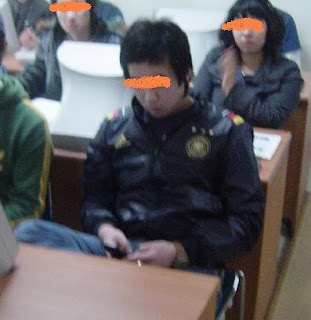
My students don't appear able to take notes. Most arrive with the textbook and a pen and a few will bring a notebook (although they may not use them) and others arrive with only their cellphones.
I wonder if I teach over my student's heads. I think I'ved learned a few things from this article and will comment more fully at the end.
Many of my Stillman colleagues regularly invited their students to their homes for dinner. The discussions often were about personal matters involving romantic relationships, family crises and money problems. Professors were the first confidants many students ever had. Indeed, they often became surrogate parents.
We foreign professors can probably never get that close to most students. A very few times, I have eaten with my students. Again, with 450+ students in my classes, it would bankrupt me to take them to dinner.
The bottom line was the same as it is at most HBCUs.
Professors who had the best success connecting with students, especially
below-average male students, emphasized friendly, personal and supportive
involvement in their lives. For example, Stephen Jackson, who taught sports
writing, was an effective professor because he understood the importance of
winning students' trust. He even ate lunch in the cafeteria with students each
day.
We foreign professors (or maybe just I) do have a looser relationship with our students. We are professors, but not 'real' professors. Most of us use our given names in class and are more familiar in class than a typical prof would be. This is part of 'Conversational English', in my opinion.
"Relax and be comfortable speaking in front of the whole class...but call me Sir", just doesn't work.

The flexible professor encouraged lively exchanges of subject matter, ideas, beliefs and opinions during class discussions. The flexible professor often did not require written responses or exams. The flexible professor let students keep pace by retaking exams, completing take-home exams or giving classroom presentations.


I had difficulty becoming flexible. The majority of my students in the English class failed to complete most of the assigned readings. Most of their essays were unacceptable, and attendance was low. I had a choice: Abandon my syllabus or flunk more than half of the class.


I abandoned the syllabus. Instead, I lectured and made assignments based on the problems and errors in the students' writing. I went over the same material, such as writing the topic sentence, again and again because some students could not master it.

Flexibility is the name of the game in Korea. Things change from week to week and two days warning is the local definition of 'long term planning'. Again, I will discuss this more at the end; I quote it now because I see strong similarity with my own classes.
Maxwell's colleague gives her observations of the students:
"Our kids haven't had many good things in their lives, " she said. "Many of them are angry and negative and rude. They've had hard lives.
Some of them don't belong here."
I would say the opposite is true here. Well, the students have had hard lives, being trapped in the hagwon system awaiting the entrance exam from Hell. Still, they have never worried about money or some form of parental support.
I always was amazed that so many of the women tolerated the
crude way the men spoke to them. One afternoon in my English class, a male
student called a young woman "a big-assed ugly bitch." I expected her to slap
him, and I would not have intervened. Instead, she dismissed the whole thing
with a wave of her hand and turned to chat with her roommate. After class, I
asked her about the insult.
I am not sure about the male/female interactions that go on in my class. I do hear phrases and comments, that in their tone and timing and the response they get, would seem to be insulting, but I don't think they are as mean-spirited as in the quote above. I do hear a lot of 'fuck you' in class from one student to another. I would throw the student out if I could be sure who it was. It mostly seems a sort of elementary school boy chatter, like the French curses my classmates and I used thirty years ago. A curse is more funny than stinging when given in a foreign language.
"Have you noticed that our students never have a sense of
urgency?" a colleague asked one afternoon as we walked to a faculty meeting.
"They don't seem to be going anywhere in particular. They just stand around or
mosey along. Frivolity."
That seems to be the case here. Korean students think the excuse, "I am late because I was sleeping" is sufficient. University is nationally considered a time to play in Korea.

He was right. Greek organization activities such as step
shows - the rhythmical, patterned dance movements favored by fraternities and
sororities - and any excuse to party and play music were the most important
events on campus.
I have an evening class this semester and have seen the classrooms come alive at night. Three rooms each have their own dance routine going on.
The effects of poverty made teaching and learning arduous. I
asked a student why she always fell asleep in my reporting and news writing
class.
"I work full-time at Target at night, " she said. "I can't get enough
sleep."
This I don't see in my classes. Oh, I see a lot of sleepy students, but few from working long hours. The ones that do work, I do my best to support.
Each week after that, I went to Kmart and CVS and shopped
for travel-size cosmetics and toiletries to replenish the basket. I learned that
several other professors also found acceptable ways to make personal items
available to students free of charge.
Maxwell is talking again about poverty. This isn't something I face in many classes but his generosity and desire to help his students is admirable.
Campus-wide, professors bought many of their classroom and
office supplies. In my building, for example, we rarely had an ample supply of
paper for our copy machine. I learned early to buy my own paper and keep it in
my desk.
I do this, too. I don't think my university is low on funds, they, uh... I'm going to avoid negative comments about my university. Complaining about unnamed students is one thing but I have mentioned the name of my university before (heck, its one of my tags) and I don't want to cross Korea's libel laws.
While disagreeable staff members and financial red tape were
constant irritants, nothing was more appalling than the students' disregard for
college property.
The staff members are a joy here. I have received all the help I could ask for, although I have had to ask to what I thought would be obvious things.
Disregard for college property is common here although I haven't noticed any fires as he later describes. Classroom fill with garbage and every inch desk space is grafittied.
By the end of the spring semester, I knew that I could not
remain at Stillman another year. I had a few good students, but a few were not
enough. One morning as I dressed for work, I accepted the reality that too much
of my time was being wasted on students who did not care. I felt guilty about
wanting to leave. But enough was enough.
I feel for Maxwell. He was clearly a motivated professor who was worn down by unmotivated students.
I've been writing with amusement and seeing irony in the comparison with Maxwell's situation and my own. We both have students with low SAT scores. Our students are untrained in western classroom skills. Many of his students had hard lives while mine generally do not. Our students are interested in the "University life" but not in studying. His difficulties have led him to go elsewhere while mine are clearly not so bad.
He finds it necessary but difficult to connect with his students as I do. He recognised what a professor needed to do in that setting but had difficulty.
At the end of last semester, I posted some suggestions I had for last year. I think Maxwell has some good suggestions and will soon follow this post up with suggestions for myself for next year.

Is it really Spring? Late Spring, even? Really?

What's up with the weather?

Saturday was hot but wildly windy.

Sunday was the strange one. I was out with KwandongAlex to let K'wife sleep in. From 8:30 to 10:30 in the morning, I was actually hunting for shade to stand in while the little guy played.
When I got home, I packed my frisbee and towels in my backpack and brought K'alex's backpack of sandcastle tools.

We stepped out around 11:30 and were cold! The only good news is that it wasn't windy. Ten AM was the high point on the thermometer.

Today, the weather is perfectly seasonal - for late March.

Wednesday, May 16, 2007

a Trip to the Unification observatory and Trains across the DMZ

.

I haven't posted in a while; I've been busy preparing a speech for Gangneung National University's Peace and Reunification Meeting. A few things have happened in the past month that uncannily link with this theme.


I was first asked to prepare a speech on foreigner's views and impressions of Korea. I was ready with good stuff (medical assistance was a big one of the list - I love the lack of waiting time at Korean clinics and the inexpensive medicine here) and bad stuff (traffic figured greatly here) when I received an email saying the topic had changed to reunification, the Korean War, the DMZ and related areas.


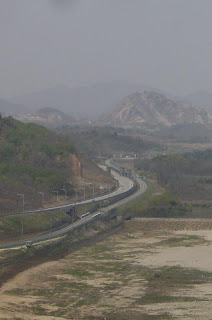
I received the message just after making a weekend ride to the Unification Observatory, at the DMZ in coastal Gangwondo.


I gave my speech on Monday to about 60 students. Today, Wednesday, I read about trains being prepared to cross the border on the East and West coasts.


On my bike trip, I rode mostly on highway 7, leaving it to enter the little fishing villages along the way but also following the old Japanese-made railway the whole way. I even took a dirt path through an old rail tunnel.


Kangneung is the modern rail head. You can see traces of the old railway as you go north from Kangneung but these are being erased all the time.


Past the observatory, the railway looks complete and ready for use.


As a travel note, you cannot ride a bicycle all the way to the observatory. At a check-in point about ten kilometres from the observatory, there was an information boothand the staff helped find a family to drive me in their car through the restricted area in 2005. Now, the booth is closed, although I luckily found another ride on my own.

Oh, about my speech: I gave it in English and a coworker translated it for me sentence by sentence. That's an interesting way to lecture. Some students laughed when I made a humourous remark and others laughed when the translator spoke (others were sleeping and I made sure to point them out while speaking about soldiers sleeping during the Naksan fire Oh, the soldiers were sleeping because they were told to stand down - they weren't obviously being lazy.)

My main point was that foreigners probably see things here more objectively and more strongly.
We are more objective because of our distance. We see the giving of aid to North Korea, particularly without requiring inspectors see where the aid goes as a mistake. The UN refused to do this but Koreans see even a poor chance to help their 'brothers' is better than no chance.

Koreans grew up with the armistice in place, and conscription is an annoying but familiar part of life here. These things are fresh and new to foreigners.

After my speech, a panel of a few North Koreans (defectors?) and a few Chinese students were scheduled to speak. I had to leave but I wondered what they would say. I quoted the Marmot discussing China's ambitions and spoke critically of North Korea. I hope I can learn what they discussed.

Finally, about the trains:
The two Koreas are now planning a test run on May 17. One train carrying about 100 people would make the crossing from the North on the east coast and a similar one would cross from the South along the west coast, South Korean officials said.


I wonder if Yahoo means the Cheolwon station rather than the one on the East Coast. There may be a station right at the DMZ, but it goes no further south. The article ends with:
The current plan calls for two passenger trains to travel about 25 km (16 miles) and finish their run at stations a few km on the other side of the border.

Seoul has been pressing to make the crossings more than a one-off event. It eventually wants to be able to send trains carrying cargo and passengers to China, Russia and other parts of Europe.

Monday, May 07, 2007

Spiderman 3

Everyone has been posting about the first blockbuster of the year so I thought I'd join in.

Of course, after the Hominid's post, there's not much left!


The actors were mostly familiar although I was surprised at how big they were. Thomas Hayden Church was superhero sized without needing any 'demolecularizing'. Topher Grace also has filled in and looked plenty meaty.

Maguire didn't look any bigger but he perfectly fits the geeky Peter Parker role. There's only one that I think would do better. Here is a still from his screen test.


On a completely different subject, some coworkers and I were involved in a project for the Tourism department. Here's Paktheelcamino taking a power nap during a presentation.


Tuesday, May 01, 2007

Meeting the family at the airport

Yangyang airport has never been a busy place. It was prepared for flights to China and opened at the peak of SARS.
I arrived early to meet my wife (she and kwandongbaby visited her folks) and found a deserted building. There was a weight training room out of sight of visitors but I guess staff decided there weren't enough visitors to worry about.

Here is Kwandongbaby with his mom's suitcase. I guess he had performed ancestor worship, bowing to his grandfather, before coming home as he was in his suit. Does he look more like a busboy or a VYuppie (Very Young Urban Professional)? Whatever, he thought he was very helpful.

Wednesday, April 25, 2007

Daylight Savings- no joke for the environment!

On April Fools Day, I claimed that Korea had adopted Daylight savings and people should put their clock forward an hour. Its a good thing Korea hasn't switched to Daylight Savings:

You may have noticed that March of this year was particularly hot. As a matter of fact, I understand that it was the hottest March since the beginning of the last century...As you know, Daylight Saving Time started almost a month early this year. You would think that members of Congress would have considered the warming effect that an extra hour of daylight would have on our climate. Or did they ? Perhaps this is another plot by a liberal Congress to make us believe that global warming is a real threat.


Found here (I am willing to believe this is a late entrant for an April Fools letter). Actually, that is a link to the newpaper this claim was written in. I found it on Catshark's blog and he linked to the angry astronomer who goes into detail about how and why it is so very foolish.

transitional species between fish and moth

All those who doubt evolution, look on this 'fith' - a transitional species between FIsh and moTHs - and despair! (click to enlarge)
Six legs?-check.
Wide wings? Check!
If you've seen a moth through a window, you'll notice the eerie similarities. If the body were a little less chunky, you wouldn't know the difference (maybe the gills and fishmouth might bother you a bit, but not much).

More seriously, anyone know anything about this fish? It has two pair of pectoral fins which separates it from older fish families, like salmon and trout, but that still leaves a huge number of species to distinguish it from.
I apologise for the glare from the tank. I just noticed it at a sashimi restaurant by the bus stop and had to shoot it.
UPDATE: friends at the talk origins google group have identified it as a sea robin, or close relative, the Red Gunard. Thanks, Mel, Dana and John.

Monday, April 23, 2007

Is Spring finally here?

A beautiful day today. I got out on the bike and managed twenty-some kilometres; not bad for a first ride. On the way, I stopped at an information booth and learned that cyclists can use the Misiryeong tunnel. I've cycled long distances but I'm a wimp about hills; this news may mean a trip sometime to Seoul, or anyway, somewhere inland.
The weather got me thinking of where I could go or what I could do this spring with my time off.
This weekend, Kwandongwife and K-son are visiting her parents and I'm staying home. Why am I not going along? Well, we want to save a little money, K-wife wants to save money and I may have singed some bridges when Kyongsangmother-in-law visited.

Anyway, with the weekend free, I am planning a trip to the DMZ -or as close as cyclists are allowed. There is an information centre at the final checkpoint and the guide there has arranged a ride for me the last few Km with other tourists in the past, so I'll do that again.

In mid May, the university has a festival of some sort and I'll get three days off then. I'm thinking about hiking across Soraksan. I'll start either at O-saek or Sorakdong and take two days to get to Baekdamsa and Yongdaeri. I don't know the dates for sure but I think it'll be May 16-18. Is anyone else interested?

Saturday, April 14, 2007

Well, I guess I'm out of a job.

Now there's a 'magic' way to learn English, discovered by the "...Korea Times ombudsman-in-chief and also editor-in-chief of The Edu Times. Park, former managing editor of The Korea Times, now teaches English media and ENIE at the Hankuk University of Foreign Studies and Kyung Hee University."

The way?

Reading newspapers.

Boy, he sure was lucky to have chosen a job in newspapers, then chance into finding this "Magic Solution to English Proficiency". Here are the highlights (click to enlarge, if needed).

Although I work in the field, my own grammar skills are not that strong (a big surprise to any that read this blog). Still, I have to wonder about the title in an "Eats, shoots and leaves" kind of way.
Magic Solution to English Proficiency

Does the title suggest that Magic is the solution? From the article, we know that reading newspapers is the solution; would that be a 'magical' rather than 'magic' solution?
.
I do understand that reading news in the target language but based on local events would have the advantages of being challenging but familiar and more interesting than events in the target language from my hometown (for example). Indeed, I use article from the Times in some of my classes.
.
I guess I object to two things. Firstly, the word magic. This makes the article appear to describe something new and wonderful. Using newspaper articles in class is a good idea, but its not a new one. I suspect most teachers do it and many students already read them at home. The word also makes English proficiency appear to suddenly be easy; that is probably the definition of a "magic(al) solution". There are ways language learning can be easier, but it is not easy.
.
Secondly, the Korea Times, and its competitor, the Korea Herald, are not really places to find literary English. The second point in the photo above states in part that, "Newspapers are interesting, concisely written, readable ... fine collection(s) of essays as well."
.
I read the Times because I think it is of better quality than the Herald but that makes it only a larger guppy in a small pool. I have enjoyed a few series in these two papers, but as a whole, I am not sure if the quote above is an accurate description. Take your pick of either paper; if I had fifty won for every obvious grammatical or spelling error, well, I could buy a coffee - but it would be a Starbucks specialty coffee!

Sunday, April 08, 2007

Canadians no longer able to mock English signs in Korea

We sure can't after this!


OTTAWA (Reuters) - Canada will remove the French-language exhibit at a major military memorial [Vimy Ridge, France] after a reporter discovered it was riddled with grammatical errors, Veterans Affairs Minister Greg Thompson said on Thursday.


The issue is an embarrassment for Ottawa, since Canada has been officially bilingual for 40 years and millions of French-speakers are very sensitive about their fate in a country where most people speak English.

Saturday, April 07, 2007

a limited method for weight loss

In Canada, I donated blood fairly regularly, encouraged by the examples set by my parents and grandparents.
Here, I've been more cautious. The Red Cross of Canada had some problems somewhat before I started to donate and I was concerned about hygiene and sterile condition here.
I watched how the process worked and was satisfied; single use needles, bags and tubing, and even the swabs used to disinfect were unsealed in front of me and immediately discarded.

I looked at the Bloodmobile as being a little too temporary or somehow lacking in solidity (and the bus did rock as candidates boarded or left -400grams lighter). Still, the blood donor clinic in my hometown arrived in trucks and was set up only for the day in a recreation centre, and the staff here were skilled and experienced.

In the picture below, we see a candidate on the left, filling out the required form. Soon, he will go into the private chamber behind him, take a blood-density test and confirm a few of the questions verbally. The nurse inside the privacy booth spoke no English but was comforted by my Canadian blood donor card and insistence that I was an appropriate candidate. She checked the boxes in the questionnaire in the correct order of 'yes's and 'no's (for the record, I think it was no, yes, then no all the way down).
To the right, in the picture are two people who have completed their donation and recovering with drinks and snacks.


The nurse here found my vein (or artery, I don't know) with no trouble. I've never had trouble in that regard, though so I really can't say she was much better or worse than Canadian nurses. I'm quite proud of my blood donor abilities, in fact. Plug me in and don't go far because it won't take long - funny, my wife was saying the same thing, the other day.

In Canada, one can donate blood every two months or so. I don't know how long one must wait here. I will donate again but I can wait; I was unusually dizzy for the afternoon and evening. The inside of my elbow remains bruised four days later.

Monday, April 02, 2007

Sigler did it (and questionable cooking advice)

As of this morning, Scott Sigler made #1 in the Amazon sci-fi/Fantasy list and #7 overall.


The most popular items on Amazon.com. Updated hourly.
________________________________________
1.
Ancestor
by Scott Sigler (Author)
Average Customer Review:
In stock soon. Order now to get
in line. First come, first served.
List Price: $19.95
Price: $11.97
You Save: $7.98 (40%)

________________________________________
2.
300
by Frank Miller (Author), Lynn Varley (Author)
Average Customer Review:
In Stock
List Price: $30.00
Price: $17.99
You Save: $12.01 (40%)
60 used & new from $14.55

In listing podcasts I listen to, I mentioned one of his books and I have listened to this one as well. I am not that confident in my ability to rate quality literature so I am hesitant to promote the book too much but his ability to reach #1 was due to careful planning.

He had been turned down by major publisher after major publisher after publisher after minor publisher.... and decided to make his books available online in audio form. After he had more than 10,000 downloads, publishers decided the book might sell after all.

Over the last two months, Sigler promoted his book on many podcasts and asked listeners to wait until the day the book was available and buy it en-mass at 9:00am -um, US East Coast time (I've forgotten the name of the timezone). He even gave away a PDF of the text -slightly different from the audio - with the understanding that e-Books haven't really caught on, no-one would print out the book because reading on loose-leaf A4 isn't that exciting either, so readers would just be more interested in buying the hard-copy (but softcover) book. Loyal listeners did buy on April 1; Australians even waited until 2:00am their time to synchronize their purchases.

I enjoyed Ancestor, but not enough to buy it, even though I feel a kind of connectedness to the author, having listened to him read for the past year.

I wonder if any of my readers do give money for services online. I'm talking about free services with a 'donate here' button, not pay services like Amazon. I listen to PodioBooks and Escape Pod and use Juice to download their content and have never donated; am I a bad man?

Now, on to cooking advice.

Charles at Liminality, has a mouth watering post about making Calzones. He makes the cooking process seem so easy that I may try it soon. Still, I've seen photos of him. He's pretty slim. Can one really trust cooking advice from a thin person?

Saturday, March 31, 2007

Daylight Savings...

Starts tonight or tomorrow morning here in Korea. I only mention it because Canada sprang forward three weeks ago to synchronise with the US so I was a little confused about when it starts here.

The Canadian site for Daylight Savings gives this suggestion and warning:

Although daylight savings starts at 2:00am in your timezone, it is easier to set your clock before you go to bed Saturday night or when you wake up Sunday morning. DO NOT set your clock both times!


So, if you find yourself an hour early for events and appointments on Sunday, probably you and your significant other both set the clocks forward. You should be careful about that.

Wednesday, March 28, 2007

Good work, El Camino Driver

Melvin (blogname: pack the El Camino - I think its a travel blog) has won an award from Gangneung city for volunteering.

Congrats, Camino Driver Man!

Monday, March 26, 2007

Managing my commute

I have a good job that I enjoy doing. I also enjoy the time off, of which I have a great deal. So, I can't really complain about the three hour a day round trip commute I do to get to work. Well, I can, but few would have sympathy for me.

Why don't I move closer to work? Well, my wife works longer hours, more days a week and more months a year than I do. She deserves a short commute (and much more).

I don't really hate the time spent on the bus. This post is about how I spend my time -oh, and at the bottom are a few notes on other parts of the life of Kwandongbrian.

I am pretty comfortable on a moving platform. I have gotten sea-sick but not that badly. Even Korean bus travel is not that bad, so I am able to read without wooziness. I can't easily use my computer on the bus - there is a little too much shaking for that. Still, I have more options than Kwandongwife who can only choose between sleeping or staring out the window while travelling.

For the longest time, I listened to my MP3 player constantly. I still listen, but not as much. I listen to a little music, mostly novelty stuff, and a double handful of podcasts and audio books.

Here is what I listen to:
Science fiction and Fantasy stories, reviews and commentary:

The Rookie (Sigler) -A new quarterback competes in an interstellar football league. Good stuff for the price (free). This and other Sigler audiobooks are among the best to be found free online and I like them. Still, that means they are big fish only in a small pool.
Podiobooks -This is where I found Sigler's first book. This and many others can be found, with variable quality. Great Moments in History is a BBC educational series that is well prepared. There is also a series of interviews on intelligent design.
Escape Pod. Short science fiction and fantasy stories of high quality. Good stuff.
University of Minnesota Narratives in Sci-fi/Fantasy. A favorite author (P.C. Hodgell) and another guy (also good) discuss the history of speculative fiction and interivew a few authors. Good stuff.
Kickass Mystic ninjas - reviewing classic science fiction and fantasy, the good, the bad and the hokey.
podcasts for thinkers
In Our Time. A BBC Radio 4 program looking at subjects from science, literature, history, religion and art. Great stuff but I had to laugh at the segment on Don Quixote, who they called Don Quik-sit.
Ideas The same as above but with Canadian accents (CBC).
Science
Quirks and Quarks A weekly science show from CBC
Science Friday a two hour weekly science show from NPR - it covers research but also political issues in science.
Skepticality An occassional show -not quite weekly about science and humanist issues.
Clean Break - An environmental news 'cast from the Toronto Star
Korea
Liminality - Charles had planned to produce weekly 'casts and I still have high hopes.
The Metropolitician - The scribbler has talked about good stuff. Most of his work is now on video 'casts but his audio 'casts can be found there.
Humor and other
Linwood Barkley - Interesting humor but based on Toronto events and not always comprehensible to outsiders.
The Now Show -Rich audio from BBC. The same caveat as above.
Jonathan Coulton - this is where I get my novelty music. Skullcrusher Mountain is the best.
Academic lectures can be found here. Some are interesting but most are straight audio from a lecture. The audio is not great and any visual aids are missing. You can find some good stuff but it takes work.
__________
I mentioned above that I don't listen to my MP3 player as much as I used to. I just got a few books from What the Book and have relearned how much I prefer reading -audio books are not as interesting for me.
_______________________________________
In other news, I fear that I may be beat up soon. Before Kwandongalex was born, my adventures were mostly in human-power travel. Now, I don't hike or ride as much. Today, possibly as compensation; while crossing a street, a truck turned without signalling and stopped as I was halfway across the street. I walked up to the window and the driver rolled down the window. I reached in and turned on the guy's turn-signal. I felt good about it but I also walked off quickly.

Saturday, March 17, 2007

I'm still here

I've been a little busy at work with the new semester starting so I wanted to put in a reminder to check this blog everyday just-in-case!

Another thing keeping me busy is Kwandongson is sick. He's recovering and tomorrow should be fine but he's managed some incredible projectile vomiting! We've been washing clothes frequently just to keep up with the demand.

I have started comment moderation on my blog. There are no heated issues here but spam made it through the word verification filter so I felt I needed more hoops to jump through to get a comment up.

I saw Casino Royale the other day. I thought it was as good as any other Bond film but what I thought about the next day was how boring it is to simply walk up and down stairs. I think they used steps normally twice in the whole movie.

Wednesday, March 14, 2007

Kwandongbrian's Hinterland's Who's who

A few years ago, my mother bought a stuffed animal - a chickadee for my little one. It had a noise maker inside that reminded me of the start of CBC's Public Service Announcements about Canadian wildlife.


Here is my version:


"The phone using student is a funny fellow, shy and hard to approach. They are sociable animals and friends may make an alarm call as you come near. They prefer large classes where they can blend in."


I am almost embarrassed at how proud I am to have gotten this picture. After spotting the phone-using-student, I had to keep my tone and speed of speaking steady as I reached into my computer case and pulled out the camera. Then I had to keep the camera low and turn it on as I approached, hoping the thirty-five other students wouldn't show too much curiosity until - Snap- had the picture and a class frozen at my response. I was so proud of myself.

Oh, for nostaglic Canadians, visit the spoof page at Hinterland's Who's Who. Best viewed with a hockey jersey and maple syrup pancakes.

Monday, March 05, 2007

What is 'Eco-tourism'?

I do understand the basics. Cycling around a country is a great example of eco-tourism; not just because there is no auto-exhaust involved, but that volume and mass limitations on a bike mean you must buy local. You cannot carry a week's worth of groceries or the like. A big part of eco-tourism ethics is to help local businesses.

In this quote regarding eco-tourism in Gangwon's mountains is an example of mutually exclusive activities being rammed together:
During a conference held at the Yongpyong Resort in PyeongChang, also in Kangwon Province, the organization told local residents that more tourist attractions would be developed in the area, but would be done without damaging the environment.

In the highlands, a kilometer above sea level in Hoenggye-ri, there will be a new tourism complex, a ski resort, golf courses, 52 kilometers of trekking paths and an eco-system tour, it said.


Golf courses, with their heavy loads of fertilizer and pesticides, complete reshaping of the terrain and alteration of plantlife cannot possibly be seriously considered in an eco-resort.

I don't think one can bring eco-tourism to a location, it has to be a grassroots activity. Again, the point is that the locals can support themselves in healthy ways and the money has a chance to circulate locally.

Letting the developers into the parks

The Korea Times discusses a bill currently being evaluated that would open National Parks for development.

A bill that would allow seven national parks to be developed without concern for the environment is under consideration in the National Assembly, triggering a dispute among government offices, civic groups and lawmakers.

According to the Ministry of Environment, the Assembly’s Construction and Transportation Committee is likely to endorse the bill, which applies mainly to the development of the south and east coast, on Monday.

The bill would make studies on the environmental effects of construction in these areas non-binding.

The seven areas to be affected are Mt. Chiri, Hallyo, Wolchul, Kaya, Tokyu and
Naejang national parks.

...

``Seventy percent of wildlife lives in the national parks, which account for 6.6 percent
of the nation
’s territory. It is an international trend to preserve the environment rather than
develop it, and the bill will surely destroy that,
’’ Yoon Guk-gu, the National Park Service public relations director, said.

More than 151 civic groups in South Kyongsang Province gathered Friday to declare that
the bill would bring a development craze to rural areas, which would not benefit local residents. It is not a step toward sustainable development, they said.

I discussed development of Kyeongpo Provincial Park, comparing it to Haeundae, almost exactly a year ago and I agree with the civic groups. The money will at least leave the rural areas and may well leave Korea entirely.

Lazy public worker may be sent to labour camps.

From the Joongang:

According to the city, “incapable and idle” public workers will join a team that will look for people throwing cigarette butts, vehicles violating speed limits or research the traffic volume on the roads. After six months, the workers will be reevaluated and those with low scores will be discharged for another six months.

The three the suggestions for idle public workers might first sound reasonable but all require some kind of training.

I wish I knew more about what police officers do in Korea instead of what they seem to do. What I have seen of police officers here does not make me proud to tell people my father was a police officer in Canada - but, like so many things in Korea, this is an area that a non- speaker of Korean can only see the surface or read the cover -there just has to be more depth.

Still, my wife, as a Korean Coast Guard officer* trained for twelve weeks and still recieves on-the-job training.

"Incapable" public workers don't seem to be an obvious choice to put into confrontations and that is what's suggested. They aren't picking up cigarette butts, they are 'look[ing] for people throwing cigarette butts'. They are going after speeders.

I could understand getting them to clean streets and giving them whistles, cameras and tickets to go after illegal parking but ... maybe the goal here is to get them into so many confrontations they quit.

*My wife is an officer in the police sense of the word, I don't know how that relates to working the ships. My father was a constable for much of his time in the Force and I think that is comparable to an enlisted soldier, rather than an 'officer'.

Thursday, March 01, 2007

Hwa-am Temple and Daesoonjinrihoe

Yesterday, Masuro paid me a visit and we went to Hwa-am Temple.

On the way there, we were never lost but we were often not where we planned to be. I don’t navigate nearly as well as I thought.

Eventually, we reached the temple. Hwa-am Temple is next to Misi-ryeong tunnel, a little north-west of Sokcho. It is a small temple in a beautiful location. It was quiet although there are many Condos nearby; in the tourist season, I have seen many busses and cars jamming the narrow road reaching the temple.

On this quiet day, we just drove right to the temple grounds. Masuro pulled out his big-ass camera and we toured the temple. Upon reaching the ‘three local gods’ shrine (Chil-seong, San-shin and the other guy), colorful, of a pleasing shape and in a natural mountain valley with a river in the background, Masuro took a photo of semi-coiled piece of rusted fence wire.


Click on any of the photos to enlarge.


Hwa-am Temple has its own fire truck- they've learned from Naksan, I guess.
Masuro at work.

Later we hiked to a big boulder above the temple. The trail beyond was closed to grounds recovery. I scrambled about on the boulder and learned how old and cowardly I have become.

The view from the boulder.


On the way home, we passed a big and ugly condo and Masuro commented that when Koreans build western-style architecture, the results are mixed at best. They seem to do very well at traditional Korean architecture. (Send your complaints to---). At that moment, we saw the roofs of a large temple over the trees lining the road.

Nothing to do with the story; just some funky cabins.

I had heard of the place and knew it wasn’t a Buddhist temple exactly but didn’t know what it was. In we went. We were stopped at the gate by men with traffic batons and Masuro asked in Korean if tourists were welcome. They nodded and let us in but the atmosphere was beginning to coalesce around us. Two men, with good English, met us when we parked, welcomed us and invited us to look around, requesting we not take pictures at certain areas. So, in we went and still didn’t know what this place was for.The Main entrance gate.

Maitreya Buddha (Buddha of the future)


The grounds were huge and empty.

The grounds were huge and empty. Although we saw bags from some group –visitors, students, fugitives, who knows, we only saw a few individuals, wearing a badge and quietly watching us. In front of the Buddha of the Future, a man told us about Daesoonjinrihoe. Jesus and Buddha both have prophecies for return. This religious group believes they had a joint incarnation in Korea and are/is expected to return again. There may be a Dao connection in this fusion religion as well.

The buildings were huge, well decorated and in a pleasing style – much as Masuro had said. Still, the constant observation, the welcome without much explanation and the tag I was asked wear while on the grounds made us feel uncomfortable. Everyone was as pleasant as could be but I just felt a little like I had visited some Montana backwoods compound.

As we left, we were invited to return in early May, when the flowers bloom. The grounds are fantastic and despite my irrational discomfort, I hope to get the little guy and Kwandongwife there for the flowers.

Wednesday, February 21, 2007

Oddities

Just a few unrelated notes I feel like commenting on.

The Joongang Ilbo has an article about economic competition with China and Japan. My favorite part: Companies should look at themselves before blaming others. Entrepreneurs must be brave and look for ways to defeat Japan and China.
Don't look for ways to grow or ways to improve; look for ways to defeat your enemies.

On the bus home today, a TV connected to a satellite dish, was playing a movie. The sound was off and I had my MP3 player on but I was watching idly. Suddenly, Boobs! Woo-hoo! I was riding with a co-worker and we shared a chuckle. I'm not disapproving, just incredulous that someone in the transportation industry wasn't more careful. I don't think it was an 'X' rated bus - and who'd want to touch the seats in such a bus!

Reviewing the IOC evaluation committee's visit.

I found two articles describing how Koreans feel the IOC evaluation committee visit went.

The first, from the Joongang Ilbo, is objective but positive. The second paragraph:.
Korea is too limited in its winter sports abilities and Pyeongchang should improve its access to the giant slalom ski venue, but other than that, inspectors gave the city a good review for its bid to host the 2014 Olympic Games.

I first took 'too limited' to mean not enough snow, not enough height, not enough inanimate resources in general. I think Nagano had problems with the ski hills not being long enough and had to cut into a national park to meet IOC criteria. I expect(ed) similar problems here. Perhaps this is what the 'access to the giant slalom' comment means.

In fact, the inspectors meant:
Korea should be more well-rounded across all of the winter sports, referring to the country’s reliance on a few sports, such as short track speed skating and speed skating, for most of its Winter Olympics medals.
Korean athletes need to shine more at Winter sports, is the real message.

I believe Koreans have the ability to organize an excellent winter olympics, I am not as enthusiastic as Gangwon Governor Kim Jin-sun. Nor do I agree with why Korea would do well.

From the Herald:
Tenacity and calmness are two leading characteristics of Koreans, who have held a long history steeped in tradition.
I'll give Koreans tenacity. Koreans are tough, no question. Calmness? Not so much.

It is said that, in an era of digital technology, the tradition of using chopsticks at the dinner table has gone a long way in developing their manual adroitness and places them at an advantageous position in the semiconductor industry.
F-ck! Not the chopstick story again! I'm glad that Koreans, for whatever reason, are doing well with semiconductors but I'm not sure how this fits. Will this be a new Olympic event? "New this year is the 'Make a semiconductor with chopsticks' event. The Koreans expect to do well but may be surprised by the North American jobseekers who would 'separate flyshit from pepper with gloves on just to say they have a job'. A true battle of East meets West."

Due to their unique dynamism, the world has come to view Koreans as people who can even make mountains or rivers if necessary.
I think Governor Kim is showing his support for Lee Myoung-bak's presidential bid, with the 'making rivers' remark.

All sarcasm aside, I hope Pyeongchang gets the olympics here.
To finish this post, I am happy to see no news of corruption in either article. Finally the triumvirate is broken.

Friday, February 16, 2007

Pyeongchang Olympic Bid

I wish the best of luck to Pyeongchang in their bid to host the 2014 Olympics. I am sincere but also I fear that Koreans might be upset with Canadians because Vancouver stole the 2010 games away.

Earlier, I questioned Korea's bid. Here in Sokcho, we have seen only a brief dusting of snow this winter. In the mountains, I am sure there is more, but enough? Recently, I learned of Swiss ski resorts helicoptering in snow in the days just before an international competition, so Korea's situation doesn't seem so bad.

Two things still concern me. First the wording of the middle banner above (click to enlarge). "Welcome to Gangneung Happy, Peace Olympic"? Actually, there may be an opportunity for ESL teachers here. Despite the many spelling errors on this blog, I do a fair job of editting. Time to throw my hat in.

My second concern is at the end of this quote from the Joongang daily.
Pyeongchang hopes its location in Asia, its experience from its bid in 2010 (when it fell second to Vancouver, Canada by three votes) and its strong infrastructure will outweigh any doubts about political instability or nature-related problems on the peninsula, as well as overcome the bids by the two other cities. An International Olympic Committee member from Korea, Park Yong-sung, was pardoned on corruption charges Monday, allowing him to get out of jail and participate in the bid activities this week.


People have complained on other blogs about Korea's system of pardoning white-collar criminals with political connections, so I'll hold off. Look here if you are interested. I can't really see how returning a convicted felon to the IOC committee can help Korea and Korea's image in the long term. I know that I have mentioned in at least one previous post that it would be nice to see an article in which the words "Korea", "Olympics" and "corruption" were not all present.

Monday, February 05, 2007

Will Korea become a Brave New World?

Huxley envisaged a world where people made to fit their professions before they were born. Alphas given great pre- and post- natal care, specifically including nutrition and education, while Epsilons were deliberately deprived of oxygen and nutrients while still in the fetal stage. Alphas were tall, strong and intelligent and Epsilons were small, possibly stooped (I can't remember) and brain damaged.


From today's Joongang Daily, describing the North Korean situation:


“When pregnant women and infants are malnourished, the physical development of not only themselves but their children and grandchildren are influenced,” said Chang Nam-soo, professor of food and nutritional sciences at Ewha Womans University. “Their stunted physiques will be handed down through generations.”
Experts warned about the dangers faced by babies born to malnourished mothers. Such children are highly likely to suffer from a low immune capability, weakened physical, intellectual and scholastic abilities, a low labor productivity and a higher risk of geriatric diseases, they said.


The average height difference for North and South Korean men is 6.6 cm. In an interesting contrast, East Germans were two centimeters shorter than West Germans at reunification.


"Oh Brave New World,
That has such people in't!"

Missing Coastie

Some sad news for the Sokcho Coast Guard. Three weeks ago, a group of coasties went out for a drink. Afterward, one left the group and has not been seen since. Foul play is suspected.
You can click on the picture to enlarge.


I don't really know police procedure but I've watched a lot of Law and Order. One thing I recall is fights over jurisdiction. You know, the feds withholding info from the cops and suchlike. Here, the Coast Guard are involved, which is mostly unsurprising when you consider the Korean name 'Sea Police'. More surprising is the involvement of Pohang police. I think the missing coastie, named Kwan, is from Pohang or he was out with a group from Pohang, but anyway, Sokcho seems like a reach to me.

Saturday, February 03, 2007

Gathering Chilk (칡) and stepping over corpses

Chilk is a very thick root; above ground it is a vine that chokes small trees. I'm told the root is good for your health. I find this likely because it tastes terrible.
One of Kwandongwife's coworkers asked if I would like to collect some, so, with some prodding, out I went.
Below, my friends clean some chilk in icy creek water. They will clean it again at home. I was waiting, reluctantly trying to volunteer to take my turn. Luckily, they did the cleaning and I stayed warm in the van.

Most of the day was warm for us as we were in a narrow valley and evaded the wind, which was terrible at the road and creek.

We collected the chilk in a low mountain valley near Wanggok village. Walking from the van, we found this snare. My friend told me it was intended for boar, which can be found in Gangwondo.

Higher in the valley and off the trail we found two dead animals. A deer, still entangled in a snare and another animal described as a 'go-ran-i' or small, wild cat (maybe similar to a lynx in size). Most distinguishing features were missing but I could certainly see one long canine. However a long canine is not diagnostic for carnivores in Korea. It could have been a water-deer as they have a pair of saber teeth instead of antlers. The fur on both animals was brown and russet so that was no help. Anyway, I have no reason to doubt the greater local knowledge of my guides so I guess it could have been a wild cat. I have photos but have chosen not to post them.

For related subjects, you could read my posts on two bears, recently re-introduced to Chilisan, being caught in farmer's traps. For Korea's saber-toothed deer, look here. Regarding wildlife in general in Korea, the Chosun has an article about the surprising number of road kill.

Saturday, January 27, 2007

I'm back

Actually, I've had the computer back for almost a week now but I'm running low on inspiration. Thanks Melissa for your keyboard and drinks story.

A friend drove me home from work the other day and we passed a truck on its way to fish Hell -there's got to be a way of constrasting humanity's mythical trip across the river to the land of death to fish on a highway but I've already pointed out my lack of inspiration.
Aha! Here's my inspiration- I'll get someone else to do it. Nathan, you know what I want- email a good classically inspired caption for me to post here. Please.


Saturday, January 20, 2007

don't spill orange juice on your keyboard

Well, duh!

Anyway, it will be a while before I can post blogs from home again. I expect to have the computer back on Wednesday but I may have to wait to get out of the doghouse...we'll see.

Oh, if you do spill a drink on your keyboard, its possible to save the keyboard, but you should act quickly. If you wait a day or two, as I did, the acids in the drink can etch the connection causing you to need a whole new keyboard.

Friday, January 05, 2007

Ijen (instep crampons)

A commenter asked about hiking in Seorak in January. I told him (maybe her), he would need 'ijen'. He asked for a picture. Here are mine, with case, from Kobea (click to enlarge).

Wikipedia also mentions instep crampons (1/3 DOWN THE PAGE).


Thursday, January 04, 2007

Will 2007 be about the hagwons?

In 2006 we read many stories about bad foreign teachers making trouble in Korea. The first article on the subject I saw this year lambasted Jeju International English Village and its director, Mr Lee (full name given in the article, isn't that unusual given Korea's libel laws?)

The Herald's article is either poorly organized or the whole story is riddle wrapped in an enigma covered in crap (I don't remember Churchill's exact quote but this story is messy and confused).

My summary of case 1:
A teacher had enough trouble at work to call the police. Officers showed up and said there was a sting going on and could she please wait it out. At the end of her contract, she was told there wasn't time to get her money back before she had to fly out of the country. Soon after, the Herald reporters called the officer who denied any knowledge of wrongdoing. The officer claimed he was checking passports and documents. The Herald called the Immigration Department and was told police don't do that kind of inspection. Jeju police (presumably not the officer in question) then said, 'Yes, we do." Finally Director Lee stated that no police had ever visited the village.

I'm trying to figure this out. I can believe both that a teacher might try to cause trouble for a school s/he was leaving and I can believe some hagwon directors are corrupt. I think the latter is more likely.I also believe a hagwon director might be in cahoots with a police officer. Could the Provincial Police Managers really not know the limits of their authority or could the Herald have called a third conspirator?Finally, could Mr Lee and the police officer not keep their stories straight or are they deliberately creating confusion?

My summary of case 2:
Mr Lee also operates "the Oxford English language hagwon in Seoul" where he is accused of tax fraud, forging signatures and non-payment of salaries. Immigration confirmed that the man is under investigation but may be hiding and has refused invitations to come to the Immigration office for questioning. Mr Lee was interviewed by the Herald and stated that he had not moved nor had he been asked to answer questions.

The whole story simply creates more questions.

Concluding the article:
It is well established that Lee and the highly questionable way he conducts his English teaching enterprises have been brought to the attention of the authorities on several occasions. The lack of initiative shown by the police, labor, and immigration departments to conduct a thorough and coordinated investigation is nothing short of disgraceful.


My own conclusion is that I was unduly harsh on the Herald staff. The article seems to be as well organized as possible and I look forward to learning more.

English teacher killed in paraglider accident on New Year's Day

An American teaching in Gyeongsangbuk Province died while paragliding near Gangneung on January 1. Dangelo Carl was paragliding to photograph the sunrise, possibly committed an operational mistake and crashed into the East Sea. The Coast Guard fished him out so I'll have to see if the missus has any information available to the public.
My condolences to any family and I can only hope that he died doing something he loved.

an alternative to skiing

Here is something I would never have considered; riding a ski lift then hiking (rather than skiing or boarding) back down. When I started reading, I envisioned hikers crossing, and screwing up, the ski-slopes but it turns out their are hike-only trails for use.

I really want to ride this Muju gondola (my highlighting): The gondolas take up to eight people. They run from 9 a.m. through 4 p.m. and take riders to a point 2,671 meters above sea level in 15 minutes.
Wow, fifteen hundred meters above Korea's highest mountain! UPDATE: Its a good thing I am an ESL teacher, not a math teacher - as Masan's greatest hiker (strangely enough, this description is without sarcasm) pointed out, Korea's tallest mountain is much taller than 1100 meters. Still, the gondola, as described, does climb seven hundred meters above Korea's tallest mountain. Uh, you trust me, right? Do I need to show my work?

Temple grounds extended to include entire parks?

This is interesting. Beginning January 1, national parks dropped their entrance fees. However, the temple fees jumped to almost the level of the original combined fee.

This is the most surprising part for me. I didn't realize that, in 2006, when I paid 3,400 won to hike to Ulsan Bowi, around half that fee went to the temple. It does explain why the entrance at O-saek,(the hotsprings and far from any major temples) is, again, about half the Seorak-dong rate (closest to Sokcho). If I hadn't read the article, I would have figured the rate had simply dropped a few hundred won.

Some hikers aren't welcoming the (slightly) reduced entry. They don't intend to visit the temples and are upset to pay for them.

Monday, January 01, 2007

Keeping it fresh: Volunteering may be illegal in Korea

This isn't all that recent and many bloggers have commented on this subject already but no one has mentioned any closure or follow-up on volunteering in Korea.

To refresh people's memories, here is an excerpt from the Korea Times:

Foreigners may face deportation or fines if they volunteer at orphanages or organize performances without reporting them to the authorities.


The interpretation came from Joo Jae-bong, an official at the Ministry of Justice. He said there should be no problem with joining a poetry club but that volunteer activites should be registered with the ministry.


``If it 's just a gathering of friends, there should be no problem,’’ he
said. ``But if they are organizing performances, they need to register to do
those things because they are changing the purpose of their stay here.’’


He said the same rule applies to those who wish to volunteer in an orphanage.
Foreigners need to register those activities with the ministry.


Is volunteering at an orphanage the only prohibited or regulated activity?

I recognize that, in not doing any research myself, I am in no position to point any fingers. Well, I guess I have something to do tomorrow after work.