Showing posts with label kwandong U. Show all posts

Tuesday, December 08, 2009

Job posting for Kwandong U

From Dave's ESL Cafe:

Kwandong University is looking for qualified candidates for Full-time Professors and Visiting Professors who will join KDU's English programs from March 2010.

Kwandong University is located in Gangneung City, which is on the northeastern coast of South Korea. Founded in 1954 based on the Christian Faith, it has an enrollment of 10,000 students. The campus is set in a beautiful area, surrounded by forest of pine trees. 
To learn more about Kwandong University and Gangneung city, visit : http://www.kwandong.ac.kr/http://eng.gangneung.go.kr/

The successful applicant will teach credit university English classes, as well as non-credit university classes and children's English program. ...


The listing offers a pay scale for those with a Master's degree and those with a 4-year degree, but the job is essentially the same.

I have some problems I could nitpick about, but I have been at Kwandong for seven years and plan to stay longer; I am more than satisfied.  I have to admit, though, that I have not looked at other job postings in the past seven years, so other places may offer better deals.

Saturday, October 31, 2009

Hallowe'en monster

It is a relatively cute monster - what with it wearing Winne-the-pooh pajamas and all. Still, a few students were terrified sufficiently for me to feel it was worth it.

On Thursday and Friday at University, I played a prank on classmates and coworkers at school. The craftsmanship was appreciated more than the effectiveness, I'm afraid. Still, a few students were briefly but properly terrified. As with fishing, the best reaction got away. I didn't have my camera ready for him.

Anyway, I made a dummy about a metre tall, dressed it in my son's pajamas, then taped a ruler -signifying a knife - to a hand. The most important part of the construction was the fasteners. It was hung from the ceiling at the head and toe, with the toe supposed to be permanent, while the head hook should come free, allowing the dummy to swing forward, attacking the person opening at the door. Obviously, there was a string to the door, but also an arrestor, so the dummy wouldn't actually hit the person - I am proud of thinking of that. A coworker covered the windows so people wouldn't see it ahead of time. Enjoy.

Thursday, August 27, 2009

Kwandong foreign teachers will start the semester late

University classes start at the regular time but foreigners will start a week late. I like the idea of time off but hate to be treated differently than the other staff.

In an effort to be fair about this, I expect the foreign students will also start late but no one felt the foreign teachers needed this information. Similarly, Korean professors who travelled overseas may also be asked to wait a week - again, there is no reason to tell the foreign profs this. As a group, my coworkers and I are the most likely to be returning from overseas, so I guess it makes sense.

Still, I have been in-country long enough to satisfy quarantine requirements and want to try to teach - as a student I would have loved to hear we have a week free, but as a teacher, I want to teach.

I had thought the quarantine at other schools was for everyone, not merely the foreigners. Perhaps I was wrong about that, too.

Oh, I have a week off but have been asked to stay away from crowded places. I would love some ironic suggestions in the comments
  1. the plagiarism-investigations office of any school
  2. the line at the bank for people with no credit card debt
  3. Roh Mu-hyeon's gravesite now that Kim Dae-jung has stolen his thunder.
  4. beaches after Aug 31: "it's too cold!"
  5. ....your suggestion here...

Wednesday, June 17, 2009

Something that makes me wish I lived in Seoul

Seoul isn't so bad.  I lived on the slopes of Mount Gwanak for a year and enjoyed hiking the mountain once a week so I could get some kind of nature fix.

On the other hand, the crowds really got to me.  I don't like even Sokcho's E-mart on Saturday afternoons and all Seoul is like that all the time.

I prefer Sokcho and can always visit Seoul once in a while.

One of the few things that could change my mind has appeared in the Herald (the link looks good but that's never certain with the Herald - excerpt below). Turns out, there are several libraries with English books in Seoul.

Excerpts:

Jeongdok Public Library

At the Jeongdok Public Library there are a little more than 4,500 books in foreign languages, nearly 3,800 of which are non-fiction, and all of which may be taken out of the library's facilities.

The library has 25 different magazine titles available for foreign visitors, including Time, Newsweek, Reader's Digest and National Geographic.

...

Namsan Library of Korea

The Namsan Library has a little more than 12,000 books in English, and more than 1,300 of among them have been purchased since 2007.

All registered members of the library can borrow books here. To register, an alien registration card is required for expats.

...

National Assembly Library

The official library of Korea's National Assembly offers about 263,680 non-fiction selections, plus about 2,000 fiction publications in English....To get there, take subway Line 5 to Yeouido Station, leaving through Exit No. 2.

Visit www.nanet.go.kr/english for more information.

There were one or two other libraries listed as well.  I know a continuing education library in Sokcho has children's books in English.  I wonder about other libraries locally. Kwandong University's library has a (relatively) large, and varied, selection of English books, all thirty years old and older.  I'll try to update this as I find out more.

Sunday, March 09, 2008

KwandongAlex's first trip to the dentist

Marathon Man is one of my favourite movies but I have my own reasons to be uncomfortable at a dental clinic. I knew taking the little guy would be a challenge, although probably more so on his second visit.

Sokcho does not have a children's dentist (I am not sure how to spell pede**** and would hate to choose the foot doctor from spellcheck) so we had to go to Gangneung. My classes last week were simply introductions and handing out class info: the syllabus, what text we would use, and so on. I felt it would be possible to do both activities on one day. It was, but it made for an exhausting day.

We took a bus to Gangneung and the driver, as about 50% of them do, thought he was driving a sports car and raced and weaved through traffic. KAlex quickly threw up, even after being dosed with Gravol before the trip. After emptying his belly, he slept the rest of the way. As an experienced traveller, I had seen this coming and our clothes remained clean, although KAlex did smell a little like fish -from breakfast, for the day.

At the Gangneung terminal, in the time it took to cross the terminal, he was back in high spirits, dancing to music from a coffee shop as we left.

The dentists did not ask, "Iz it safe?". They were friendly and took good care of the little guy. Still, the chair had restraints and I was instructed to hold KAlex's knees through the ordeal while the dentist and three assistants did their work. After filling two cavities, we were free to go and the little guy even mustered enough energy to wave goodbye as we left.

He fell asleep in the taxi to work and I deposited him in the staff office on a table in the care of the secretaries while I bought some lunch. When I had returned, the secretaries had not moved - they were still studying the little guy, who had not moved either -not one muscle. I actually put my hand on his chest to feel for motion. Man, that was one tired little guy.

I gave him forty minutes to rest before waking him. He was quiet and unhappy for an hour. During that time, we went to a class and I told them what to expect and KAlex was coed over. He did not respond much, just played with his dinosaurs in a corner next to the whiteboard.

After the class, we had some time and he recovered. He could eat no food because of the freezing he was given for the dental work but he sucked down some yogurt drink and seemed satisfied.

Soon he was running, playing and smiling. At this point, as noted in an earlier post, he began romancing the women on campus.

After two more classes, where he was roundly admired, we were ready to go home. The taxi ride to the terminal seemed fine but the little guy was sick again soon after we got out of the taxi.

Again, he recovered quickly. He ate some pastries and fed some to the pigeons -making him happy but probably not the terminal staff.

He fell asleep before we left Gangneung and slept all the way to Sokcho, which was nice. He was awake but wanted to be carried all the way from the bus stop to home, which was not so nice.

Now, he has another cold. I think we really wore down his energy on Friday, leaving him susceptible to illness. I think I'll be brushing his teeth on the hour, every hour from now on. That sounds less annoying than making another trip like that!

Friday, March 07, 2008

Already working on being a heartbreaker


The little one came to work with me today for reason worth their own post -and that post will explain why I am too tired to get into it now -and was quickly working some magic with the ladies.

The first woman he kissed was a complete stranger (way to go, son!); a student who walked by with friends, cooed over him, then asked for a kiss. Alex readily complied. I pulled my coworker away from making a request of his own - he's a married man, for crying out loud.

Then a staff member, hearing the story, asked for her own kiss - and was wonderfully kind enough to wipe the runny nose she became aware of during that kiss.

Saturday, November 17, 2007

Electrocuted trying to save Lil' Paper-face

I have an evening class at the university that I get to choose the material for. The topic for the past week was 'emergencies'. In the third and final class of the week, I taught a little first aid, specifically the Heimlich Maneuver. I also taught the students to take care of themselves first, before attempting any sort of a rescue. After all, increasing the number of victims by one, by definition, isn't helping the situation.

Upon noticing an incident where someone or some people (or some animals or even plants, I guess) are in danger, first keep yourself out of danger or at least understand the risks.

I taught the students the mnemonic, "No wire, no fire; No gas, no glass". These are things to look out for; I think the 'No glass' part is for completeness. Although I wouldn't want to kneel in broken glass, it's danger or terror value is much less that the others on the list.

Then, I brought the students, one at a time, into the next room where Lil' Paper-face was laying motionless (by a lucky coincidence, on a beach blanket). The first student reached out to see if he was sleeping or unconscious, disregarding the wire that (in the rules of first aid training, and almost as immutable as the rules of horror movies) naturally meant there was an electrical hazard.
The next student then had to rescue two victims. Well, I feel I could teach the steps of artificial respiration but had no intention of doing so; the important next step (after removing the wire and checking to see if they were sleeping) was to call 119 (911 in North America).

The second student performed the steps correctly so the two were saved, although poor Lil' Paper-face just fell to pieces after the class.

Monday, May 28, 2007

Teaching English at University: A dream lay dying

This is not a tale of teaching ESL in Korea but serious look at Journalism professor, Bill Maxwell, who chose to teach at a historic black college as part of a debt he felt he owed his own wonderful professors.

The article in full is here and I found it linked from Clicked.

I think 'historic black college' has a specific meaning and it may be clear to others. I may have missed it. My impression is the college this professor taught at was quite small, had been built specifically for black students and may have had a large percentage of donations, scholarships and subsidies operating to the student's benefit.

My own university is completely different from the idealized one I characterized (accurately or not) above. There are scholarships but also mine is a private university with tuition much higher that of provincial or national schools.

As I read the article, I was struck by the similarities and contrasts with my own situation.


During those first few weeks of school, the new equipment began arriving and my
hopes continued to rise. My first year at Stillman, which had fewer than 1, 000
students, had not been as smooth or as fulfilling as I had hoped. My students'
academic performance had been generally disappointing, and I could not persuade
most students to even attend class regularly.
Well, I teach nearly 500 students myself and there are more than 15 foreign teachers at my university, so while not a large school, we dwarf Stillman.
The classes I teach are mandatory and not in the student's major. They take ESL because they must. Maxwell's students should be somewhat interested in their studies as it was their own choice that brought them there.
My colleagues and I were witnessing the result of low admission standards. Were
we expecting too much of young people who scored poorly on the SAT, who were
rarely challenged to excel in high school, who were not motivated to take
advantage of opportunities to learn, who could not imagine where a sound
education could take them?
My student's were challenged and possibly even threatened to excel at high school but my university is a lower tier school so the bit about low admission standards is right on.
Maxwell describes how a white professor asked for assistance, wondering if there was a racial barrier in class:
A few minutes into my exchange with the class, I realized the white professor was not the problem. The students simply did not - or could not - read closely. My colleagues and I could not teach what we had been trained to teach.
"My students don't use me, " an English professor said. "At most, I may run into two or three a year who make me work. Talking over your students' heads is a waste of everybody's time."
My students don't appear able to take notes. Most arrive with the textbook and a pen and a few will bring a notebook (although they may not use them) and others arrive with only their cellphones.
I wonder if I teach over my student's heads. I think I'ved learned a few things from this article and will comment more fully at the end.
Many of my Stillman colleagues regularly invited their students to their homes for dinner. The discussions often were about personal matters involving romantic relationships, family crises and money problems. Professors were the first confidants many students ever had. Indeed, they often became surrogate parents.
We foreign professors can probably never get that close to most students. A very few times, I have eaten with my students. Again, with 450+ students in my classes, it would bankrupt me to take them to dinner.
The bottom line was the same as it is at most HBCUs.
Professors who had the best success connecting with students, especially
below-average male students, emphasized friendly, personal and supportive
involvement in their lives. For example, Stephen Jackson, who taught sports
writing, was an effective professor because he understood the importance of
winning students' trust. He even ate lunch in the cafeteria with students each
day.
We foreign professors (or maybe just I) do have a looser relationship with our students. We are professors, but not 'real' professors. Most of us use our given names in class and are more familiar in class than a typical prof would be. This is part of 'Conversational English', in my opinion.
"Relax and be comfortable speaking in front of the whole class...but call me Sir", just doesn't work.

The flexible professor encouraged lively exchanges of subject matter, ideas, beliefs and opinions during class discussions. The flexible professor often did not require written responses or exams. The flexible professor let students keep pace by retaking exams, completing take-home exams or giving classroom presentations.


I had difficulty becoming flexible. The majority of my students in the English class failed to complete most of the assigned readings. Most of their essays were unacceptable, and attendance was low. I had a choice: Abandon my syllabus or flunk more than half of the class.


I abandoned the syllabus. Instead, I lectured and made assignments based on the problems and errors in the students' writing. I went over the same material, such as writing the topic sentence, again and again because some students could not master it.

Flexibility is the name of the game in Korea. Things change from week to week and two days warning is the local definition of 'long term planning'. Again, I will discuss this more at the end; I quote it now because I see strong similarity with my own classes.
Maxwell's colleague gives her observations of the students:
"Our kids haven't had many good things in their lives, " she said. "Many of them are angry and negative and rude. They've had hard lives.
Some of them don't belong here."
I would say the opposite is true here. Well, the students have had hard lives, being trapped in the hagwon system awaiting the entrance exam from Hell. Still, they have never worried about money or some form of parental support.
I always was amazed that so many of the women tolerated the
crude way the men spoke to them. One afternoon in my English class, a male
student called a young woman "a big-assed ugly bitch." I expected her to slap
him, and I would not have intervened. Instead, she dismissed the whole thing
with a wave of her hand and turned to chat with her roommate. After class, I
asked her about the insult.
I am not sure about the male/female interactions that go on in my class. I do hear phrases and comments, that in their tone and timing and the response they get, would seem to be insulting, but I don't think they are as mean-spirited as in the quote above. I do hear a lot of 'fuck you' in class from one student to another. I would throw the student out if I could be sure who it was. It mostly seems a sort of elementary school boy chatter, like the French curses my classmates and I used thirty years ago. A curse is more funny than stinging when given in a foreign language.
"Have you noticed that our students never have a sense of
urgency?" a colleague asked one afternoon as we walked to a faculty meeting.
"They don't seem to be going anywhere in particular. They just stand around or
mosey along. Frivolity."
That seems to be the case here. Korean students think the excuse, "I am late because I was sleeping" is sufficient. University is nationally considered a time to play in Korea.

He was right. Greek organization activities such as step
shows - the rhythmical, patterned dance movements favored by fraternities and
sororities - and any excuse to party and play music were the most important
events on campus.
I have an evening class this semester and have seen the classrooms come alive at night. Three rooms each have their own dance routine going on.
The effects of poverty made teaching and learning arduous. I
asked a student why she always fell asleep in my reporting and news writing
class.
"I work full-time at Target at night, " she said. "I can't get enough
sleep."
This I don't see in my classes. Oh, I see a lot of sleepy students, but few from working long hours. The ones that do work, I do my best to support.
Each week after that, I went to Kmart and CVS and shopped
for travel-size cosmetics and toiletries to replenish the basket. I learned that
several other professors also found acceptable ways to make personal items
available to students free of charge.
Maxwell is talking again about poverty. This isn't something I face in many classes but his generosity and desire to help his students is admirable.
Campus-wide, professors bought many of their classroom and
office supplies. In my building, for example, we rarely had an ample supply of
paper for our copy machine. I learned early to buy my own paper and keep it in
my desk.
I do this, too. I don't think my university is low on funds, they, uh... I'm going to avoid negative comments about my university. Complaining about unnamed students is one thing but I have mentioned the name of my university before (heck, its one of my tags) and I don't want to cross Korea's libel laws.
While disagreeable staff members and financial red tape were
constant irritants, nothing was more appalling than the students' disregard for
college property.
The staff members are a joy here. I have received all the help I could ask for, although I have had to ask to what I thought would be obvious things.
Disregard for college property is common here although I haven't noticed any fires as he later describes. Classroom fill with garbage and every inch desk space is grafittied.
By the end of the spring semester, I knew that I could not
remain at Stillman another year. I had a few good students, but a few were not
enough. One morning as I dressed for work, I accepted the reality that too much
of my time was being wasted on students who did not care. I felt guilty about
wanting to leave. But enough was enough.
I feel for Maxwell. He was clearly a motivated professor who was worn down by unmotivated students.
I've been writing with amusement and seeing irony in the comparison with Maxwell's situation and my own. We both have students with low SAT scores. Our students are untrained in western classroom skills. Many of his students had hard lives while mine generally do not. Our students are interested in the "University life" but not in studying. His difficulties have led him to go elsewhere while mine are clearly not so bad.
He finds it necessary but difficult to connect with his students as I do. He recognised what a professor needed to do in that setting but had difficulty.
At the end of last semester, I posted some suggestions I had for last year. I think Maxwell has some good suggestions and will soon follow this post up with suggestions for myself for next year.

Wednesday, March 14, 2007

Kwandongbrian's Hinterland's Who's who

A few years ago, my mother bought a stuffed animal - a chickadee for my little one. It had a noise maker inside that reminded me of the start of CBC's Public Service Announcements about Canadian wildlife.


Here is my version:


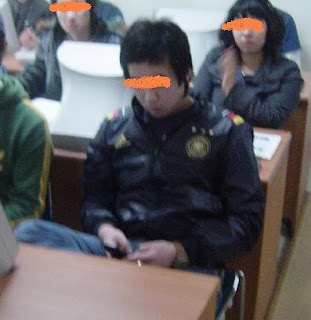
"The phone using student is a funny fellow, shy and hard to approach. They are sociable animals and friends may make an alarm call as you come near. They prefer large classes where they can blend in."


I am almost embarrassed at how proud I am to have gotten this picture. After spotting the phone-using-student, I had to keep my tone and speed of speaking steady as I reached into my computer case and pulled out the camera. Then I had to keep the camera low and turn it on as I approached, hoping the thirty-five other students wouldn't show too much curiosity until - Snap- had the picture and a class frozen at my response. I was so proud of myself.

Oh, for nostaglic Canadians, visit the spoof page at Hinterland's Who's Who. Best viewed with a hockey jersey and maple syrup pancakes.