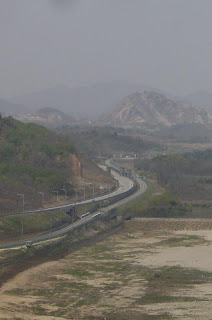
Saturday, June 30, 2007

The Joongang Daily is a little confused.

The Joongang is normally my favourite news-source. The claims in this article obviously surprised me all the more concerning their source.

I can accept the title: In a rarity, malaria kills two people in Korea. Probably, death from malaria is uncommon here. This sentence is what surprised me: "No one in Korea has ever been infected on the peninsula by malaria, although some travelers have returned here with the disease."


Further, after searching the Joongang's own archives, I found this article, "With bipartisan nod, Seoul to fund NGO flood aid" (August 4, 2006).
According to the article:

... the flood disaster in the North rang alarm bells in the South about the potential for an epidemic as the number of patients with malaria in the North reportedly increased after last month’s flooding. Earlier this month, a South Korean activist group, Good Friends, said that an increasing number of malaria patients have been found in Kaesong and Haeju in the North after the flood.

The Korea Center for Disease Control and Prevention said mosquitoes could fly from North Korea to South Korean regions near the Demilitarized Zone. According to the center’s data from January to June, 333 patients with malaria were reported to the center, up 47 percent from 226 patients in the same period last year. The western parts of the DMZ, Gimpo and Paju in Gyeonggi province and Ganghwa in Incheon, are likely to be infested by malaria mosquitoes, flying up to 18 kilometers from Kaesong, Jangpyong, and Tosan in North Korea, the center said.


Other news of Malaria in South Korea:
  • -the Canadian Red Cross will not accept blood donations from visitors to areas near the DMZ for several months after return due to fears of malarial transmission.
  • - the July 2007 edition of National Geographic includes a world map that shows northern South Korea as having Plasmodium vivax, one form of Malaria.
  • -In the late '90s, military leaders described malarial mosquitoes at the DMZ as a hazard for their troops. Amusingly, I recall the article as almost reading that the North Koreans were sending the malaria across the DMZ deliberately.
  • -According the CDC: South Korea: Risk limited to Demilitarized Zone and to rural areas in the northern parts of Kyonggi and Kangwon Provinces.
  • -A student told me that during his military service, he contracted malaria.

These articles all focus on North Korea and northern South Korea but the original article specifically states, "...the peninsula...", not merely South Korea and do include parts of South Korea.

My best wishes go out to the families of the "57-year-old Korean patient and [the] 59-year-old Greek man" (both people were sick in the same hospital -how is only one a patient?). I also hope the family of the "Greek man" are not further demonized - the article suggests the Greek man infected the "Korean patient".

UPDATE: The Joongang has edited its online edition, adding the word tropical:
Original:No one in Korea has ever been infected on the peninsula by malaria, although some travelers have returned here with the disease.
Current (July 3, 10:30pm):No one in Korea has ever been infected on the peninsula by tropical malaria, although some travelers have returned here with the disease.

There is also some discussion of "plasmodium falciparum" (incorrectly written: the genus name should be capitalized) that I don't recall in the original article. Aside from this nitpick, the article is now correct.

Tuesday, June 26, 2007

Bike lanes - paint 'em yourself


The Toronto Star as an article about the Other Urban Repair Squad. This group of people are frustrated about waiting for the city to set up bike lanes so they paint them themselves.
What could we do here?

Thursday, June 21, 2007

Mr Soldier-man, tear down this fence! ...and more

From the Joongang Daily, comes this picture of a soldier removing fencing from Sacheon Beach, just north of Gangneung.


I have volunteered now and again for several years at Hyeonseong Elementary School in rural Yangyang District. The Joongang Daily tells me that 23 students were invited to the National Folk Museum to learn Taek Kyon. That would be the entire school population.

Jeju trip

I just spent four days and three nights in Jeju Special Self-Governing Province (On the island, you will never see a simple 'Jeju Province') with Kwandongmom and KwandongAlex.

We visited a few tourist sites and mostly just relaxed - the little guy hates carseats so every drive included almost constant wailing. I showed K'mom what I thought typified Jeju - a few craters, a cave, a village of traditional homes and a few beaches.

Everything revolved around the little guy. We rode a horse and camel - two things I would have avoided were it not for him. For other big-footed foreigners - bring narrow shoes if you plan to ride: I couldn't fit my water-sandals in the stirrups and rode with only my toes holding my weight.

The little guy was a babe magnet: well, a middle school girl magnet. They would surround him without care for how they overwhelmed and terrified him.

I will post more later.

Friday, June 15, 2007

A sandwich for members of a Chinese religious group?


I make plenty of spelling mistakes so I don't often mock the, um, interesting English I find in Korea.
However, I am curious if 'taost' is missing an 'i' or has the vowels reversed.

Saturday, June 09, 2007

A little bored

You scored as Scientific Atheist, These guys rule. I'm not one of them myself, although I play one online. They know the rules of debate, the Laws of Thermodynamics, and can explain evolution in fifty words or less. More concerned with how things ARE than how they should be, these are the people who will bring us into the future.

Scientific Atheist

100%

Agnostic

75%

Apathetic Atheist

75%

Spiritual Atheist

67%

Angry Atheist

33%

Militant Atheist

33%

Theist

0%

What kind of atheist are you?
created with QuizFarm.com

Monday, June 04, 2007

Wouldn't it be ironic if these people placed themselves on 'do not call' lists?

First, notice the ads at the bottom left of the picture. Three in one afternoon. I don't hate the people who do this to make money - I might have before one of my foreign students told me this was her job -although not at my location.

What I really want to talk about, however, is the circumstances than led me to making the poster middle-right.
Below, you can see it more clearly (click to enlarge).
Some Jehovah's Witnesses knocked on my door a few weeks ago but were put off by my inability to speak Korean.

Then on May 27th a Korean family of JWs from Yangyang and with at least one English speaker appeared at my door. I didn't talk to them long (although I wasn't rude -bringing children along is a great or cowardly way to avoid anger) but the man said something about knowing me. Yangyang isn't far off and I lived there for two years, so its certainly possible but was it a coincidence that brought him to my door?

Yesterday, June 3, two more JWs knocked on my door. This time there were two women, a native speaker of English and a Korean. I was less polite this time.

Today, Monday June 4th, two more people knocked on my door. They appeared unconnected to the JWs but soon revealed themselves to be missionaries for one faith or another.

I was furious -with myself. First, the poster I'd made was inside the door, waiting for next Sunday, and second, I may have been too specific in making my poster by naming JWs.

I slammed the door in their faces and cursed a few times alone in the apartment.

The next afternoon I'm home, I'll have the sign on the door and pot of water on the table in easy reach!

Friday, June 01, 2007

A surprising similarity found between my university and Korea's best

A coworker and I were complaining about smokers at our university and I repeated the explanation I had heard for the lax enforcement of the smoking areas here. Ours is private university and although the courses taught may be of acceptable quality (and I think they are), non-academic situations fall under the "The customer is always right" heading. We can't enforce campus rules on smoking for fear of losing students and their money.

My coworker asked, "Where would the students go?"

If they are at this university (a bottom tier university), the next step down is actually on to a scooter delivering Chinese food for the rest of their lives.

And I thought, hey, we are just like Seoul National or Korea University; we could set strict guidelines for entry and people would find themselves compelled to follow them. SNUs guidelines would be more scholastic while ours would be involving other areas of university life, but that's just quibbling.

Wednesday, May 30, 2007

Photo of Handsome Man in Great Suit found online

I guess Kwandongwife was doing a vanity search with my name or some such thing.


강릉시 대학생 초청「평화통일 토론회」

강릉시협의회에서는 지난 5월 14일 강릉의 대학생 및 자문위원님들 약 70여명이 함께 한 가운데 '강릉시 대학생 초청 [평화통일 토론회]'를 개최하였다. 토론에 앞서 초청강연의 시간을 마련하여 Brian Dean 관동대 교수(캐나다인)님이 'The Korean War, the past 53 years of armistice and the impressions of a foreigner'을 주제로 말씀해 주셨다.

This photo is from the speech I gave two weeks ago. I can't link directly to the page but you could find it (if you wanted to) from here.

Monday, May 28, 2007

Teaching English at University: A dream lay dying

This is not a tale of teaching ESL in Korea but serious look at Journalism professor, Bill Maxwell, who chose to teach at a historic black college as part of a debt he felt he owed his own wonderful professors.

The article in full is here and I found it linked from Clicked.

I think 'historic black college' has a specific meaning and it may be clear to others. I may have missed it. My impression is the college this professor taught at was quite small, had been built specifically for black students and may have had a large percentage of donations, scholarships and subsidies operating to the student's benefit.

My own university is completely different from the idealized one I characterized (accurately or not) above. There are scholarships but also mine is a private university with tuition much higher that of provincial or national schools.

As I read the article, I was struck by the similarities and contrasts with my own situation.


During those first few weeks of school, the new equipment began arriving and my
hopes continued to rise. My first year at Stillman, which had fewer than 1, 000
students, had not been as smooth or as fulfilling as I had hoped. My students'
academic performance had been generally disappointing, and I could not persuade
most students to even attend class regularly.
Well, I teach nearly 500 students myself and there are more than 15 foreign teachers at my university, so while not a large school, we dwarf Stillman.
The classes I teach are mandatory and not in the student's major. They take ESL because they must. Maxwell's students should be somewhat interested in their studies as it was their own choice that brought them there.
My colleagues and I were witnessing the result of low admission standards. Were
we expecting too much of young people who scored poorly on the SAT, who were
rarely challenged to excel in high school, who were not motivated to take
advantage of opportunities to learn, who could not imagine where a sound
education could take them?
My student's were challenged and possibly even threatened to excel at high school but my university is a lower tier school so the bit about low admission standards is right on.
Maxwell describes how a white professor asked for assistance, wondering if there was a racial barrier in class:
A few minutes into my exchange with the class, I realized the white professor was not the problem. The students simply did not - or could not - read closely. My colleagues and I could not teach what we had been trained to teach.
"My students don't use me, " an English professor said. "At most, I may run into two or three a year who make me work. Talking over your students' heads is a waste of everybody's time."
My students don't appear able to take notes. Most arrive with the textbook and a pen and a few will bring a notebook (although they may not use them) and others arrive with only their cellphones.
I wonder if I teach over my student's heads. I think I'ved learned a few things from this article and will comment more fully at the end.
Many of my Stillman colleagues regularly invited their students to their homes for dinner. The discussions often were about personal matters involving romantic relationships, family crises and money problems. Professors were the first confidants many students ever had. Indeed, they often became surrogate parents.
We foreign professors can probably never get that close to most students. A very few times, I have eaten with my students. Again, with 450+ students in my classes, it would bankrupt me to take them to dinner.
The bottom line was the same as it is at most HBCUs.
Professors who had the best success connecting with students, especially
below-average male students, emphasized friendly, personal and supportive
involvement in their lives. For example, Stephen Jackson, who taught sports
writing, was an effective professor because he understood the importance of
winning students' trust. He even ate lunch in the cafeteria with students each
day.
We foreign professors (or maybe just I) do have a looser relationship with our students. We are professors, but not 'real' professors. Most of us use our given names in class and are more familiar in class than a typical prof would be. This is part of 'Conversational English', in my opinion.
"Relax and be comfortable speaking in front of the whole class...but call me Sir", just doesn't work.

The flexible professor encouraged lively exchanges of subject matter, ideas, beliefs and opinions during class discussions. The flexible professor often did not require written responses or exams. The flexible professor let students keep pace by retaking exams, completing take-home exams or giving classroom presentations.


I had difficulty becoming flexible. The majority of my students in the English class failed to complete most of the assigned readings. Most of their essays were unacceptable, and attendance was low. I had a choice: Abandon my syllabus or flunk more than half of the class.


I abandoned the syllabus. Instead, I lectured and made assignments based on the problems and errors in the students' writing. I went over the same material, such as writing the topic sentence, again and again because some students could not master it.

Flexibility is the name of the game in Korea. Things change from week to week and two days warning is the local definition of 'long term planning'. Again, I will discuss this more at the end; I quote it now because I see strong similarity with my own classes.
Maxwell's colleague gives her observations of the students:
"Our kids haven't had many good things in their lives, " she said. "Many of them are angry and negative and rude. They've had hard lives.
Some of them don't belong here."
I would say the opposite is true here. Well, the students have had hard lives, being trapped in the hagwon system awaiting the entrance exam from Hell. Still, they have never worried about money or some form of parental support.
I always was amazed that so many of the women tolerated the
crude way the men spoke to them. One afternoon in my English class, a male
student called a young woman "a big-assed ugly bitch." I expected her to slap
him, and I would not have intervened. Instead, she dismissed the whole thing
with a wave of her hand and turned to chat with her roommate. After class, I
asked her about the insult.
I am not sure about the male/female interactions that go on in my class. I do hear phrases and comments, that in their tone and timing and the response they get, would seem to be insulting, but I don't think they are as mean-spirited as in the quote above. I do hear a lot of 'fuck you' in class from one student to another. I would throw the student out if I could be sure who it was. It mostly seems a sort of elementary school boy chatter, like the French curses my classmates and I used thirty years ago. A curse is more funny than stinging when given in a foreign language.
"Have you noticed that our students never have a sense of
urgency?" a colleague asked one afternoon as we walked to a faculty meeting.
"They don't seem to be going anywhere in particular. They just stand around or
mosey along. Frivolity."
That seems to be the case here. Korean students think the excuse, "I am late because I was sleeping" is sufficient. University is nationally considered a time to play in Korea.

He was right. Greek organization activities such as step
shows - the rhythmical, patterned dance movements favored by fraternities and
sororities - and any excuse to party and play music were the most important
events on campus.
I have an evening class this semester and have seen the classrooms come alive at night. Three rooms each have their own dance routine going on.
The effects of poverty made teaching and learning arduous. I
asked a student why she always fell asleep in my reporting and news writing
class.
"I work full-time at Target at night, " she said. "I can't get enough
sleep."
This I don't see in my classes. Oh, I see a lot of sleepy students, but few from working long hours. The ones that do work, I do my best to support.
Each week after that, I went to Kmart and CVS and shopped
for travel-size cosmetics and toiletries to replenish the basket. I learned that
several other professors also found acceptable ways to make personal items
available to students free of charge.
Maxwell is talking again about poverty. This isn't something I face in many classes but his generosity and desire to help his students is admirable.
Campus-wide, professors bought many of their classroom and
office supplies. In my building, for example, we rarely had an ample supply of
paper for our copy machine. I learned early to buy my own paper and keep it in
my desk.
I do this, too. I don't think my university is low on funds, they, uh... I'm going to avoid negative comments about my university. Complaining about unnamed students is one thing but I have mentioned the name of my university before (heck, its one of my tags) and I don't want to cross Korea's libel laws.
While disagreeable staff members and financial red tape were
constant irritants, nothing was more appalling than the students' disregard for
college property.
The staff members are a joy here. I have received all the help I could ask for, although I have had to ask to what I thought would be obvious things.
Disregard for college property is common here although I haven't noticed any fires as he later describes. Classroom fill with garbage and every inch desk space is grafittied.
By the end of the spring semester, I knew that I could not
remain at Stillman another year. I had a few good students, but a few were not
enough. One morning as I dressed for work, I accepted the reality that too much
of my time was being wasted on students who did not care. I felt guilty about
wanting to leave. But enough was enough.
I feel for Maxwell. He was clearly a motivated professor who was worn down by unmotivated students.
I've been writing with amusement and seeing irony in the comparison with Maxwell's situation and my own. We both have students with low SAT scores. Our students are untrained in western classroom skills. Many of his students had hard lives while mine generally do not. Our students are interested in the "University life" but not in studying. His difficulties have led him to go elsewhere while mine are clearly not so bad.
He finds it necessary but difficult to connect with his students as I do. He recognised what a professor needed to do in that setting but had difficulty.
At the end of last semester, I posted some suggestions I had for last year. I think Maxwell has some good suggestions and will soon follow this post up with suggestions for myself for next year.

Is it really Spring? Late Spring, even? Really?

What's up with the weather?

Saturday was hot but wildly windy.

Sunday was the strange one. I was out with KwandongAlex to let K'wife sleep in. From 8:30 to 10:30 in the morning, I was actually hunting for shade to stand in while the little guy played.
When I got home, I packed my frisbee and towels in my backpack and brought K'alex's backpack of sandcastle tools.

We stepped out around 11:30 and were cold! The only good news is that it wasn't windy. Ten AM was the high point on the thermometer.

Today, the weather is perfectly seasonal - for late March.

Wednesday, May 16, 2007

a Trip to the Unification observatory and Trains across the DMZ

.

I haven't posted in a while; I've been busy preparing a speech for Gangneung National University's Peace and Reunification Meeting. A few things have happened in the past month that uncannily link with this theme.


I was first asked to prepare a speech on foreigner's views and impressions of Korea. I was ready with good stuff (medical assistance was a big one of the list - I love the lack of waiting time at Korean clinics and the inexpensive medicine here) and bad stuff (traffic figured greatly here) when I received an email saying the topic had changed to reunification, the Korean War, the DMZ and related areas.


I received the message just after making a weekend ride to the Unification Observatory, at the DMZ in coastal Gangwondo.


I gave my speech on Monday to about 60 students. Today, Wednesday, I read about trains being prepared to cross the border on the East and West coasts.


On my bike trip, I rode mostly on highway 7, leaving it to enter the little fishing villages along the way but also following the old Japanese-made railway the whole way. I even took a dirt path through an old rail tunnel.


Kangneung is the modern rail head. You can see traces of the old railway as you go north from Kangneung but these are being erased all the time.


Past the observatory, the railway looks complete and ready for use.


As a travel note, you cannot ride a bicycle all the way to the observatory. At a check-in point about ten kilometres from the observatory, there was an information boothand the staff helped find a family to drive me in their car through the restricted area in 2005. Now, the booth is closed, although I luckily found another ride on my own.

Oh, about my speech: I gave it in English and a coworker translated it for me sentence by sentence. That's an interesting way to lecture. Some students laughed when I made a humourous remark and others laughed when the translator spoke (others were sleeping and I made sure to point them out while speaking about soldiers sleeping during the Naksan fire Oh, the soldiers were sleeping because they were told to stand down - they weren't obviously being lazy.)

My main point was that foreigners probably see things here more objectively and more strongly.
We are more objective because of our distance. We see the giving of aid to North Korea, particularly without requiring inspectors see where the aid goes as a mistake. The UN refused to do this but Koreans see even a poor chance to help their 'brothers' is better than no chance.

Koreans grew up with the armistice in place, and conscription is an annoying but familiar part of life here. These things are fresh and new to foreigners.

After my speech, a panel of a few North Koreans (defectors?) and a few Chinese students were scheduled to speak. I had to leave but I wondered what they would say. I quoted the Marmot discussing China's ambitions and spoke critically of North Korea. I hope I can learn what they discussed.

Finally, about the trains:
The two Koreas are now planning a test run on May 17. One train carrying about 100 people would make the crossing from the North on the east coast and a similar one would cross from the South along the west coast, South Korean officials said.


I wonder if Yahoo means the Cheolwon station rather than the one on the East Coast. There may be a station right at the DMZ, but it goes no further south. The article ends with:
The current plan calls for two passenger trains to travel about 25 km (16 miles) and finish their run at stations a few km on the other side of the border.

Seoul has been pressing to make the crossings more than a one-off event. It eventually wants to be able to send trains carrying cargo and passengers to China, Russia and other parts of Europe.

Monday, May 07, 2007

Spiderman 3

Everyone has been posting about the first blockbuster of the year so I thought I'd join in.

Of course, after the Hominid's post, there's not much left!


The actors were mostly familiar although I was surprised at how big they were. Thomas Hayden Church was superhero sized without needing any 'demolecularizing'. Topher Grace also has filled in and looked plenty meaty.

Maguire didn't look any bigger but he perfectly fits the geeky Peter Parker role. There's only one that I think would do better. Here is a still from his screen test.


On a completely different subject, some coworkers and I were involved in a project for the Tourism department. Here's Paktheelcamino taking a power nap during a presentation.


Tuesday, May 01, 2007

Meeting the family at the airport

Yangyang airport has never been a busy place. It was prepared for flights to China and opened at the peak of SARS.
I arrived early to meet my wife (she and kwandongbaby visited her folks) and found a deserted building. There was a weight training room out of sight of visitors but I guess staff decided there weren't enough visitors to worry about.

Here is Kwandongbaby with his mom's suitcase. I guess he had performed ancestor worship, bowing to his grandfather, before coming home as he was in his suit. Does he look more like a busboy or a VYuppie (Very Young Urban Professional)? Whatever, he thought he was very helpful.

Wednesday, April 25, 2007

Daylight Savings- no joke for the environment!

On April Fools Day, I claimed that Korea had adopted Daylight savings and people should put their clock forward an hour. Its a good thing Korea hasn't switched to Daylight Savings:

You may have noticed that March of this year was particularly hot. As a matter of fact, I understand that it was the hottest March since the beginning of the last century...As you know, Daylight Saving Time started almost a month early this year. You would think that members of Congress would have considered the warming effect that an extra hour of daylight would have on our climate. Or did they ? Perhaps this is another plot by a liberal Congress to make us believe that global warming is a real threat.


Found here (I am willing to believe this is a late entrant for an April Fools letter). Actually, that is a link to the newpaper this claim was written in. I found it on Catshark's blog and he linked to the angry astronomer who goes into detail about how and why it is so very foolish.

transitional species between fish and moth

All those who doubt evolution, look on this 'fith' - a transitional species between FIsh and moTHs - and despair! (click to enlarge)
Six legs?-check.
Wide wings? Check!
If you've seen a moth through a window, you'll notice the eerie similarities. If the body were a little less chunky, you wouldn't know the difference (maybe the gills and fishmouth might bother you a bit, but not much).

More seriously, anyone know anything about this fish? It has two pair of pectoral fins which separates it from older fish families, like salmon and trout, but that still leaves a huge number of species to distinguish it from.
I apologise for the glare from the tank. I just noticed it at a sashimi restaurant by the bus stop and had to shoot it.
UPDATE: friends at the talk origins google group have identified it as a sea robin, or close relative, the Red Gunard. Thanks, Mel, Dana and John.

Monday, April 23, 2007

Is Spring finally here?

A beautiful day today. I got out on the bike and managed twenty-some kilometres; not bad for a first ride. On the way, I stopped at an information booth and learned that cyclists can use the Misiryeong tunnel. I've cycled long distances but I'm a wimp about hills; this news may mean a trip sometime to Seoul, or anyway, somewhere inland.
The weather got me thinking of where I could go or what I could do this spring with my time off.
This weekend, Kwandongwife and K-son are visiting her parents and I'm staying home. Why am I not going along? Well, we want to save a little money, K-wife wants to save money and I may have singed some bridges when Kyongsangmother-in-law visited.

Anyway, with the weekend free, I am planning a trip to the DMZ -or as close as cyclists are allowed. There is an information centre at the final checkpoint and the guide there has arranged a ride for me the last few Km with other tourists in the past, so I'll do that again.

In mid May, the university has a festival of some sort and I'll get three days off then. I'm thinking about hiking across Soraksan. I'll start either at O-saek or Sorakdong and take two days to get to Baekdamsa and Yongdaeri. I don't know the dates for sure but I think it'll be May 16-18. Is anyone else interested?

Saturday, April 14, 2007

Well, I guess I'm out of a job.

Now there's a 'magic' way to learn English, discovered by the "...Korea Times ombudsman-in-chief and also editor-in-chief of The Edu Times. Park, former managing editor of The Korea Times, now teaches English media and ENIE at the Hankuk University of Foreign Studies and Kyung Hee University."

The way?

Reading newspapers.

Boy, he sure was lucky to have chosen a job in newspapers, then chance into finding this "Magic Solution to English Proficiency". Here are the highlights (click to enlarge, if needed).

Although I work in the field, my own grammar skills are not that strong (a big surprise to any that read this blog). Still, I have to wonder about the title in an "Eats, shoots and leaves" kind of way.
Magic Solution to English Proficiency

Does the title suggest that Magic is the solution? From the article, we know that reading newspapers is the solution; would that be a 'magical' rather than 'magic' solution?
.
I do understand that reading news in the target language but based on local events would have the advantages of being challenging but familiar and more interesting than events in the target language from my hometown (for example). Indeed, I use article from the Times in some of my classes.
.
I guess I object to two things. Firstly, the word magic. This makes the article appear to describe something new and wonderful. Using newspaper articles in class is a good idea, but its not a new one. I suspect most teachers do it and many students already read them at home. The word also makes English proficiency appear to suddenly be easy; that is probably the definition of a "magic(al) solution". There are ways language learning can be easier, but it is not easy.
.
Secondly, the Korea Times, and its competitor, the Korea Herald, are not really places to find literary English. The second point in the photo above states in part that, "Newspapers are interesting, concisely written, readable ... fine collection(s) of essays as well."
.
I read the Times because I think it is of better quality than the Herald but that makes it only a larger guppy in a small pool. I have enjoyed a few series in these two papers, but as a whole, I am not sure if the quote above is an accurate description. Take your pick of either paper; if I had fifty won for every obvious grammatical or spelling error, well, I could buy a coffee - but it would be a Starbucks specialty coffee!

Sunday, April 08, 2007

Canadians no longer able to mock English signs in Korea

We sure can't after this!


OTTAWA (Reuters) - Canada will remove the French-language exhibit at a major military memorial [Vimy Ridge, France] after a reporter discovered it was riddled with grammatical errors, Veterans Affairs Minister Greg Thompson said on Thursday.


The issue is an embarrassment for Ottawa, since Canada has been officially bilingual for 40 years and millions of French-speakers are very sensitive about their fate in a country where most people speak English.

Saturday, April 07, 2007

a limited method for weight loss

In Canada, I donated blood fairly regularly, encouraged by the examples set by my parents and grandparents.
Here, I've been more cautious. The Red Cross of Canada had some problems somewhat before I started to donate and I was concerned about hygiene and sterile condition here.
I watched how the process worked and was satisfied; single use needles, bags and tubing, and even the swabs used to disinfect were unsealed in front of me and immediately discarded.

I looked at the Bloodmobile as being a little too temporary or somehow lacking in solidity (and the bus did rock as candidates boarded or left -400grams lighter). Still, the blood donor clinic in my hometown arrived in trucks and was set up only for the day in a recreation centre, and the staff here were skilled and experienced.

In the picture below, we see a candidate on the left, filling out the required form. Soon, he will go into the private chamber behind him, take a blood-density test and confirm a few of the questions verbally. The nurse inside the privacy booth spoke no English but was comforted by my Canadian blood donor card and insistence that I was an appropriate candidate. She checked the boxes in the questionnaire in the correct order of 'yes's and 'no's (for the record, I think it was no, yes, then no all the way down).
To the right, in the picture are two people who have completed their donation and recovering with drinks and snacks.


The nurse here found my vein (or artery, I don't know) with no trouble. I've never had trouble in that regard, though so I really can't say she was much better or worse than Canadian nurses. I'm quite proud of my blood donor abilities, in fact. Plug me in and don't go far because it won't take long - funny, my wife was saying the same thing, the other day.

In Canada, one can donate blood every two months or so. I don't know how long one must wait here. I will donate again but I can wait; I was unusually dizzy for the afternoon and evening. The inside of my elbow remains bruised four days later.