
Lao-ocean girl, an ex-pat living in Gangneung has some news about the Salmon Festival, which I posted about a few weeks ago, starting tomorrow (Saturday the 23rd) and horrifying (but unsurprising) news about the communal bowls used in Korean restaurants and foodcarts. I have tried to ignore my discomfort in sharing soups and even dipping bowls but no longer. Read it.
Anyway, come to Yangyang and enjoy the salmon, but don't share.
Friday, October 22, 2004


Temple stay at Naksansa
I saw this article in the Korea Herald and thought I would describe my temple stay experience at Naksan Temple. The article is about Jagwang Temple but the basics are the same at every temple.
Experience Buddhist monk life through templestay
A typical weekend visit to the Jagwang Temple runs for 24 hours,
"The tea ceremony helps me to erase myself," she said slowly
I went to Naksan Temple with 6 friends. [Note, there is a minimum group size, you should enquire when planning a visit.] Five of us lived in Yangyang and had been to the temple at least a few times, while it was the first visit for two. If you want to learn about the temple itself, look on the web or, do a temple stay, I guess.
Planning to stay the night made the whole visit seem different. I knew the grounds as well as any layman. In 2003, a group of diplomats came for a templestay and I was drafted into being a guide for their visit. In preparation, I had to do a fair bit of study on the temple and the region. I knew what many of the paintings meant and who Ui-seung and Won-hyo were. I could even parrot a few Zen lines. Still, I had spoken to only about 3 monks in all my stay in Korea.
The visit was interesting and informative but incomplete; I learned a lot but only intermittently had a glimpse of what a monk's life entailed. The visit felt more like an intense guided tour than an immersion into the life of a monk. I fully understand that 24 hours in a temple is not enough to see the inner workings of a lifetime of devotion, but I wanted more. Just as my 5 days a year working at my in-law's farm doesn't make me farmer, the temple stay didn't give me a lot of insight into the thoughts and motivations of a monk.
Our stay was a busy one. The tour of the site, meditation practice, tea ceremony and evening meal (I probably have the order mixed up) filled the afternoon and evening. Perhaps that really is an example of a monk's life: one of fairly constant work, not the easeful existence imagined by outsiders.
It was also an intense one. My understanding of Buddhist philosophy is that one must do whatever one thing without thinking about other things. Do one thing intensely. The tea ceremony was very atmospheric; inside a temple room of wood and mud and reeds, carefully preparing the tea and thoughtfully savouring it. Our (okay, 'my') attempts to chat were quickly stopped. This was a tea CEREMONY damnit, not a tea SOCIAL.
The trip was a chance to focus on simple things but not to relax in the modern sense.
Our Q and A session with the monk started slowly but picked up as we thought about what we wanted to ask. The monk guiding us was named Pap-gong (and, in my thoughts, I immediately called her Popcorn. She was a biguni, or female monk. I also converted that to bikini. 'Popcorn, the bikini') although we addressed her as Seu-nim, or reverend monk. She was posted at Naksan to help with the templestay program and was separate from the other, male, monks at the temple. She had an elder mentor somewhere else in Korea she visited on occasion and was also mentoring an orphaned high school girl in Pusan. I learned a lot about the rigors of a monk's life when she told us she meditated eight hours a day when she was young but no longer had that much energy so her meditation periods were now shorter.
After the Q & A, she gave us a koan or Seon (Korean Zen) riddle for us to meditate on. I was already in pain from sitting crosslegged for some time and when she asked how long we would like to meditate, I choose the shortest period she suggested, ten minutes. The riddle was doubly difficult because the translator was a little quiet and I wasn't sure if it was 'Why does the whiteboard have hair' or 'Why does the white board have hair?' Perhaps non-teachers wouldn't have that trouble. I was sure that no whiteboard I'd used in class had hair unless someone headbutted the edge by accident while leaving class. After the meditation, another templestayer said of course, it was 'white board' as in lumber. Finally, after speaking to the translator, we learned we had lost ten minutes of our lives because the words were 'white boar' as in male pig. Ah well, I would have just wasted them, chatting.
 Ringing the bell
We woke at 3:00 am to do the 108 bows. We went to the main hall in the original part of Naksan temple and joined the service. The monks were in gray and brown and Buddhist students and we visitors were in yellow hanbok. By the way, it isn't just 108 bows, the service included bowing to several of the statues three times each. Then, without warning, the students and monks just kept bowing. We joined in, at our own paces. I was going pretty quickly until I noticed another visitor staying in the full bow position for a few seconds each time. I then tried to slow down and think more about why I was bowing and show a little more respect. Again without warning, everyone started to leave. If I counted the bowing during the service, I think I did the full 108. After leaving the building, I learned that the other visitor was just tired and resting with each box. Dang, I could have made it.
The other visitors went back to bed while I wandered around the temple a bit. The giant standing Buddha looked wonderful, gleaming in the quiet darkness. I was the only one around and I stayed longer than I had previously meditated just enjoying the peace.
After a short nap, we got up again to see the sunrise; Yangyang being famous for it's sunrises. The day dawned very clear, which is nice but slight cloud cover makes for better colors.
After sunrise, we left the temple on our separate ways. The full templestay includes a tour of Sorakdong, the main entrance to Soraksan, with it's giant bronze, sitting Buddha but we were locals and had seen it. I, for one, went home to bed.
Here are some links for those interested:
Click here for the main templestay website. Naksan's templestays are run by a tour agency called itour.
Right beside the temple is a youth hostel. No English.
Finally, about temples and Korean Buddhism, click here. I bought the book but now it's free online.
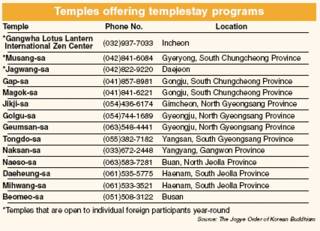 temple information- from the Korea Herald
Experience Buddhist monk life through templestay
A typical weekend visit to the Jagwang Temple runs for 24 hours,
starting on Saturday around 3 p.m. and finishing at the same time
Sunday afternoon. It's an introspective experience, giving the visitor
a glimpse of the solitary lives of Buddhist monks and nuns, while
allowing them to participate in regular temple activities. ...
The Buddhist tea ceremony - a crucial part of being able to able to
free your mind and focus on reflecting upon the world and yourself
- involves learning the meaning of the complex tea preparation rituals
and drinking etiquette. But for Hae Il-shim, what seems like a
painstaking process of carefully washing the teacups and pot before
brewing the tea is actually a highly pleasurable part of her day.
"The tea ceremony helps me to erase myself," she said slowly
sipping tea from a delicate looking kiln-fired green teacup.
"The discipline of the ceremony allows me to find Buddha in my
mind and reminds me that I'm not special. This is a way of
remembering to respect and treat everyone evenly."
...After meditation is finished, it's time for a Q and A meeting
with the temple "seunim" (a respectful way to address a
Buddhist monk or nun in Korea) before heading off to bed
at 10 p.m. During this time, visitors are encouraged to ask
questions or seek advice on Buddhism, personal problems
or even the meaning of life. According to Chong Ah seunim,
the abbot of Jagwang Temple, most foreigners enroll in the
temple stay program because they want to see and experience
the reality of Korean Buddhism. ...With the 5 a.m. ceremony
coming all too quickly, pondering the wisdom of the seunim's
advice from the evening before doesn't seem all that important
as you begin the first of the 108 bows - one for each of the
anguishes or sufferings encountered throughout life's stages.
Prostrating yourself on the ground 108 times to show respect
to Buddha and your Buddhist self is an agonizing experience,
but provides an interesting insight into what it takes to lead a monk's life.
Planning to stay the night made the whole visit seem different. I knew the grounds as well as any layman. In 2003, a group of diplomats came for a templestay and I was drafted into being a guide for their visit. In preparation, I had to do a fair bit of study on the temple and the region. I knew what many of the paintings meant and who Ui-seung and Won-hyo were. I could even parrot a few Zen lines. Still, I had spoken to only about 3 monks in all my stay in Korea.
The visit was interesting and informative but incomplete; I learned a lot but only intermittently had a glimpse of what a monk's life entailed. The visit felt more like an intense guided tour than an immersion into the life of a monk. I fully understand that 24 hours in a temple is not enough to see the inner workings of a lifetime of devotion, but I wanted more. Just as my 5 days a year working at my in-law's farm doesn't make me farmer, the temple stay didn't give me a lot of insight into the thoughts and motivations of a monk.
Our stay was a busy one. The tour of the site, meditation practice, tea ceremony and evening meal (I probably have the order mixed up) filled the afternoon and evening. Perhaps that really is an example of a monk's life: one of fairly constant work, not the easeful existence imagined by outsiders.
It was also an intense one. My understanding of Buddhist philosophy is that one must do whatever one thing without thinking about other things. Do one thing intensely. The tea ceremony was very atmospheric; inside a temple room of wood and mud and reeds, carefully preparing the tea and thoughtfully savouring it. Our (okay, 'my') attempts to chat were quickly stopped. This was a tea CEREMONY damnit, not a tea SOCIAL.
The trip was a chance to focus on simple things but not to relax in the modern sense.
Our Q and A session with the monk started slowly but picked up as we thought about what we wanted to ask. The monk guiding us was named Pap-gong (and, in my thoughts, I immediately called her Popcorn. She was a biguni, or female monk. I also converted that to bikini. 'Popcorn, the bikini') although we addressed her as Seu-nim, or reverend monk. She was posted at Naksan to help with the templestay program and was separate from the other, male, monks at the temple. She had an elder mentor somewhere else in Korea she visited on occasion and was also mentoring an orphaned high school girl in Pusan. I learned a lot about the rigors of a monk's life when she told us she meditated eight hours a day when she was young but no longer had that much energy so her meditation periods were now shorter.
After the Q & A, she gave us a koan or Seon (Korean Zen) riddle for us to meditate on. I was already in pain from sitting crosslegged for some time and when she asked how long we would like to meditate, I choose the shortest period she suggested, ten minutes. The riddle was doubly difficult because the translator was a little quiet and I wasn't sure if it was 'Why does the whiteboard have hair' or 'Why does the white board have hair?' Perhaps non-teachers wouldn't have that trouble. I was sure that no whiteboard I'd used in class had hair unless someone headbutted the edge by accident while leaving class. After the meditation, another templestayer said of course, it was 'white board' as in lumber. Finally, after speaking to the translator, we learned we had lost ten minutes of our lives because the words were 'white boar' as in male pig. Ah well, I would have just wasted them, chatting.
 Ringing the bell
 We woke at 3:00 am to do the 108 bows. We went to the main hall in the original part of Naksan temple and joined the service. The monks were in gray and brown and Buddhist students and we visitors were in yellow hanbok. By the way, it isn't just 108 bows, the service included bowing to several of the statues three times each. Then, without warning, the students and monks just kept bowing. We joined in, at our own paces. I was going pretty quickly until I noticed another visitor staying in the full bow position for a few seconds each time. I then tried to slow down and think more about why I was bowing and show a little more respect. Again without warning, everyone started to leave. If I counted the bowing during the service, I think I did the full 108. After leaving the building, I learned that the other visitor was just tired and resting with each box. Dang, I could have made it.
The other visitors went back to bed while I wandered around the temple a bit. The giant standing Buddha looked wonderful, gleaming in the quiet darkness. I was the only one around and I stayed longer than I had previously meditated just enjoying the peace.
After a short nap, we got up again to see the sunrise; Yangyang being famous for it's sunrises. The day dawned very clear, which is nice but slight cloud cover makes for better colors.
After sunrise, we left the temple on our separate ways. The full templestay includes a tour of Sorakdong, the main entrance to Soraksan, with it's giant bronze, sitting Buddha but we were locals and had seen it. I, for one, went home to bed.
Here are some links for those interested:
Click here for the main templestay website. Naksan's templestays are run by a tour agency called itour.
Right beside the temple is a youth hostel. No English.
Finally, about temples and Korean Buddhism, click here. I bought the book but now it's free online.
 temple information- from the Korea Herald
Tuesday, October 19, 2004
Doug Bennett: My favorite musician, dead at 53
When I was a speed swimmer in my teens, the coach used to play Doug and the Slugs all the time. I enjoyed the music and when they played nearby - at the Kee To Bala, in Muskoka, they were my first choice to try to get in underage. I had learned to like the music because i heard it so often but when I saw them in concert, WOW!- The best Bar-band in Canada. The Kee had strange floors ( I think should-be-condemned is a better description of the floors) and dancers got a big spring. It was like dancing on a trampoline. I saw them again several times at the Kee and also at Front 54 in Thorold. Nobody sat and listened to Doug. He wouldn't let you- I mean that, I think he would drag people onto the floor. One year, he had this bit where he would find a bar-goer and ask them obnoxious questions while holding their hair and making them nod their head to his queries. My friend Ron thought it was great when he was tackled but I think someone later sued him.
I have no idea if his music was 'good'. I can't carry a tune. But I know his concert show was the best I had ever seen
 Doug and the Slugs
This picture is from their second album. I found it here.
Goodbye Doug. "Too bad you had to get caught. That's not you to make a mistake"
I have no idea if his music was 'good'. I can't carry a tune. But I know his concert show was the best I had ever seen
 Doug and the Slugs
This picture is from their second album. I found it here.
Goodbye Doug. "Too bad you had to get caught. That's not you to make a mistake"
Monday, October 18, 2004
Cranes have returned to Cheorwon
While visiting a Korean friend, I noticed a newspaper with a picture of some Manchurian cranes on the front page. Upon returning home, I could not find the picture online. Anyway, they have returned to Cheorwon. I thought Korea was just a rest stop on a longer migration but this site says Korea is their wintering site. As I couldn't find the photo I wanted here is a Korean stamp photo featuring the Manchurian crane.
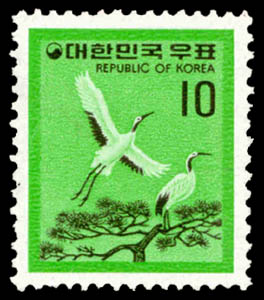 Manchurian Crane
The site that gave me their migration route also gave their name as Manchurian or Japanese Crane. I already used a 'Sea of Japan/East Sea' joke for the Japanese Maple below so I guess I can't here (sigh).
I went to Cheorwon a few years ago with the Royal Asiatic Society and the weather was crummy but the birds were fantastic. Never having seen an ostrich, when I saw these giants, I thought they could be ostriches. These are big birds. They fly in 'V's and their huge wings look prehistoric.
Manchurian Crane
The site that gave me their migration route also gave their name as Manchurian or Japanese Crane. I already used a 'Sea of Japan/East Sea' joke for the Japanese Maple below so I guess I can't here (sigh).
I went to Cheorwon a few years ago with the Royal Asiatic Society and the weather was crummy but the birds were fantastic. Never having seen an ostrich, when I saw these giants, I thought they could be ostriches. These are big birds. They fly in 'V's and their huge wings look prehistoric.
Sunday, October 17, 2004
.jpg)
New Hiking Route in Seorak National Park
I posted earlier about a trail being reopened after 20 years closure for recovery from overuse. On Friday I made the hike and here are the details. I apologize for the quality of the photos; my wife is using our digital so these are film photos that have been scanned.
.jpg) Entrance to Heul-lim Gol
Entrance to Heul-lim Gol
I learned about the new trail in the Joongang Daily. I will refer to the article a few times.
The trail is a little inconvenient to reach as it is between Hangyeryoung and Osaek. The article describes the trailhead as 2 km below Hangyeryoung when it is actually three and a half. My friend and I took the bus to Hangyeryoung (pass or or highest point of the road) and walked down to the trailhead. It was a fast walk and not too scary although the bus drivers sure lean on their horns a lot. There were a lot of switchbacks and if you were a good longjumper, you could probably reach the trailhead in one jump; the landing would be messy though.
The trail has been closed for twenty years and only recently reopened. This is a good thing as the soil is a very fine powdery dirt that will erode quickly. As yet the trail is not very wide but there are several points where the trail splits and rejoins. I have heard that along the Appalachian Trail in the Eastern US, hikers are strongly requested to stick to the one path even if it is under water to reduce erosion around the trail. There is no such education here and some Seorak trails are 10 meters wide. The Heullim trail is not but could soon be.
Do not expect a solitary experience in Seorak in the Fall. I hoped to avoid crowds by hiking on a weekday. If the weekend is more crowded, Seoul would have to be empty. The first half of the hike was relatively private but at the top, there was a group of perhaps 50 shuffling and clambering over each other to enjoy the view. To get to the top, one had to climb 3 or 4 metres almost vertically and the top was a rounded knob of rough rock so people literally did clamber over each other.
The views were great and would be even when the fall colors are gone.
.jpg) Hangyeryeong
Hangyeryeong
Above is our starting point. We walked downhill for 40 minutes before climbing above it. Clicking on the picture will enlarge it and you will see how many vehicles are parked there.
.jpg) Japanese Maple
Japanese Maple
The Maple of Japan or, as it's known here, the East Maple, was the brightest in the forest. It's shocking red was wonderful and many people collected leaves to take home.
As I've said before though, it's the wildlife that I really want to see while hiking. I wasn't disappointed:
.jpg) Snake -(poisonous?)
Snake -(poisonous?)
We saw two snakes. I took a stick and encouraged this one to vacate the trail because the next Korean coming down either would not come down or would encourage the snake to vacate this world with a stick. A man beside me kept warning me, saying 'Dok-sa' which I am sure means poisonous.
I don't know if the snake is poisonous. I know that many people in my part of Canada talk about the cottonmouth snakes and copperhead snakes they've seen, unaware that there are none such in Canada. A lot of harmless foxsnakes and milksnakes are beaten to death for no good reason. I have no reason to believe Koreans are any better educated about their snakes. On the other hand, it's the only kind of snake I've seen in Korea, and I've seen it in four provinces so it is common enough to be well-known. If any readers know, please tell me.
...
After reaching the peak, we continued down to Osaek valley. The trail got progressively busier but I saw only a little garbage. (I always plan to bring a bag and collect garbage and never do.)
At O-saek, we caught a bus home to Yangyang. The buses from Yangyang to Hangyeryoung from O-saek to Yangyang are regular but the schedule has recently changed. Greenyard Hotel, which houses the hot springs, has a bus of it's own to and from Yangyang and the airport.
I had planned to make the trip a two day affair, going to Daechungbong- the highest peak, and spending the night, then going down to Hangyeryoung and Heullim. I learned online that the Daechungbong sleeping hut is booked up for more than a week in advance. Actually, a Korean friend found out for me. The English site gives a phone number to call but the Korean site allows you to reserve online and check for vacancies.
The hike took about four hours from Hangye to O-saek and maybe five and a half to and from Yangyang.
.jpg) Entrance to Heul-lim Gol
Entrance to Heul-lim Gol
I learned about the new trail in the Joongang Daily. I will refer to the article a few times.
The trail is a little inconvenient to reach as it is between Hangyeryoung and Osaek. The article describes the trailhead as 2 km below Hangyeryoung when it is actually three and a half. My friend and I took the bus to Hangyeryoung (pass or or highest point of the road) and walked down to the trailhead. It was a fast walk and not too scary although the bus drivers sure lean on their horns a lot. There were a lot of switchbacks and if you were a good longjumper, you could probably reach the trailhead in one jump; the landing would be messy though.
The trail has been closed for twenty years and only recently reopened. This is a good thing as the soil is a very fine powdery dirt that will erode quickly. As yet the trail is not very wide but there are several points where the trail splits and rejoins. I have heard that along the Appalachian Trail in the Eastern US, hikers are strongly requested to stick to the one path even if it is under water to reduce erosion around the trail. There is no such education here and some Seorak trails are 10 meters wide. The Heullim trail is not but could soon be.
Do not expect a solitary experience in Seorak in the Fall. I hoped to avoid crowds by hiking on a weekday. If the weekend is more crowded, Seoul would have to be empty. The first half of the hike was relatively private but at the top, there was a group of perhaps 50 shuffling and clambering over each other to enjoy the view. To get to the top, one had to climb 3 or 4 metres almost vertically and the top was a rounded knob of rough rock so people literally did clamber over each other.
The views were great and would be even when the fall colors are gone.
.jpg) Hangyeryeong
Hangyeryeong
Above is our starting point. We walked downhill for 40 minutes before climbing above it. Clicking on the picture will enlarge it and you will see how many vehicles are parked there.
.jpg) Japanese Maple
Japanese Maple
The Maple of Japan or, as it's known here, the East Maple, was the brightest in the forest. It's shocking red was wonderful and many people collected leaves to take home.
As I've said before though, it's the wildlife that I really want to see while hiking. I wasn't disappointed:
.jpg) Snake -(poisonous?)
Snake -(poisonous?)
We saw two snakes. I took a stick and encouraged this one to vacate the trail because the next Korean coming down either would not come down or would encourage the snake to vacate this world with a stick. A man beside me kept warning me, saying 'Dok-sa' which I am sure means poisonous.
I don't know if the snake is poisonous. I know that many people in my part of Canada talk about the cottonmouth snakes and copperhead snakes they've seen, unaware that there are none such in Canada. A lot of harmless foxsnakes and milksnakes are beaten to death for no good reason. I have no reason to believe Koreans are any better educated about their snakes. On the other hand, it's the only kind of snake I've seen in Korea, and I've seen it in four provinces so it is common enough to be well-known. If any readers know, please tell me.
...
After reaching the peak, we continued down to Osaek valley. The trail got progressively busier but I saw only a little garbage. (I always plan to bring a bag and collect garbage and never do.)
At O-saek, we caught a bus home to Yangyang. The buses from Yangyang to Hangyeryoung from O-saek to Yangyang are regular but the schedule has recently changed. Greenyard Hotel, which houses the hot springs, has a bus of it's own to and from Yangyang and the airport.
I had planned to make the trip a two day affair, going to Daechungbong- the highest peak, and spending the night, then going down to Hangyeryoung and Heullim. I learned online that the Daechungbong sleeping hut is booked up for more than a week in advance. Actually, a Korean friend found out for me. The English site gives a phone number to call but the Korean site allows you to reserve online and check for vacancies.
The hike took about four hours from Hangye to O-saek and maybe five and a half to and from Yangyang.
Along my cycling route
I think we've now had a full month without rain. I've had many great rides past my university and down some back roads, meeting the coast at Naksan Temple. The total trip is about 15 km and half that is on a cycling path. So long as it's not covered in drying rice, the path is wonderful.
 Traditional roof and persimmon tree.
 Traditional roof and persimmon tree.
Tuesday, October 12, 2004
Wetlands
I love a good swamp. Sorry, a good wetland. Apparently, swamps are unpleasant places, possibly bordered by the homes of slack-jawed yokels. A wetland is an ecologically-important area of water, thick mud and myriad plants and animals that is worth saving. Keep the Dutch away (In Ontario, they have the rep of swa...wetland-drainers)!
The Joongang Daily has an article about attempts to preserve wetlands in Incheon. The wetlands are located on two islands: Silmi, of movie fame, and Yeongjong, which also includes the International Airport. I am all for protecting wetlands and consider myself an environmentalist but I think the airport has an valid argument here.
Airport authorities said that the islands, if left undeveloped,
would attract migratory birds and present a hazard to
operations at the airport nearby."No foreign airliners will
use Incheon International Airport after they hear that the
airport is near a natural preserve that is densely packed
with birds," an official said.
Birds and airports are a very bad mix. I am more troubled by the official's statement, "No foreign airlines...". Would Korean Air and Asiana continue to use the airport? Hmmm, where can I get to from Kimhae?
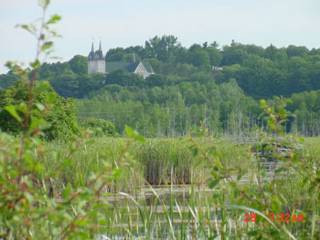 Crying out for a canoe to explore
(Probably, I am the one crying for a canoe. Hey, anyone in Korea have a used canoe or even an old windsurfer board and kayak paddle for sale?)
Above is a wetland maintained for education purposes. My mom is a volunteer here. This the Wye Marsh in Midland, Ontario, Canada. The photo is from their site.
Although I don't care for mosquitoes ( or blackflies, deerflies, horseflies,..), paddling in a wetland was always exciting to me. The narrow, winding routes are mazelike, mysterious. Who knows what is around the corner? Turtles, pike sunning themselves, birds aplenty, and such a variety of other animals that, after more than four years without a canoe trip, I can hardly imagine anymore.
Sure, hiking in Korea is fine, pleasant, good exercise even. And I have seen a deer while hiking, probably an escapee from an antler farm. Canoeing through a Canadian wetl..ah heck, swamp, just has more to be seen, more rewards for exploring.
I hope Korea finds a way to preserve some real wetlands ( not pesticide-filled irrigation ponds) but this really seems to be something they should have thought about before starting an ambitious airport project. Arguing about it only 2 or 3 years after completion could give the impression that Koreans don't plan ahead well.
The Joongang Daily has an article about attempts to preserve wetlands in Incheon. The wetlands are located on two islands: Silmi, of movie fame, and Yeongjong, which also includes the International Airport. I am all for protecting wetlands and consider myself an environmentalist but I think the airport has an valid argument here.
Airport authorities said that the islands, if left undeveloped,
would attract migratory birds and present a hazard to
operations at the airport nearby."No foreign airliners will
use Incheon International Airport after they hear that the
airport is near a natural preserve that is densely packed
with birds," an official said.
Birds and airports are a very bad mix. I am more troubled by the official's statement, "No foreign airlines...". Would Korean Air and Asiana continue to use the airport? Hmmm, where can I get to from Kimhae?
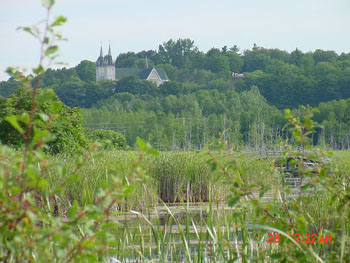 Crying out for a canoe to explore
(Probably, I am the one crying for a canoe. Hey, anyone in Korea have a used canoe or even an old windsurfer board and kayak paddle for sale?)
Above is a wetland maintained for education purposes. My mom is a volunteer here. This the Wye Marsh in Midland, Ontario, Canada. The photo is from their site.
Although I don't care for mosquitoes ( or blackflies, deerflies, horseflies,..), paddling in a wetland was always exciting to me. The narrow, winding routes are mazelike, mysterious. Who knows what is around the corner? Turtles, pike sunning themselves, birds aplenty, and such a variety of other animals that, after more than four years without a canoe trip, I can hardly imagine anymore.
Sure, hiking in Korea is fine, pleasant, good exercise even. And I have seen a deer while hiking, probably an escapee from an antler farm. Canoeing through a Canadian wetl..ah heck, swamp, just has more to be seen, more rewards for exploring.
I hope Korea finds a way to preserve some real wetlands ( not pesticide-filled irrigation ponds) but this really seems to be something they should have thought about before starting an ambitious airport project. Arguing about it only 2 or 3 years after completion could give the impression that Koreans don't plan ahead well.
Documentary on NK Defectors
The Marmot, or a guest blogger, has a post about a documentary discussing the lives of North Korean defectors living in South Korea. The show is on KBS2 at 11pm tomorrow night (Wed the 13th). It will be in Korean but I will probably try to follow what's going on. What was interesting about the post was the quotes from defectors living in South Korea.
“Having risked their lives to escape their north, what are their dreams of South Korea?”
Eon Pil-suk (not her real name/defector) “Did we suffer like this to come to South Korea, only to be treated like this? Who can settle in with this kind of alienation and ostracism?”
” Defectors who have fallen into crime! Where does it all end?!”
This matches the early October report in the Joongang daily with the title '3 of 4 defectors here on welfare'. The article also mentions a surveys finding that 'just over two-thirds of North Korean defectors here said it was difficult to adjust to the competition inherent in South Korean society. '
I expect that all ex-pats in Korea follow this news with at least mild interest. My interest perked up with the daring entry in the Canadian Embassy in Beijing by 44 North Koreans. I've been keeping up with the news as best i can but have found no developments more than three days after the event. This is my first time following this kind of story so I wonder how it suddenly disappeared from the media.
“Having risked their lives to escape their north, what are their dreams of South Korea?”
Eon Pil-suk (not her real name/defector) “Did we suffer like this to come to South Korea, only to be treated like this? Who can settle in with this kind of alienation and ostracism?”
” Defectors who have fallen into crime! Where does it all end?!”
This matches the early October report in the Joongang daily with the title '3 of 4 defectors here on welfare'. The article also mentions a surveys finding that 'just over two-thirds of North Korean defectors here said it was difficult to adjust to the competition inherent in South Korean society. '
I expect that all ex-pats in Korea follow this news with at least mild interest. My interest perked up with the daring entry in the Canadian Embassy in Beijing by 44 North Koreans. I've been keeping up with the news as best i can but have found no developments more than three days after the event. This is my first time following this kind of story so I wonder how it suddenly disappeared from the media.
Sunday, October 10, 2004
New trail opens in Seoraksan
It's been a slow week for me. I had big plans to do a hike in Seoraksan but just felt too lazy. Here is the hike I would have done. From the Jungang Ilbo:
The western part of the highest peak, Daecheong, which stands
1,708 meters above sea level, is called "inner Seorak;" the other
side, closest to the ocean is called "outer Seorak." For the first
time in 20 years, hiking trails through the Heulim valley, which
is hidden between the rocky walls of Mount Manmulsang (A
Thousand Rock Shapes) and Chilhyeongje peak, will soon be
open to the public after having been closed for conservation
purposes. Lee Jong-seung, a 61-year-old hiker, guided our
group of reporters to the as-yet-inaccessible valley.
Park officials expect the valley to be open to the public in
time for the Chuseok holiday, which begins Sept. 27. Until
then, any attempt to navigate the passage without an
experienced guide would be difficult. In other words, don't
do what we did.
From a rest area in Hangye-ryeong, a two-kilometer
(1.2 miles) drive toward Yangyang on Highway 44 leads
our group to an abandoned parking lot. Two hundred
meters from here is a sign that reads, "No longer used
as climbing routes." This is where Heulim valley begins.
This Friday (I have the day off), I will try to get there. There is no bus stopping at Heulim Valley, so I think I have to go to Hangyeryoung and walk down the road for two kilometres.
 Me with the fastest hiker I know.
I hike pretty frequently in the cooler weather in Korea. In Canada, I hiked perhaps 10 times but went canoeing nearly every ice-free day. I'll be canoeing this December if I go home.
I hike, as most foreigners do, to enjoy the quiet and the scenery. We typically dress lightly and walk quickly. In Canada, I also hike to enjoy the wildlife, but I've seen enough chipmunks so there's not much in Korea to excite me. Most Koreans tend to hike to enjoy each others company and so dress warmly and walk slowly.
Having passed many Koreans on the trail -and if you've been to Seorak, you can understand that 'many' means 'a whole frickin lot' - I thought I was a pretty fast hiker. The man in the picture walked me into the ground. We traveled from O-saek to Biseon-dae in about 7 hours (about 16 km) and I actually ran a few times to catch up.
Anyway, look for a report on the trail next Saturday.
The western part of the highest peak, Daecheong, which stands
1,708 meters above sea level, is called "inner Seorak;" the other
side, closest to the ocean is called "outer Seorak." For the first
time in 20 years, hiking trails through the Heulim valley, which
is hidden between the rocky walls of Mount Manmulsang (A
Thousand Rock Shapes) and Chilhyeongje peak, will soon be
open to the public after having been closed for conservation
purposes. Lee Jong-seung, a 61-year-old hiker, guided our
group of reporters to the as-yet-inaccessible valley.
Park officials expect the valley to be open to the public in
time for the Chuseok holiday, which begins Sept. 27. Until
then, any attempt to navigate the passage without an
experienced guide would be difficult. In other words, don't
do what we did.
From a rest area in Hangye-ryeong, a two-kilometer
(1.2 miles) drive toward Yangyang on Highway 44 leads
our group to an abandoned parking lot. Two hundred
meters from here is a sign that reads, "No longer used
as climbing routes." This is where Heulim valley begins.
This Friday (I have the day off), I will try to get there. There is no bus stopping at Heulim Valley, so I think I have to go to Hangyeryoung and walk down the road for two kilometres.
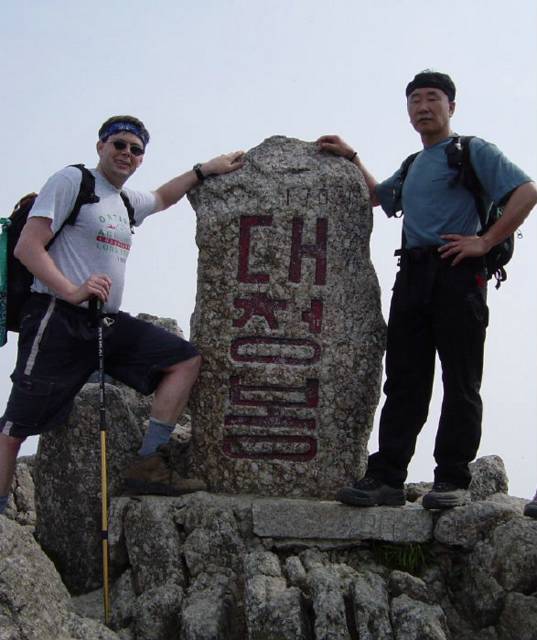 Me with the fastest hiker I know.
I hike pretty frequently in the cooler weather in Korea. In Canada, I hiked perhaps 10 times but went canoeing nearly every ice-free day. I'll be canoeing this December if I go home.
I hike, as most foreigners do, to enjoy the quiet and the scenery. We typically dress lightly and walk quickly. In Canada, I also hike to enjoy the wildlife, but I've seen enough chipmunks so there's not much in Korea to excite me. Most Koreans tend to hike to enjoy each others company and so dress warmly and walk slowly.
Having passed many Koreans on the trail -and if you've been to Seorak, you can understand that 'many' means 'a whole frickin lot' - I thought I was a pretty fast hiker. The man in the picture walked me into the ground. We traveled from O-saek to Biseon-dae in about 7 hours (about 16 km) and I actually ran a few times to catch up.
Anyway, look for a report on the trail next Saturday.
Tuesday, October 05, 2004
Fall colors at higher elevations
This picture is from the Joongang Ilbo. It's from somewhere in Seorak National Park.
 autumn on Seorak Mountain
Here, at sea level, there is still only green.
Oh, another important thing to see here is the number of people. I will start hiking again now that it is cool enough, but I will only go on weekdays. If you are lucky enough to have a weekday off, I recommend it. A friend described Seoraksan in the fall on a weekend at 'crowded as the Jongno subway transfer station' with everyone walking in step.
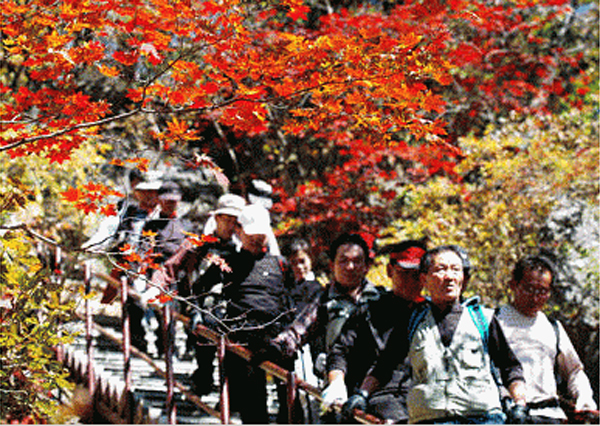 autumn on Seorak Mountain
Here, at sea level, there is still only green.
Oh, another important thing to see here is the number of people. I will start hiking again now that it is cool enough, but I will only go on weekdays. If you are lucky enough to have a weekday off, I recommend it. A friend described Seoraksan in the fall on a weekend at 'crowded as the Jongno subway transfer station' with everyone walking in step.
Utilities officials lie in other countries, too!
I came across this article while looking at MSNBC. It reminded me to be a little less judgmental. I was surprised to see this problem in the US but wouldn't have noticed it here in Korea.
Lead levels misrepresented in U.S. cities
Cities across the country are manipulating the results of
tests used to detect lead in water, violating federal law
and putting millions of Americans at risk of drinking
more of the contaminant than their suppliers are reporting.
Some cities, including Philadelphia and Boston, have thrown
out tests that show high readings or have avoided testing
homes most likely to have lead, records show. In New York
City, the nation's largest water provider has for the past three
years assured its 9.3 million customers that its water was safe
because the lead content fell below federal limits. But the city
has withheld from regulators hundreds of test results that would
have raised lead levels above the safety standard in two of those
years, according to records.
We have our own water problems in Canada. A few years ago in Walkerton:
Seven people died from drinking contaminated water.
Hundreds suffered from the symptoms of the disease, not
knowing if they too would die.
According to the local medical officer of health, it all could
have been prevented. Dr. Murray McQuigge stunned the
country with his revelation on CBC Radio on May 25, 200
that the Walkerton Public Utilities Commission knew there
was a problem with the water several days before they told the public.
This is what we expect here in Korea. An online travel guide to Korea warns us that:
Much of the water that is supplied comes from the Han River,
the massive waterway that separates Seoul into two. This River
is supposedly clean enough to swim in, and that is debatable,
but it's certainly not clean enough to drink. Of course it is treated
chemically, but it is better to side with caution on this one as who
knows if those chemicals are even legal in the US.
Here the US is considered a safe place with reasonable health guidelines and we can now see that may not be the case.
I just need to think about these things once in a while to avoid becoming an IA clone. Korea has problems but they aren't alone.
Lead levels misrepresented in U.S. cities
Cities across the country are manipulating the results of
tests used to detect lead in water, violating federal law
and putting millions of Americans at risk of drinking
more of the contaminant than their suppliers are reporting.
Some cities, including Philadelphia and Boston, have thrown
out tests that show high readings or have avoided testing
homes most likely to have lead, records show. In New York
City, the nation's largest water provider has for the past three
years assured its 9.3 million customers that its water was safe
because the lead content fell below federal limits. But the city
has withheld from regulators hundreds of test results that would
have raised lead levels above the safety standard in two of those
years, according to records.
We have our own water problems in Canada. A few years ago in Walkerton:
Seven people died from drinking contaminated water.
Hundreds suffered from the symptoms of the disease, not
knowing if they too would die.
According to the local medical officer of health, it all could
have been prevented. Dr. Murray McQuigge stunned the
country with his revelation on CBC Radio on May 25, 200
that the Walkerton Public Utilities Commission knew there
was a problem with the water several days before they told the public.
This is what we expect here in Korea. An online travel guide to Korea warns us that:
Much of the water that is supplied comes from the Han River,
the massive waterway that separates Seoul into two. This River
is supposedly clean enough to swim in, and that is debatable,
but it's certainly not clean enough to drink. Of course it is treated
chemically, but it is better to side with caution on this one as who
knows if those chemicals are even legal in the US.
Here the US is considered a safe place with reasonable health guidelines and we can now see that may not be the case.
I just need to think about these things once in a while to avoid becoming an IA clone. Korea has problems but they aren't alone.
Thursday, September 30, 2004
North Koreans at the Canadian Embassy in Beijing
Big news last night about the daring entry into the Canadian Embassy in Beijing of 44 North Korean defectors. Being Canadian, I just hope our officials don't screw the situation up. Reports from The Marmot and another blogger named myrick suggest they may though.
With a title like: Custody of N.K. Defectors Under Discussion in Beijing in the Chosun Ilbo, I am already worried.
This picture from the Ilbo shows that it was a pretty daring break-in. I wish them all the best.
 North Koreans scaling the wall of the Canadian Embassy in Beijing
With a title like: Custody of N.K. Defectors Under Discussion in Beijing in the Chosun Ilbo, I am already worried.
This picture from the Ilbo shows that it was a pretty daring break-in. I wish them all the best.
 North Koreans scaling the wall of the Canadian Embassy in Beijing
Problems for small businesses
Chuseok is normally an important time for Korean businesses, much as Christmas is important for North American businesses. This Chuseok was a bad time for Korean small businesses and there has been much in the papers about small businesses defaulting on their loans. The papers, and local wisdom hold that the poor economy is what's harming the businesses.
I have a different explanation, but I cannot back it up with articles or examples. I, and any foreigner who spends a few months here, will see new businesses appear and disappear regularly. I do not understand exactly what a 'feasibility study' is, but I would take the effort to find out and perform one before starting a business of my own. Koreans seem to test by doing; starting a business without any real consideration of demand or location or other vendors of the same product or service nearby.
Another problem seems to be trying the make a place seem successful. Here is the president's office of an English school I worked at that went bankrupt after a few months. No, I am not the president, I just wanted to pose.
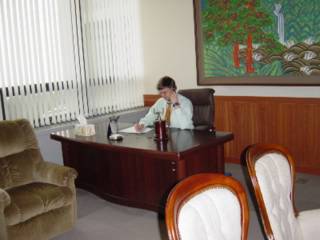 Posing in the president's office.
This seems pretty luxurious for a company that couldn't pay rent!
Foreclose on the businesses or not, what they really need is some sense and education about how to actually run a business.
I have a different explanation, but I cannot back it up with articles or examples. I, and any foreigner who spends a few months here, will see new businesses appear and disappear regularly. I do not understand exactly what a 'feasibility study' is, but I would take the effort to find out and perform one before starting a business of my own. Koreans seem to test by doing; starting a business without any real consideration of demand or location or other vendors of the same product or service nearby.
Another problem seems to be trying the make a place seem successful. Here is the president's office of an English school I worked at that went bankrupt after a few months. No, I am not the president, I just wanted to pose.
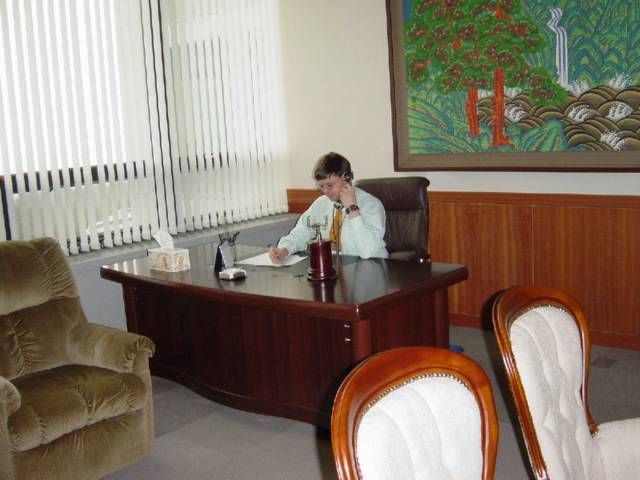 Posing in the president's office.
This seems pretty luxurious for a company that couldn't pay rent!
Foreclose on the businesses or not, what they really need is some sense and education about how to actually run a business.
Wednesday, September 29, 2004
Local festivals
I would always get frustrated with the Korea Herald for announcing festivals or special tourism events only a day before the event started. Here I am now, doing the same.
This Friday, the Songi Mushroom Festival starts, here in Yangyang. Songi, or Pine, mushrooms are a phallic-shaped delicacy in Korea and Yangyang's have been scientifically tested and shown to be the best. Okay, I don't know what that 'scientifically tested' bit means, but that's what locals tell me.
The best quality mushrooms can cost 250,000 won a kilo (I guess that's $100.00US a pound). The lower quality mushrooms are, well, mushroom shaped, with a large umbrella. As the quality, or possibly the age, increases, the umbrella shrinks and they become more phallic. Visitors to the District office might be surprised to see what first appears to be a giant gold penis in a glass display case, but it is only a mushroom.
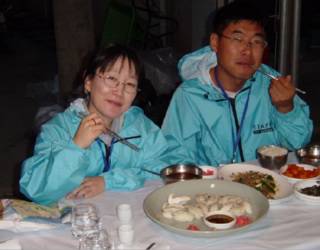 Yangyang tourism staff enjoying Songi Mushrooms
The festival runs Oct. 1 to 5 and I found the highlight last year was being taken up a nearby mountain to 'hunt' for Songi mushrooms. Actually, it was more of an Easter Egg hunt, as the mushrooms had been placed there earlier. We were told that the mushroom were in the right kind of locations, in the downslope shadow of a pine tree. You have to register for the hunt but foreigners can probably jump the queue a bit.
I have to admit that the Songi hunt was a nice time outside but I wouldn't have come to Yangyang just for the festival. If you are planning to come anyway, you know, visit Seorak Mountain and such, a few hours at the festival wouldn't be misspent.
_ _ _ _ _
Now some festival news in good enough time that you can make plans to arrive.
The Yangyang Salmon Festival is October 23-24 this year.
Now, I don't understand why salmon in Alaska and Western Canada run in the spring and summer but Korean salmon run in late fall; but they do and the festival is a fun one.
--I guess Great Lakes Salmon run in the fall, too. Anyway, ...
You can eat salmon until you are sick, if that for some reason interests you. It's good, cheap and plentiful. The best part of the weekend, though, is catching the salmon by hand.
I think that all my aunts back home are involved with the Humane Society and similar animal rights organizations. I also believe in animal rights, but chasing after salmon in a shallow stretch of river enclosed by nets on a warm fall day is a lot of fun, a real guilty pleasure that I hope my aunts forgive me for.
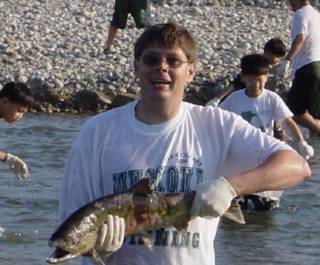 Catching salmon
I was tempted to catch the salmon and throw them over the net to freedom but but didn't think they'd get very far. The river is even more of a gauntlet than in the past. I think the salmon hatchery and research centre near the mouth of the river has a net across and 80 or 90% are stopped there and collected (the centre has tours and information on salmon biology, last year with English-speaking guides). Then come the fishermen who don't use lures and bait but huge treble hooks and a strong rod to snag the fish. The worst are the ones who stand on the bridge and watch the salmon in the clear water, snag them and reel them up to the bridge, most breaking free to fall, gutted, back into the river. The salmon I caught was actually caught elsewhere and delivered by truck to the festival site.
Still, a friend who is quite a purist when it comes to fishing and does use lures and such, caught a few a km upstream of town.
I hope I haven't painted too grim a picture. I really do recommend coming for this festival.
_ _ _ _ _
Yangyang has a traditional 'O-Il Jang', a fifth day market. Every calendar day with a '4' or a '9' is market day. I always wake up early for market day -because the damn cattle auction takes places from five to seven AM right beside my apartment. There is a lot of produce and such and some antique-y things or crafts for sale as well. During the festivals, there are a few dozen extra vendors.
Yangyang Gun (district, not weapon) has an English website but the dates are from last year.
An English speaker working for Yangyang Gun tourism gave me some information about the salmon festival at 033-670-2516.
This Friday, the Songi Mushroom Festival starts, here in Yangyang. Songi, or Pine, mushrooms are a phallic-shaped delicacy in Korea and Yangyang's have been scientifically tested and shown to be the best. Okay, I don't know what that 'scientifically tested' bit means, but that's what locals tell me.
The best quality mushrooms can cost 250,000 won a kilo (I guess that's $100.00US a pound). The lower quality mushrooms are, well, mushroom shaped, with a large umbrella. As the quality, or possibly the age, increases, the umbrella shrinks and they become more phallic. Visitors to the District office might be surprised to see what first appears to be a giant gold penis in a glass display case, but it is only a mushroom.
 Yangyang tourism staff enjoying Songi Mushrooms
The festival runs Oct. 1 to 5 and I found the highlight last year was being taken up a nearby mountain to 'hunt' for Songi mushrooms. Actually, it was more of an Easter Egg hunt, as the mushrooms had been placed there earlier. We were told that the mushroom were in the right kind of locations, in the downslope shadow of a pine tree. You have to register for the hunt but foreigners can probably jump the queue a bit.
I have to admit that the Songi hunt was a nice time outside but I wouldn't have come to Yangyang just for the festival. If you are planning to come anyway, you know, visit Seorak Mountain and such, a few hours at the festival wouldn't be misspent.
_ _ _ _ _
Now some festival news in good enough time that you can make plans to arrive.
The Yangyang Salmon Festival is October 23-24 this year.
Now, I don't understand why salmon in Alaska and Western Canada run in the spring and summer but Korean salmon run in late fall; but they do and the festival is a fun one.
--I guess Great Lakes Salmon run in the fall, too. Anyway, ...
You can eat salmon until you are sick, if that for some reason interests you. It's good, cheap and plentiful. The best part of the weekend, though, is catching the salmon by hand.
I think that all my aunts back home are involved with the Humane Society and similar animal rights organizations. I also believe in animal rights, but chasing after salmon in a shallow stretch of river enclosed by nets on a warm fall day is a lot of fun, a real guilty pleasure that I hope my aunts forgive me for.
 Catching salmon
I was tempted to catch the salmon and throw them over the net to freedom but but didn't think they'd get very far. The river is even more of a gauntlet than in the past. I think the salmon hatchery and research centre near the mouth of the river has a net across and 80 or 90% are stopped there and collected (the centre has tours and information on salmon biology, last year with English-speaking guides). Then come the fishermen who don't use lures and bait but huge treble hooks and a strong rod to snag the fish. The worst are the ones who stand on the bridge and watch the salmon in the clear water, snag them and reel them up to the bridge, most breaking free to fall, gutted, back into the river. The salmon I caught was actually caught elsewhere and delivered by truck to the festival site.
Still, a friend who is quite a purist when it comes to fishing and does use lures and such, caught a few a km upstream of town.
I hope I haven't painted too grim a picture. I really do recommend coming for this festival.
_ _ _ _ _
Yangyang has a traditional 'O-Il Jang', a fifth day market. Every calendar day with a '4' or a '9' is market day. I always wake up early for market day -because the damn cattle auction takes places from five to seven AM right beside my apartment. There is a lot of produce and such and some antique-y things or crafts for sale as well. During the festivals, there are a few dozen extra vendors.
Yangyang Gun (district, not weapon) has an English website but the dates are from last year.
An English speaker working for Yangyang Gun tourism gave me some information about the salmon festival at 033-670-2516.
Tuesday, September 28, 2004
How to be a farmer: a checklist
My Chuseok was a good time but a pretty busy one. I spent two 4-5 hour days picking Chinese cabbage and three days sneezing from the farm dust.
I learned a little about farming and here is a checklist for farming in Korea.
1) Get a Kyong-ung-gi and a funny hat.
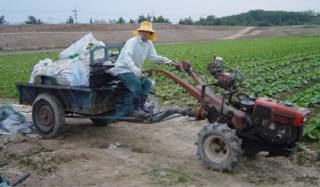 Kyeong-ung-gi
These two-wheeled tractors can do anything you need on the farm. You can pull various plows and trailers, pump water and, well, that's all but it's a lot for a little tractor. If you don't have an appropriately funny hat, you can use a normal hat and wrap it with a towel - a whole new meaning to my late father's non-pc term, 'Towel-head'.
2) Use the tractor to carry pesticide, a tractor sized load of pesticide.
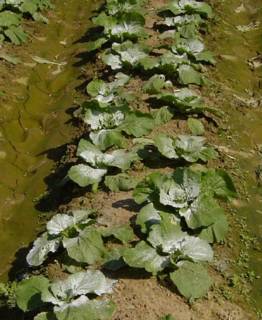 pesticide, not frosting!
I'm not sure if this is my in-laws' cabbage plot or not but I've seen him use similar amounts elsewhere. This is why Korean wash and peel all fruit and vegetables.
3) Use clear or black plastic or vinyl for everything you can think of. You can make temporary green houses and also cover the garden rows in the spring. The black plastic keeps the earth warm and prevents weeds from getting sunlight. When you are done, pick up what you can but if you miss some, or a lot, leave it. Let nature take care of it.
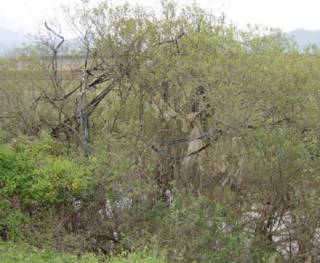 garbage in trees
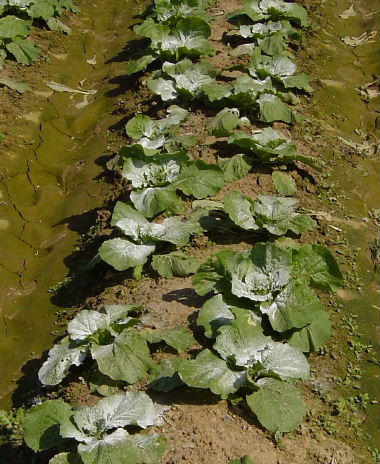
4) Despite my being a smartass, farming is tough work. Some time ago (I have no idea how long it takes cabbage to grow and we were picking young cabbage), the in-laws planted several rows of cabbage, and each position in the row had a few cabbage plants growing. I helped pick some of the cabbage, leaving one plant in each position. I spent two days of 4 to 5 hours picking until my back ached. Then I squatted and picked more until my legs hurt, repeating this until I began to whine to my wife who was in equal pain but is a little tougher than I. Here is some of the field:
 big-ass cabbage field
5) If all else fails, do as I suggested in a previous post about rice and sell the land so a factory can be built.
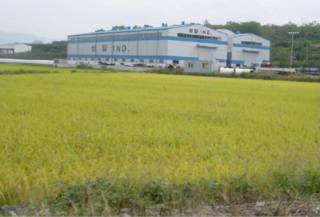 building on rice fields
The fields in this part of Kyeongsangnam-do are now almost completely surrounded by these factories. Every time I visit, I see a few more, and this time, I saw several that were repaired from last Chuseok's Typhoon Mae-mi.
I learned a little about farming and here is a checklist for farming in Korea.
1) Get a Kyong-ung-gi and a funny hat.
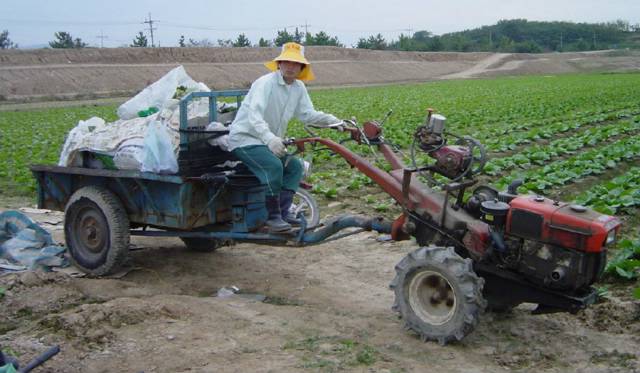 Kyeong-ung-gi
These two-wheeled tractors can do anything you need on the farm. You can pull various plows and trailers, pump water and, well, that's all but it's a lot for a little tractor. If you don't have an appropriately funny hat, you can use a normal hat and wrap it with a towel - a whole new meaning to my late father's non-pc term, 'Towel-head'.
2) Use the tractor to carry pesticide, a tractor sized load of pesticide.
 pesticide, not frosting!
I'm not sure if this is my in-laws' cabbage plot or not but I've seen him use similar amounts elsewhere. This is why Korean wash and peel all fruit and vegetables.
3) Use clear or black plastic or vinyl for everything you can think of. You can make temporary green houses and also cover the garden rows in the spring. The black plastic keeps the earth warm and prevents weeds from getting sunlight. When you are done, pick up what you can but if you miss some, or a lot, leave it. Let nature take care of it.
 garbage in trees
4) Despite my being a smartass, farming is tough work. Some time ago (I have no idea how long it takes cabbage to grow and we were picking young cabbage), the in-laws planted several rows of cabbage, and each position in the row had a few cabbage plants growing. I helped pick some of the cabbage, leaving one plant in each position. I spent two days of 4 to 5 hours picking until my back ached. Then I squatted and picked more until my legs hurt, repeating this until I began to whine to my wife who was in equal pain but is a little tougher than I. Here is some of the field:
 big-ass cabbage field
5) If all else fails, do as I suggested in a previous post about rice and sell the land so a factory can be built.
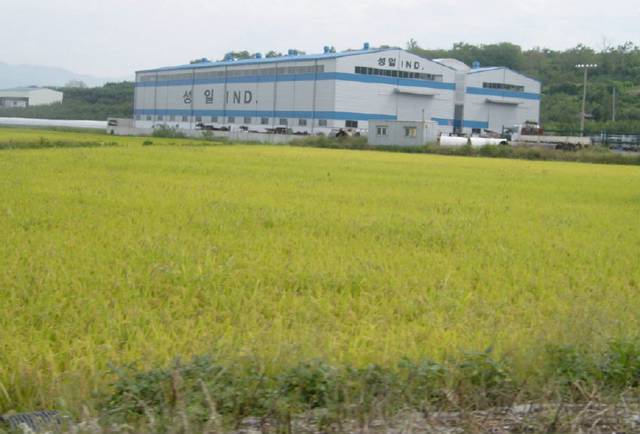 building on rice fields
The fields in this part of Kyeongsangnam-do are now almost completely surrounded by these factories. Every time I visit, I see a few more, and this time, I saw several that were repaired from last Chuseok's Typhoon Mae-mi.
Their grandfather's grave
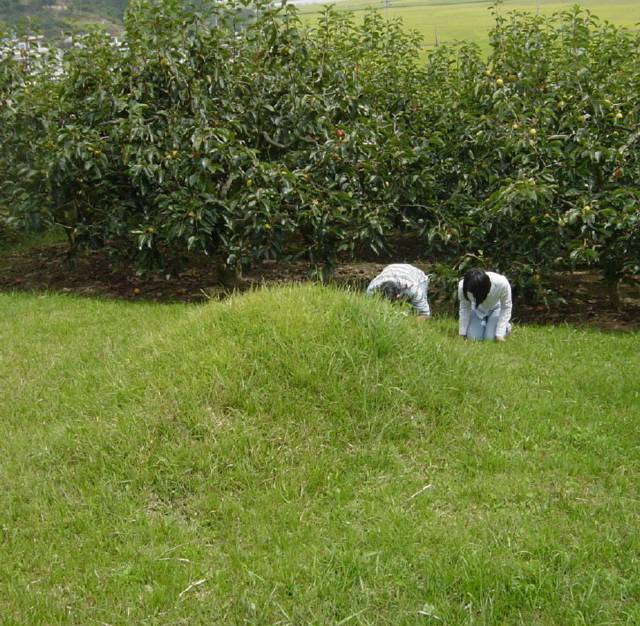 Grandfather's grave
In a previous post, I wrote about the scarcity of grave sites in Korea and promised further investigation if I didn't think my in-laws would find the questions too ghoulish.
Well, I found it too ghoulish. I joined in with the bowing and tried to be respectful but, I'm sorry, it didn't mean much to me. While bowing at my grandfather-in-laws' grave, my brother-in-law spent a little more time than needed to merely follow the forms. I felt it meant something to him so I didn't press with questions.
Anyway, this is my in-laws' farm and there are a few graves of their ancestors there. They have plenty of room among the persimmon. The grandfather and 'mother on the other side were cremated and are kept in a local temple.
While getting a ride to the airport, we passed a huge traffic jam in only one lane; the lane to a cemetery so they do have them in Kyeongsangnam-do, which I questioned earlier.
Finally, in looking at news reports about Chuseok, I found most newspapers used the term 'tomb' while I prefer 'grave'. I always thought tomb referred to a larger or fancier place than grave did.
Chuseok
Here's wishing you a Happy Chuseok, unless Chuseok shouldn't be considered 'happy'. Then, a Solemn Chuseok to you. Whatever, maybe the proper descriptive should be 'frustrating' or 'exhausting'.
From the Korea Herald:
For many others, and especially housewives, the Chuseok
holiday is an unwelcome return of stress - time-consuming
journeys to visit parents and relatives as well as preparing
food for ancestral rites.
"I'm still undecided whether I should go to see my
parents-in-law living in Mokpo, South Jeolla Province,"
said Seoul housewife Yoo Sun-ock. "It's usually a five-hour
trip from Seoul to Mokpo, but during the holiday season it
will take as many as 14 hours because of traffic jams. Even
thinking of fighting the mass traffic irritates me so much."
I had a similar distance to travel but flew as the two airports involved are close enough to my home and my in-laws' home to make it feel like door-to-door.
From the Korea Herald:
For many others, and especially housewives, the Chuseok
holiday is an unwelcome return of stress - time-consuming
journeys to visit parents and relatives as well as preparing
food for ancestral rites.
"I'm still undecided whether I should go to see my
parents-in-law living in Mokpo, South Jeolla Province,"
said Seoul housewife Yoo Sun-ock. "It's usually a five-hour
trip from Seoul to Mokpo, but during the holiday season it
will take as many as 14 hours because of traffic jams. Even
thinking of fighting the mass traffic irritates me so much."
I had a similar distance to travel but flew as the two airports involved are close enough to my home and my in-laws' home to make it feel like door-to-door.
Thursday, September 23, 2004

Finally a Korean News Source discussing 'Fan Death' as a myth
UPDATE: Welcome to wikipedia users. I'm not sure why you were sent here but you are in luck: The wikipedia article on Fan Death also quotes Dr Yeon dong-su, a professor at my university (really, I didn't write the wikipedia article). I recorded an interview with him in Sept of 2006 and you can find it here.
Most foreigners in Korea eventually learn about 'fan death'. Koreans will straight-facedly explain that using a fan at night in a closed room could kill you. They give two possible reasons; hypothermia and lack of oxygen. There have apparently been TV shows with doctors scientifically describing how it happens.
Strangely, it only happens here.
From the article in the Joongang Ilbo:
Another stiflingly hot summer has come and gone
in Korea, and with it, the risk of dying by electric fan.
If you've never heard of death by electric fan, you're
probably not from here. Every summer, mainstream
Korean newspapers carry reports of people dying after
sleeping in a room with the electric fan on and the doors
and windows closed. A search of the jouncing Ilbo's archives
reveals stories about fan death dating back to the early 1970s.
A July 9, 1973, story describes how a 20-year-old man was
found dead in the morning after going to sleep with two fans
turned on and the rooms windows and door shut. The story
also describes a mysterious jar of chemicals found in the room
but does not explain what it was. A wider search of Korean
newspapers shows that each summer from 1990 to 2004,
about 10 stories related to someone dying in the presence
of an electric fan were published. Some of the deaths were
chalked up to electrical failure of the fan and related fires,
but many of them said the victims died from suffocation
or hypothermia because the windows and doors were closed.
Further in the article, a man from the land of cold, in what may be the coldest city in the world was quoted:
Gord Giesbrecht, a physical education professor at the
University of Manitoba in Canada, is a leading expert on
hypothermia. He said he has never heard of fan death or
anything like it. "It's hard to imagine, because to die of
hypothermia, [one's body temperature] would have to
get down to 28, drop by 10 degrees overnight. We've got
people lying in snowbanks overnight here in Winnipeg
and they survive," he said.
There was another article at an online newspaper called 'ulsanpear' and listed as www.ulsanpear.biz but the link isn't working for me now.
Most foreigners in Korea eventually learn about 'fan death'. Koreans will straight-facedly explain that using a fan at night in a closed room could kill you. They give two possible reasons; hypothermia and lack of oxygen. There have apparently been TV shows with doctors scientifically describing how it happens.
Strangely, it only happens here.
From the article in the Joongang Ilbo:
Another stiflingly hot summer has come and gone
in Korea, and with it, the risk of dying by electric fan.
If you've never heard of death by electric fan, you're
probably not from here. Every summer, mainstream
Korean newspapers carry reports of people dying after
sleeping in a room with the electric fan on and the doors
and windows closed. A search of the jouncing Ilbo's archives
reveals stories about fan death dating back to the early 1970s.
A July 9, 1973, story describes how a 20-year-old man was
found dead in the morning after going to sleep with two fans
turned on and the rooms windows and door shut. The story
also describes a mysterious jar of chemicals found in the room
but does not explain what it was. A wider search of Korean
newspapers shows that each summer from 1990 to 2004,
about 10 stories related to someone dying in the presence
of an electric fan were published. Some of the deaths were
chalked up to electrical failure of the fan and related fires,
but many of them said the victims died from suffocation
or hypothermia because the windows and doors were closed.
Further in the article, a man from the land of cold, in what may be the coldest city in the world was quoted:
Gord Giesbrecht, a physical education professor at the
University of Manitoba in Canada, is a leading expert on
hypothermia. He said he has never heard of fan death or
anything like it. "It's hard to imagine, because to die of
hypothermia, [one's body temperature] would have to
get down to 28, drop by 10 degrees overnight. We've got
people lying in snowbanks overnight here in Winnipeg
and they survive," he said.
There was another article at an online newspaper called 'ulsanpear' and listed as www.ulsanpear.biz but the link isn't working for me now.
Subscribe to:
Posts (Atom)


 Posts
Posts


