
A few weeks ago, I interviewed a coworker, Marcus, regarding his reasons for choosing to take Korean citizenship.
Today, I interviewed another coworker who has also chosen to be Korean. Tammy has been here for almost thirty years and has been Korean for about twenty years. Although Marcus' decision was based on logic, Tammy's was based more on emotion. She simply feels at home here.
This is my third podcast and I find recording them interesting. Odeo offers a great service but for each of the three recordings, the first time through didn't save properly and I had to do the interviews a second time. Such repetition might have made my delivery smoother but I also find that I reference the previous (and erased) podcast in the current one. I hope this isn't too distracting.
I am satisfied with the interview but I found myself at least once concentrating on the mechanics of recording (volume level, elapsed time,...) too much and giving a sort of meaningless grunt when she stopped talking. Interviewing people requires real skills!
You can download the mp3 here.
Or, listen to it below.
powered by ODEO
Thursday, May 25, 2006


Monday, May 22, 2006
Korean as a second language podcast
Intro: This is the first of who-knows-how-many podcasts about learning Korean. At this point, I can't say that much about what future podcasts will cover but I expect they will include a sample conversation, possibly a vocabulary list, and a pronunciation guide. Naturally, the pronuncation segment will cover problems I know I have; there are likely to other problems I am unaware of. The first few 'casts will be a review of lessons a have already completed - I don't want to sound too terrible right away.
My expectation for these casts is that listeners review the shownotes while listening the first (or first few)time(s). Then, they will be able to listen again for review purposes anywhere. That's if all goes well. A more modest or reasonable expectation is that listeners will turn off and delete the podcast a minute after the intro.
After a few 'casts, I will reorder the 'casts each time a new one is made. In other words, if a future cast seems simpler in content than this one, it will be listed first.
I have some desire and even a need to learn Korean but a limited motivation. I own several Korean Language books and have completed a few units of each. The first few 'casts, including this one, will be based on a unit from one of these books. Today's cast is based on lesson 12 from 'Korean through English, book one' from Seoul National University. The title of the lesson is, "where are you going?" I will not repeat the complete unit here and I will only use one or possibly two units from any one book so I don't think I am running afoul of copyright infringement. If anything, perhaps I will encourage you to buy the book.
With me today is a student of mine, Bak Ji-min. She will read the conversation, we will repeat it and then work on alternatives. Then she will help me with the pronunciation. Today's pronunciation exercise involves pronouncing and recognizing some Korean vowel sounds. The modern transliteration of hangeul to english would spell these vowels as "a", "eo" and "eu". The closest English comparison would be "a" as in 'bat, 'o' as in dot and 'u' as in but. Again, the Korean sounds are not exact matches with the English letters they are represented by. For example, Koreans spell the english word "cop" - police officer - an 'a'.
In my translation of the conversation, I left out the subject a few times as Koreans typically don't use the subject if it is already clear.
If you do choose to listen more than once, the Korean starts at around 3:20
A: 어디가세요? --Where are you going?
B: 학교에 가요. --going to school.
Alternatives:힉원, 운동장
A: 수업이 있어요? --Do you have a class?
B: 네, 수업이 있어요. --Yes, I have a class.
A: 몇 시에 시작해요? --When does your class start?
B: 열시에 시작해요. --Starts at 10.
A: 벌써 아홉시 반이에요. -- It's already 9:30.
빨리 가세요. -- Should hurry
a.................... eo............................ eu
'아' .................'어'............................'으'
감........................검......................................금
Persimmon.......sword................................gold
사.......................서
temple suffix...west
차........................처
Tea....................Wife
가........................거......................................그
Go.......................'big' -Chinese...................He
상........................성......................................승
'Leaf' -Chinese...Castle..............................Buddhist monk
powered by ODEO
Find the MP3 here.
My expectation for these casts is that listeners review the shownotes while listening the first (or first few)time(s). Then, they will be able to listen again for review purposes anywhere. That's if all goes well. A more modest or reasonable expectation is that listeners will turn off and delete the podcast a minute after the intro.
After a few 'casts, I will reorder the 'casts each time a new one is made. In other words, if a future cast seems simpler in content than this one, it will be listed first.
I have some desire and even a need to learn Korean but a limited motivation. I own several Korean Language books and have completed a few units of each. The first few 'casts, including this one, will be based on a unit from one of these books. Today's cast is based on lesson 12 from 'Korean through English, book one' from Seoul National University. The title of the lesson is, "where are you going?" I will not repeat the complete unit here and I will only use one or possibly two units from any one book so I don't think I am running afoul of copyright infringement. If anything, perhaps I will encourage you to buy the book.
With me today is a student of mine, Bak Ji-min. She will read the conversation, we will repeat it and then work on alternatives. Then she will help me with the pronunciation. Today's pronunciation exercise involves pronouncing and recognizing some Korean vowel sounds. The modern transliteration of hangeul to english would spell these vowels as "a", "eo" and "eu". The closest English comparison would be "a" as in 'bat, 'o' as in dot and 'u' as in but. Again, the Korean sounds are not exact matches with the English letters they are represented by. For example, Koreans spell the english word "cop" - police officer - an 'a'.
In my translation of the conversation, I left out the subject a few times as Koreans typically don't use the subject if it is already clear.
If you do choose to listen more than once, the Korean starts at around 3:20
Where are you going?
A: 어디가세요? --Where are you going?
B: 학교에 가요. --going to school.
Alternatives:힉원, 운동장
A: 수업이 있어요? --Do you have a class?
B: 네, 수업이 있어요. --Yes, I have a class.
A: 몇 시에 시작해요? --When does your class start?
B: 열시에 시작해요. --Starts at 10.
A: 벌써 아홉시 반이에요. -- It's already 9:30.
빨리 가세요. -- Should hurry
Pronunciation
a.................... eo............................ eu
'아' .................'어'............................'으'
감........................검......................................금
Persimmon.......sword................................gold
사.......................서
temple suffix...west
차........................처
Tea....................Wife
가........................거......................................그
Go.......................'big' -Chinese...................He
상........................성......................................승
'Leaf' -Chinese...Castle..............................Buddhist monk
powered by ODEO
Find the MP3 here.
Saturday, May 20, 2006
A slow news day?
As Kent Brockman once said, "I guess you could say... this barely qualifies as news."
I am sure Penman is a good guy (he lives in coastal Gangwondo so he has good taste, anyway) and I don't really blame him for his article. The Herald, after all, chose to run it.
He spent some time in China and then moved to Korea. Korea was a surprise. A pleasant surprise. The end.
As the Herald closes it's archives after a week, I'll post the section the Herald must have loved here:
At first read, this sounds pretty naive but, then, I have to agree that most Koreans are modest and polite. It is only the loud ones who are very loud that alter my perception. Perhaps I owe Penman some thanks for reminding me.
I am sure Penman is a good guy (he lives in coastal Gangwondo so he has good taste, anyway) and I don't really blame him for his article. The Herald, after all, chose to run it.
He spent some time in China and then moved to Korea. Korea was a surprise. A pleasant surprise. The end.
As the Herald closes it's archives after a week, I'll post the section the Herald must have loved here:
...Koreans keep their sense of a truly unique national identity. I think this rubs off into the psyche of the people, as most Koreans are modest and polite. This, coupled with Korea's geographical position in Asia and, up until very recently, a troubled relationship with their true brothers, North Korea, makes South Korea an exciting and interesting place to live! I can't yet offer a subjective comparative to Japan, unfortunately, because, simply, I've never been, but it's hard to imagine them being too far ahead! Admittedly, I, like most Western people my age, didn't have to many ideas about Korea, but it is safe to assume, if I had made many negative ones they might have been dispelled quickly. So far, I'm lovin' it!
At first read, this sounds pretty naive but, then, I have to agree that most Koreans are modest and polite. It is only the loud ones who are very loud that alter my perception. Perhaps I owe Penman some thanks for reminding me.
Wednesday, May 17, 2006
Low birthrates, pro and con
Note: I mispelled a name. My apologies.
I just read Rick Ruffin's article about birthrates and the previous article he was commenting on. Korea has an amazingly low birthrate and the two articles discuss whether this is good or bad. The first article makes the case that Korea is reaching a dangerously lopsided ratio of employed population to total population. The few of employable age will need to pay greater and greater taxes to maintain the elderly.
Ruffin's reply is that reducing the population by having fewer children is the best way to reduce overcrowding, pollution, farm-field exhaustion and other problems.
Reducing the population through reducing the number of children per family does sound like one of the most benign ways to protect the environment but it all comes down to numbers.
Some numbers can be found in a pdf at 'weforum'. There, I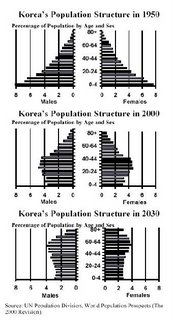 found, "Korea will need to figure out how to support a growing inactive population with fewer workers. As shown in the figure above, if Korea maintains its current activity rates between 2000 and 2030, the ratio of workers to retirees is expected to plummet from nearly 7.1 to 2.7."
Click on the picture for a larger view of the population pyramid.
I have no basis for comparison to the ratio of nearly three workers to one retiree but the ratio for children is absent. Naturally, there will still be some children even with the small birthrate and they will also need care.
Korea of 2030 may continue to be viable with these ratios but it will have even less breathing room. There will be less surplus and a big surplus is needed considering our neighbor to the north. Should reunification happen, caring for the North Koreans will be difficult now; in the near future, it will be all but impossible.
There is another way to look at the decreasing birthrate. There will be fewer 'pureblooded' Koreans. I do not feel this is bad in itself and I don't want to belittle my own son's racial mixture but the broader perspective is that the world is 'samifying'. The world culture is already becoming western and the world's people are losing their distinctiveness. Koreans and Indians choose to wear western suits rather than hanboks or saris. McDonalds is everywhere...
Anyway, there is a book describing how the world's cultures are becoming more similar. I have only listened to the interview but the book can be found here.
I do agree that if the world's population can be kept stable, or preferably, drop slightly but steadily for a few generations, the world will be a better place. It just seems to me that Korea is experiencing a precipitious drop rather than the gentle one that would allow greater longterm stability.
I don't know if this next article, in the Times the same day as Raffin's article, has any relevance but it is ironic to find the two together.
The article describes a Kyongsang family with 12 children. An excerpt:
Here is one couple that should be well-taken-care-of when they retire!
I just read Rick Ruffin's article about birthrates and the previous article he was commenting on. Korea has an amazingly low birthrate and the two articles discuss whether this is good or bad. The first article makes the case that Korea is reaching a dangerously lopsided ratio of employed population to total population. The few of employable age will need to pay greater and greater taxes to maintain the elderly.
The most outstanding problem with low birthrates is it increases the ratio of old people to young people. It spawns an awesome situation of a shrinking labor force. The reduction in the number of taxpayers is set to cause the collapse of various welfare funds on which a growing number of elderly rely. The situation is serious enough to threaten existence of the nation itself.
Ruffin's reply is that reducing the population by having fewer children is the best way to reduce overcrowding, pollution, farm-field exhaustion and other problems.
Almost every environmental problem- and most social and political problems throughout the world today- are because of human population increase. Pollution, famine, pestilence, over-development and war can all be attributed to high concentrations of humans. And you are encouraging everyone to have more kids! You are concerned that there will not be enough people paying into the "system" to support the increasing aging population. Well I say the money saved from not having to deal with pollution and waste created by too many people can more than make up for the money needed to support all the grandmothers and grandfathers soon to appear on the scene.
Reducing the population through reducing the number of children per family does sound like one of the most benign ways to protect the environment but it all comes down to numbers.
Some numbers can be found in a pdf at 'weforum'. There, I
 found, "Korea will need to figure out how to support a growing inactive population with fewer workers. As shown in the figure above, if Korea maintains its current activity rates between 2000 and 2030, the ratio of workers to retirees is expected to plummet from nearly 7.1 to 2.7."
Click on the picture for a larger view of the population pyramid.
I have no basis for comparison to the ratio of nearly three workers to one retiree but the ratio for children is absent. Naturally, there will still be some children even with the small birthrate and they will also need care.
Korea of 2030 may continue to be viable with these ratios but it will have even less breathing room. There will be less surplus and a big surplus is needed considering our neighbor to the north. Should reunification happen, caring for the North Koreans will be difficult now; in the near future, it will be all but impossible.
There is another way to look at the decreasing birthrate. There will be fewer 'pureblooded' Koreans. I do not feel this is bad in itself and I don't want to belittle my own son's racial mixture but the broader perspective is that the world is 'samifying'. The world culture is already becoming western and the world's people are losing their distinctiveness. Koreans and Indians choose to wear western suits rather than hanboks or saris. McDonalds is everywhere...
Anyway, there is a book describing how the world's cultures are becoming more similar. I have only listened to the interview but the book can be found here.
I do agree that if the world's population can be kept stable, or preferably, drop slightly but steadily for a few generations, the world will be a better place. It just seems to me that Korea is experiencing a precipitious drop rather than the gentle one that would allow greater longterm stability.
I don't know if this next article, in the Times the same day as Raffin's article, has any relevance but it is ironic to find the two together.
The article describes a Kyongsang family with 12 children. An excerpt:
A church pastor and his wife living in Kumi, North Kyongsang Province, gave birth to their 12th child Sunday, adding another member to their already large family. Rev. Kim Suk-tae, 47, and his wife Um Kye-suk, 42, a couple married for 20 years, will now shepherd the country's largest single family.
Here is one couple that should be well-taken-care-of when they retire!
Monday, May 15, 2006
Cycling: broken teeth, bears and a mild rant
Actually my two stories are not connected at all - well, bikes are in both stories.
My teeth are fine but apparently my bike gears have some serious tooth decay. During this riding season, I found that when I really made a powerful stroke, the chain would skip and sometimes fall loose. At the bike shop, the owner brought to my attention the sad state of my middle ring- the one connected to the peddles. Several teeth are broken and many are unnaturally sharp. While the smaller and larger rings are in better shape, they too show the effects of grinding.
I left the shop with my bike and the need to consider what to do. I think I need to replace the three rings, but do I also need to replace the chain? A friend in Canada, Barry Faulkner, showed me how to measure the chain. Apparently, 12 links should be 12 inches. I have not yet measured it, by the way. He told me that chains stretch a little and should be replaced every 15,000km or so ( or was it miles - all errors in this post are my own). At the time, it didn't seem all that important; a long ride was 50km and most were commuting-type rides of under 5km. 15,000km would take years.
Well, I've had my bike for about 13 years now and have cycled across most of Canada (Yes, I am so damn proud of that that I try to fit into every bike post. Sorry to annoy you). I've also covered fair ground here in Korea. I guess I probably am at or above 15,000 by now.
If I didn't mention it before, a stretched chain doesn't fit the gear properly anymore and so grinds them. I suppose other things can grind gears, like not shifting far enough to allow the chain to fit tightly to the gear.
The bike shop owner has given me good service in the past but this is a major overhaul and likely to be exensive. His shop caters to mountain bikes - as all shops in Korea seem to - and I worry about his ordering the right parts. I guess I should start investigating the situation - the gears have the Shimano brandname and a number and such so product matching should be simple - instead of writing about it.
By before I go, a story about a Canadian cyclist -in Canada- who was attacked by a black bear.
A mountain biker in Alberta was apparently chased down and attacked. He is in the hospital but will be okay, he has a few broken bones and such but the article suggested that he would recover more or less completely.
Firstly, I feel for the guy. If he saw the bear approaching, I guess he would try to pedal away. The article didn't have a lot of details but he could have been climbing a hill or just finished climbing a hill and unable to race away. Or maybe it was simple, level ground; bears are much faster than they look. Once the bear got him, it had him for hours. Other cyclists found him and the bear, left to get help and then rescued him. I can't imagine hearing or seeing help so close leaving again.
Back to my trip across Canada (fit it in again. Woo-hoo!). On my trip I saw one grizzly at a distance and a black bear cub near road on two occassions. Seeing the grizzly was cool and I would have missed it except that I first saw and questioned the student standing on the roadside beside her car and waving a big antennae array. She pointed to the grey mass several hundred meters away. This opportunity for a close connection with the location is why I love cycling.
Seeing the cubs was much scarier. The first time, I was on level ground and the cub was in some brush very near the highway's shoulder. I began to edge into traffic as I approached and the horn of a surprised driver scared the bear away. I am sure that I upset the driver (who was oblivious to the bear) but I am glad he sounded his horn. The second time, I had just finished a fair climb, there were no cars nearby and I was tired. As I passed the bear I 1)tried to take a picture holding the camera sideways and hoping it was in the frame 2) looked anxiously for it's mother and 3) struggled to come up with any reasonable speed to pull away from a possibly dangerous situation.
Yeah, I feel for the guy and wish him a fast recovery.
On the other hand, he was wearing headphones when he was attacked. Now, they may have had nothing to do with his injuries. It's completley possible that listening to whatever was not a factor in being attacked or in not being able to escape. I just hate the idea of listening to music or podcasts or non-natural sounds when exercising in natural surroundings. This is probably material for a separate post so I'll be brief here. I wear headphones in the gym and find they help fill in the time spent on the exercise bike but I would never use them while riding outside. I listen to podcasts while walking downtown but would never listen while hiking.
Part of the reason is concentration. I have already implied that the cyclist attacked by the bear might not have been concentrating because of what he was listening too. Road cycling is concentration intensive and I think headphones are illegal while cycling or even driving a car. I'm not sure about the illegal part, but it is known to be a bad idea.
I do find background music helps me concentrate when I study or do a variety of other tasks (marking papers and other school work but also wood carving), however . Odd, that.
The main reason I disapprove of listening to music and the like in natural settings is that I respect the settings too much - unlike some students, I wouldn't listen to my MP3 player in class or at meetings or at church and I feel forests deserve the same treatment. I am of the view that hiking, canoeing and other outdoor sports cannot be fully enjoyed without really immersing yourself in the situation.
This view may bring me back to the concentration issue. I do not want to immerse myself in cycling when I am at the gym because it is pretty monotonous but I do want to immerse myself in cycling on a quiet back-country road because it is peaceful.
Anyway, I hope the guy will soon be well and, regardless of their responsibility in his injuries, I also hope he leaves his headphones at home or, well, not on his head, when he next goes riding.
My teeth are fine but apparently my bike gears have some serious tooth decay. During this riding season, I found that when I really made a powerful stroke, the chain would skip and sometimes fall loose. At the bike shop, the owner brought to my attention the sad state of my middle ring- the one connected to the peddles. Several teeth are broken and many are unnaturally sharp. While the smaller and larger rings are in better shape, they too show the effects of grinding.
I left the shop with my bike and the need to consider what to do. I think I need to replace the three rings, but do I also need to replace the chain? A friend in Canada, Barry Faulkner, showed me how to measure the chain. Apparently, 12 links should be 12 inches. I have not yet measured it, by the way. He told me that chains stretch a little and should be replaced every 15,000km or so ( or was it miles - all errors in this post are my own). At the time, it didn't seem all that important; a long ride was 50km and most were commuting-type rides of under 5km. 15,000km would take years.
Well, I've had my bike for about 13 years now and have cycled across most of Canada (Yes, I am so damn proud of that that I try to fit into every bike post. Sorry to annoy you). I've also covered fair ground here in Korea. I guess I probably am at or above 15,000 by now.
If I didn't mention it before, a stretched chain doesn't fit the gear properly anymore and so grinds them. I suppose other things can grind gears, like not shifting far enough to allow the chain to fit tightly to the gear.
The bike shop owner has given me good service in the past but this is a major overhaul and likely to be exensive. His shop caters to mountain bikes - as all shops in Korea seem to - and I worry about his ordering the right parts. I guess I should start investigating the situation - the gears have the Shimano brandname and a number and such so product matching should be simple - instead of writing about it.
By before I go, a story about a Canadian cyclist -in Canada- who was attacked by a black bear.
A mountain biker in Alberta was apparently chased down and attacked. He is in the hospital but will be okay, he has a few broken bones and such but the article suggested that he would recover more or less completely.
Firstly, I feel for the guy. If he saw the bear approaching, I guess he would try to pedal away. The article didn't have a lot of details but he could have been climbing a hill or just finished climbing a hill and unable to race away. Or maybe it was simple, level ground; bears are much faster than they look. Once the bear got him, it had him for hours. Other cyclists found him and the bear, left to get help and then rescued him. I can't imagine hearing or seeing help so close leaving again.
Back to my trip across Canada (fit it in again. Woo-hoo!). On my trip I saw one grizzly at a distance and a black bear cub near road on two occassions. Seeing the grizzly was cool and I would have missed it except that I first saw and questioned the student standing on the roadside beside her car and waving a big antennae array. She pointed to the grey mass several hundred meters away. This opportunity for a close connection with the location is why I love cycling.
Seeing the cubs was much scarier. The first time, I was on level ground and the cub was in some brush very near the highway's shoulder. I began to edge into traffic as I approached and the horn of a surprised driver scared the bear away. I am sure that I upset the driver (who was oblivious to the bear) but I am glad he sounded his horn. The second time, I had just finished a fair climb, there were no cars nearby and I was tired. As I passed the bear I 1)tried to take a picture holding the camera sideways and hoping it was in the frame 2) looked anxiously for it's mother and 3) struggled to come up with any reasonable speed to pull away from a possibly dangerous situation.
Yeah, I feel for the guy and wish him a fast recovery.
On the other hand, he was wearing headphones when he was attacked. Now, they may have had nothing to do with his injuries. It's completley possible that listening to whatever was not a factor in being attacked or in not being able to escape. I just hate the idea of listening to music or podcasts or non-natural sounds when exercising in natural surroundings. This is probably material for a separate post so I'll be brief here. I wear headphones in the gym and find they help fill in the time spent on the exercise bike but I would never use them while riding outside. I listen to podcasts while walking downtown but would never listen while hiking.
Part of the reason is concentration. I have already implied that the cyclist attacked by the bear might not have been concentrating because of what he was listening too. Road cycling is concentration intensive and I think headphones are illegal while cycling or even driving a car. I'm not sure about the illegal part, but it is known to be a bad idea.
I do find background music helps me concentrate when I study or do a variety of other tasks (marking papers and other school work but also wood carving), however . Odd, that.
The main reason I disapprove of listening to music and the like in natural settings is that I respect the settings too much - unlike some students, I wouldn't listen to my MP3 player in class or at meetings or at church and I feel forests deserve the same treatment. I am of the view that hiking, canoeing and other outdoor sports cannot be fully enjoyed without really immersing yourself in the situation.
This view may bring me back to the concentration issue. I do not want to immerse myself in cycling when I am at the gym because it is pretty monotonous but I do want to immerse myself in cycling on a quiet back-country road because it is peaceful.
Anyway, I hope the guy will soon be well and, regardless of their responsibility in his injuries, I also hope he leaves his headphones at home or, well, not on his head, when he next goes riding.
Wednesday, May 10, 2006
Tour de/da/ Korea
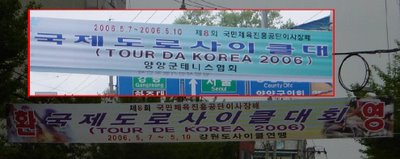
It hasn't been a great Tour De Korea. I was working throughout the races so I was unable to watch any of them but I did see these signs. Is 'Da' an Italianized version (brought to mind by the 'Da Vinci Code' publicity)? The two signs faced one another - I cut'n'pasted the top one in.
 Seoul bloggers have been commenting on the good weather but here it has been miserable. I've gone back to wearing a jacket and carrying a new umbrella - my old one was bent up in the wind. Man, rain and wind; those cyclists must be loving the race.
The organizers can't be too happy with the weather either. I saw one pace car in the ditch; I guess because of slippery driving conditions. Perhaps the riders look on the bright side by thinking, "At least there are no fires and water reserves are back up to where they should be."
.jpg) Seoul bloggers have been commenting on the good weather but here it has been miserable. I've gone back to wearing a jacket and carrying a new umbrella - my old one was bent up in the wind. Man, rain and wind; those cyclists must be loving the race.
Seoul bloggers have been commenting on the good weather but here it has been miserable. I've gone back to wearing a jacket and carrying a new umbrella - my old one was bent up in the wind. Man, rain and wind; those cyclists must be loving the race.The organizers can't be too happy with the weather either. I saw one pace car in the ditch; I guess because of slippery driving conditions. Perhaps the riders look on the bright side by thinking, "At least there are no fires and water reserves are back up to where they should be."
Sunday, May 07, 2006
Children's day Coast Guard Tour
I had a chance to to ride on a Coast Guard boat on Children's Day. I love being on the water and had a good time. Our little guy didn't care for the rocking though and was pretty sick. He was sick while he was inside the galley cabin and a little time in the fresh air fixed him up. We finally found the perfect location; in the doorway where we could be warm enough yet still have some moving air.
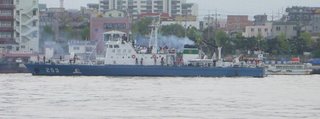
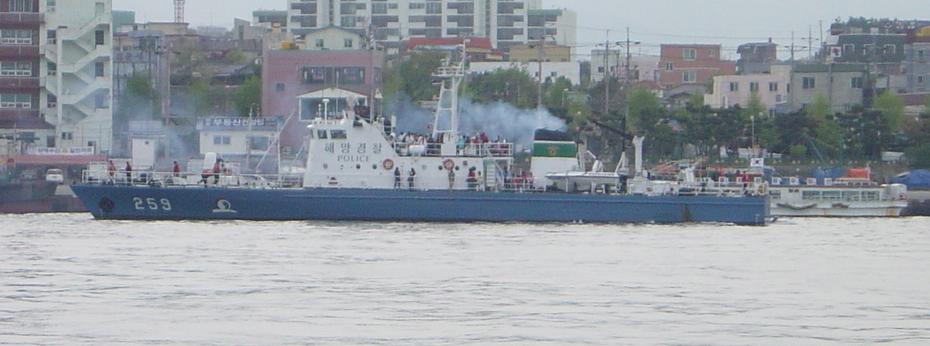
Below, a 250 ton Coast Guard ship.
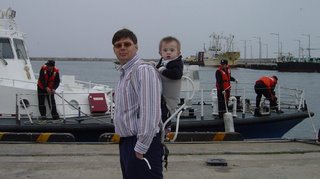
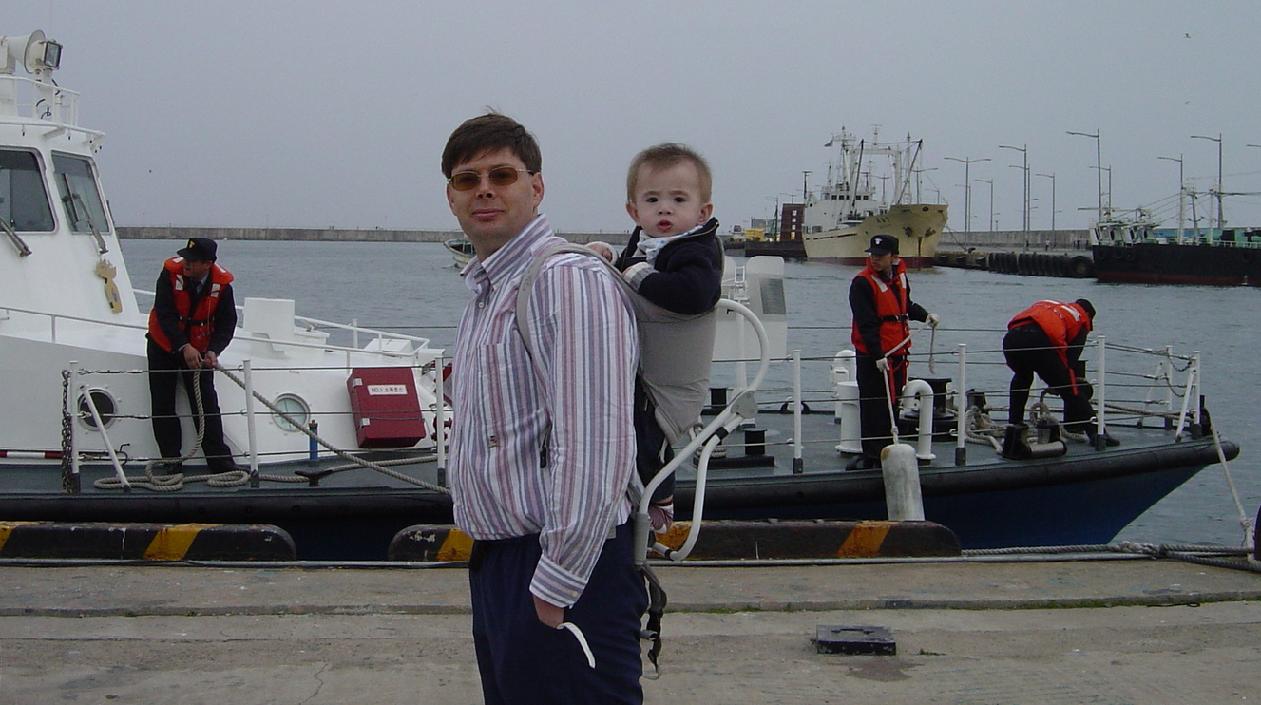
 KwandongAlex and I in front of the 50 ton ship we toured in.
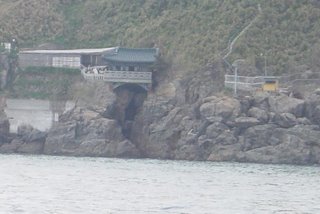
 I had wanted to see Naksan from this vantage for years and finally got the chance.
Below, a 250 ton Coast Guard ship.
 KwandongAlex and I in front of the 50 ton ship we toured in.
 I had wanted to see Naksan from this vantage for years and finally got the chance.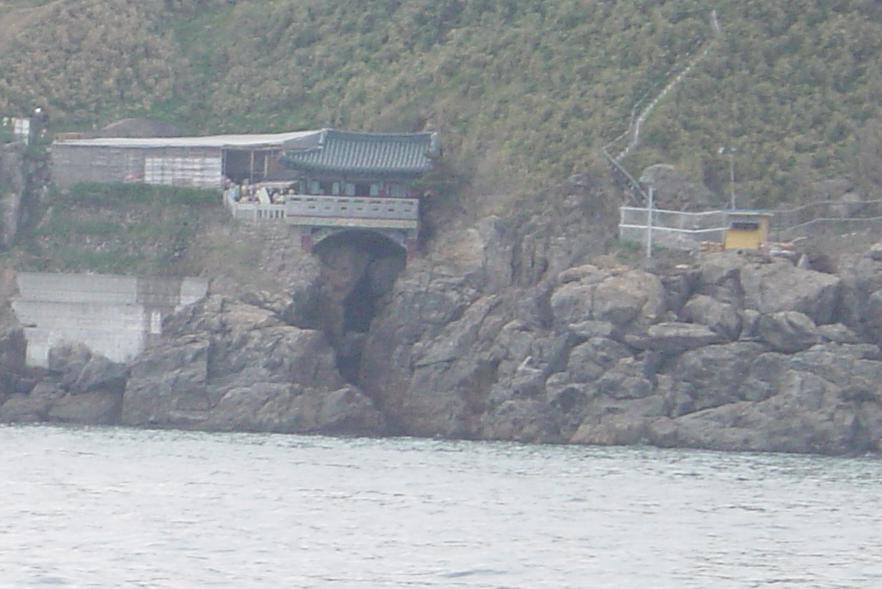
Fun at E-mart
He seems to be having fun. A good thing, too. I had to hunt around to find a cart. Actually, at ten months old, him riding in the cart was probably more important to me than to him.
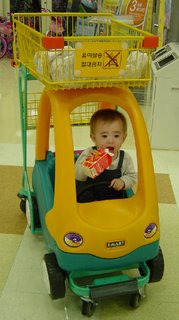
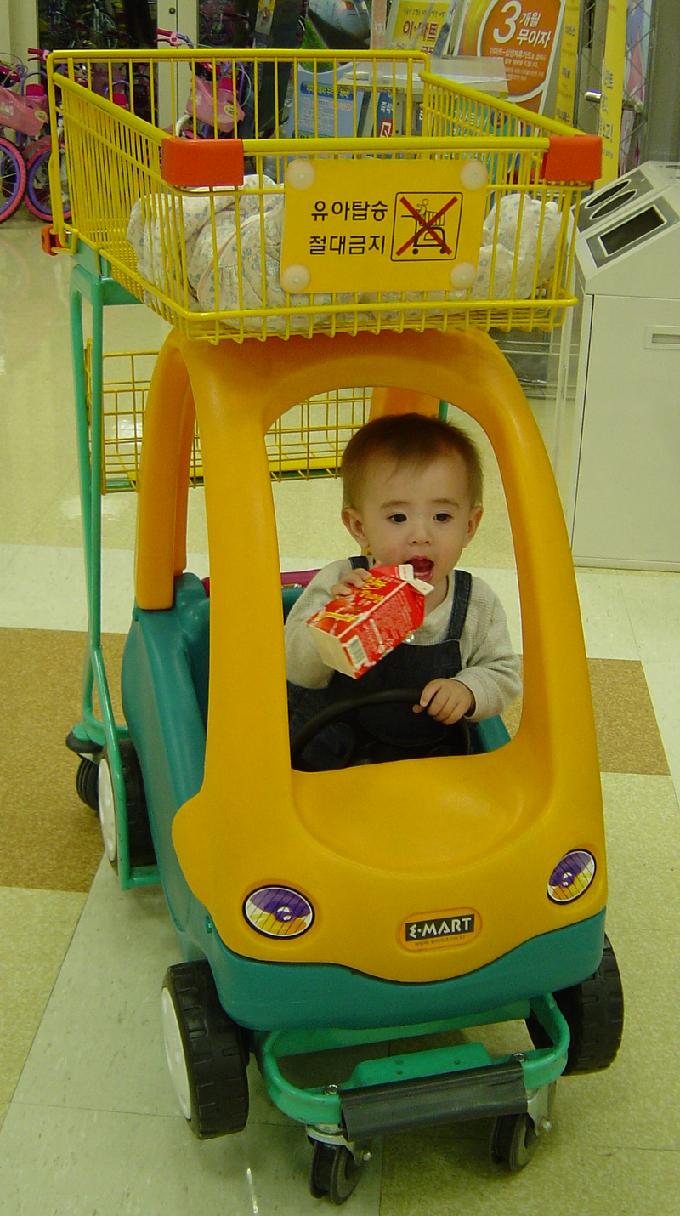
Thursday, May 04, 2006
Tour De Korea
I saw a sign in Yangyang that this year's Tour De Korea is about to start. The race starts in Seoul and takes two days to reach Yangyang, then they have some time trials and circuit racing.
I could find no information about this year's race but here are some links from last year's.
Oranckay was all over it last year. Recently he had some connectivity problems but he is the best source for the tour.
I also found a website forum with a discussion about the race.
I could find no information about this year's race but here are some links from last year's.
Oranckay was all over it last year. Recently he had some connectivity problems but he is the best source for the tour.
I also found a website forum with a discussion about the race.
The Tour of Korea is a fairly hard race. Mike Carter, a friend and racer who got 2nd there last year and 8th this year, told me a little bit about who is elligible to get in the race and what it's like when I saw him while he was here doing it this June.Basically, elite-level racers and professionals are the only racers allowed in. That means that the people who do the race have all been racing for at least a few years. Because there is no road racing for people to partake in to learn to race in South Korea, the 'local' riders consist mostly of racers who compete in track events, and a few who
comprise a road team that travels to different Asian countries to race during
the summer. According to Mike, the track riders have alot of trouble even
finishing each stage, let alone being a factor in the race. Apparently, and to
the behest of the riders who were finishing the stages, the officials were
allowing these local riders to drop out half way through some of the stages and
still start the next-day's stage -- a definite violation of UCI (International
governing organization of cycling) rules. But, being as the race is "the Tour of
Korea," they wanted to be able to say that at least some Koreans finished the
race.Sorry that I'm still in 'quote mode'. I don't know how to get out. Anyway, I also rode about last year's race but I just rehashed what others said. If you like, check the archive for May 2005.
Wednesday, May 03, 2006
An interesting place to park illegally
.jpg)
My father was a police officer and we lived near the station. I would often see the brakelights of cars come on as the drivers realized a police station was ahead. If they thought about it, they would realize that police stations are not (or weren't, I don't know about nowadays) armored fortresses with cameras and people guarding the roads nearby. They don't particlularly care if you're speeding. I guess that the locals aren't that fussy about what happens just outside their stations either, but it does look bad.
Audio is working in post below.
It took some effort to make the player in the post below work and I found that once it worked, every time I went back to add this update, it stopped working. It took a lot of work to get that player going - you had better LOVE it!
Oh, the problem mostly went away when I used 'Firefox' browser instead of Explorer.
Oh, the problem mostly went away when I used 'Firefox' browser instead of Explorer.
Choosing to be Korean
Update: I am trying to get the audio to work on my site. You can still follow the link to ODEO and listen there.
Today I interviewed Marcus, or Masuro, about his decision to be a Korean citizen. It is a subject I am very curious about because being Canadian is important to me; it's a emotional issue. For Marcus, however, it seems to be the practical choice.
This is not my first time playing with audioblogging but I am a novice - one manifestation of my lack of experience is the low volume of the audio. Crank it up. The conversation is just under eleven minutes.
To listen to the audio as an MP3, visit Odeo.
Today I interviewed Marcus, or Masuro, about his decision to be a Korean citizen. It is a subject I am very curious about because being Canadian is important to me; it's a emotional issue. For Marcus, however, it seems to be the practical choice.
This is not my first time playing with audioblogging but I am a novice - one manifestation of my lack of experience is the low volume of the audio. Crank it up. The conversation is just under eleven minutes.
To listen to the audio as an MP3, visit Odeo.
Saturday, April 29, 2006
Naksansa, a year later
NOTE: I had written a different opening that I decided was pretty stupid so if you visited on Saturday night, this post now has a new title.
I had the opportunity to meet two Seoul bloggers today (Saturday). We met at Naksan Beach Hotel and I tried to show them around the temple.
Nathan, the Seoul Hero, seems like a great guy and I had a good morning chatting and looking at how Naksan Temple has begun to rebuild after last year's fire. His friend, Joe, the Seoul man, was also a friendly sort and I enjoyed a good but too-short talk with the two of them.
Nathan has also blogged about his experience with many compliments to me - so thank you very much! Joe blooged about it as well, and, as well, had blogger problems putting many photos into one post. As it is the end of the month, I will link to his archive for April '06 and his three (!) posts should be at the top. (If anyone cares, I have a solution that dates back to the Picasa -Hello days: Post as many pics as you can in one post, set blogger to 'Edit html', copy the html into Wordpad or something, do that as often as you want, then paste the whole bundle into one post (again, set to 'Edit html') and delete all the previous posts used solely to upload pictures. Simple stuff, hey? Near the end of the month, as now, it's easier to link to the archive for that month.)
We spent Saturday morning wandering around Naksan Temple looking at what damage remains from last year's fire (Check the archives for April '05 for my several posts and eye witness accounts of the fire).
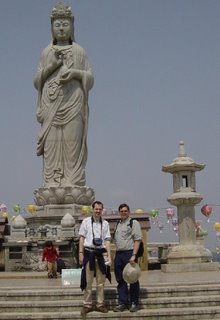
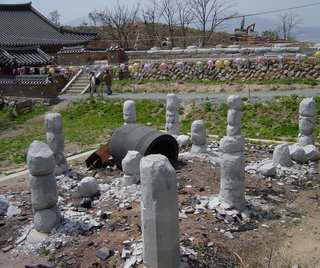
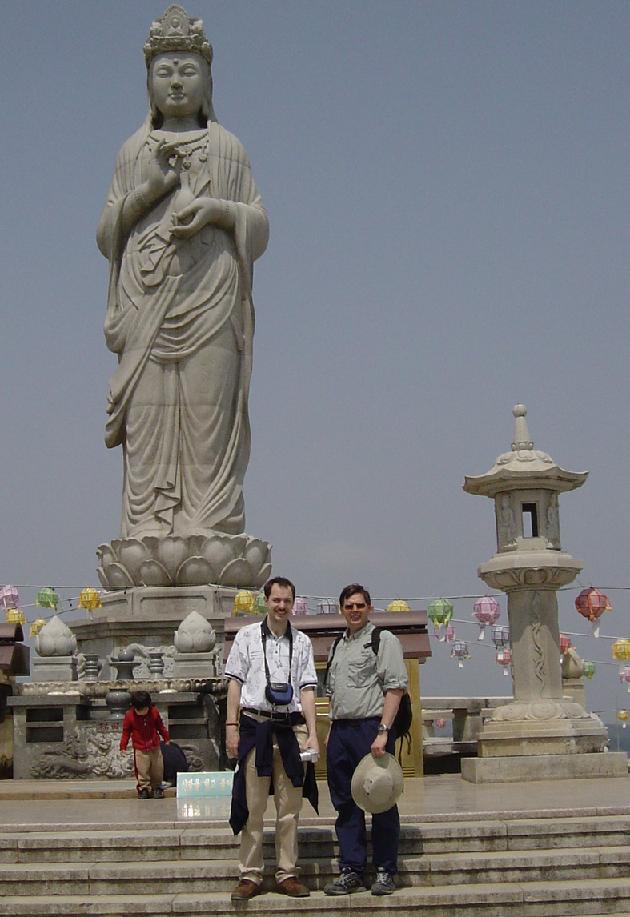
Here are Nathan and I at the giant Bodisatva of Mercy. Although the statue is fine, some of the stone around the base has heat fractures.
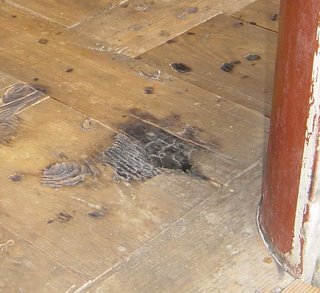
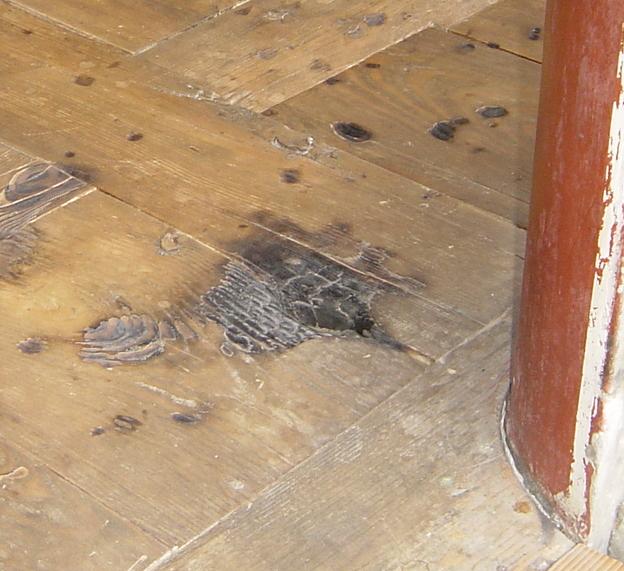
The temple just below the statue sustained some burns on it's floor.
 The ancient bell that had been at the temple for, well, a long time, melted in the fire. It had crystallized with age and use so it was not in use in recent times. Here is the bell used in early '05. I hadn't realized they had just left the bell in the wreckage of its platform.
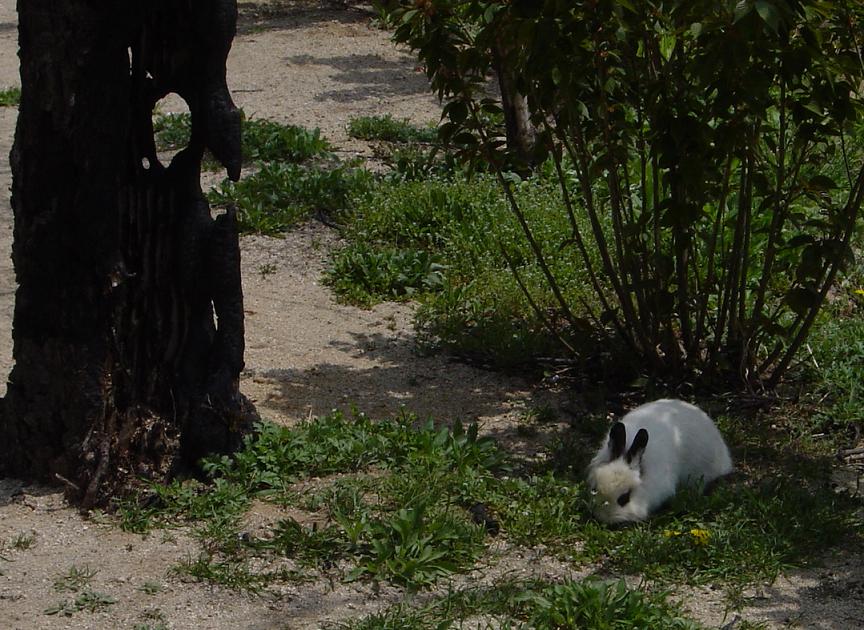
As perhaps a sign of the old and new, here is a burnt-out cherry tree and new temple resident rabbit.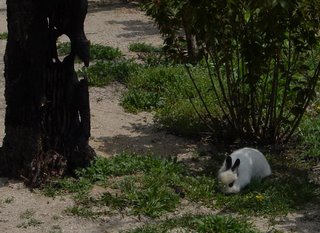
Blogger has trouble allowing me to place more than four or five photos in one post so this photos are continued in the next post.
I had the opportunity to meet two Seoul bloggers today (Saturday). We met at Naksan Beach Hotel and I tried to show them around the temple.
Nathan, the Seoul Hero, seems like a great guy and I had a good morning chatting and looking at how Naksan Temple has begun to rebuild after last year's fire. His friend, Joe, the Seoul man, was also a friendly sort and I enjoyed a good but too-short talk with the two of them.
Nathan has also blogged about his experience with many compliments to me - so thank you very much! Joe blooged about it as well, and, as well, had blogger problems putting many photos into one post. As it is the end of the month, I will link to his archive for April '06 and his three (!) posts should be at the top. (If anyone cares, I have a solution that dates back to the Picasa -Hello days: Post as many pics as you can in one post, set blogger to 'Edit html', copy the html into Wordpad or something, do that as often as you want, then paste the whole bundle into one post (again, set to 'Edit html') and delete all the previous posts used solely to upload pictures. Simple stuff, hey? Near the end of the month, as now, it's easier to link to the archive for that month.)
We spent Saturday morning wandering around Naksan Temple looking at what damage remains from last year's fire (Check the archives for April '05 for my several posts and eye witness accounts of the fire).
Here are Nathan and I at the giant Bodisatva of Mercy. Although the statue is fine, some of the stone around the base has heat fractures.
The temple just below the statue sustained some burns on it's floor.
 The ancient bell that had been at the temple for, well, a long time, melted in the fire. It had crystallized with age and use so it was not in use in recent times. Here is the bell used in early '05. I hadn't realized they had just left the bell in the wreckage of its platform.
As perhaps a sign of the old and new, here is a burnt-out cherry tree and new temple resident rabbit.
Blogger has trouble allowing me to place more than four or five photos in one post so this photos are continued in the next post.
Naksansa, a year later
Again, Blogger has trouble allowing me more than four pictures in a single post.
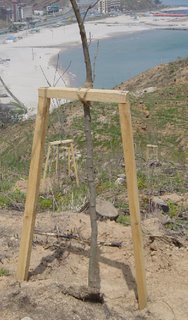
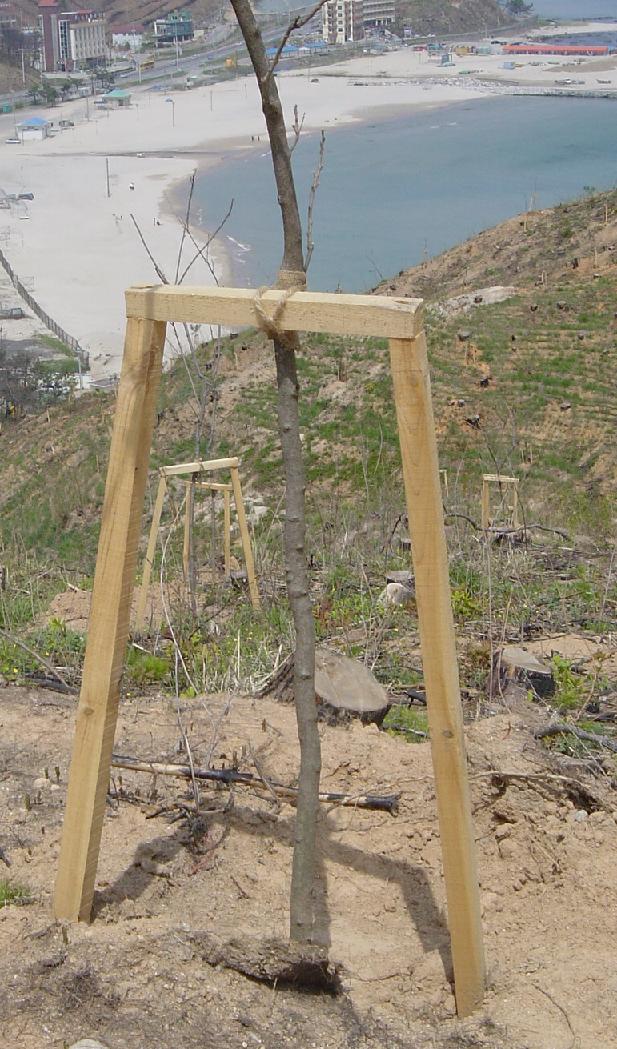
Sometime before Arbor Day, I expressed a wish to help with treeplanting on Nak Mountain's denuded slopes. I thought that the planting would resemble the work I did one spring back in Canada in my university days. I imagined carrying a bag with perhaps a hundred little trees and a shovel; pacing off two metres and planting another one.
I had seen the reality a few weeks ago but was only in a position to take a picture today. An ajummah army planted the trees and placed the stakes. No one can compete with them.
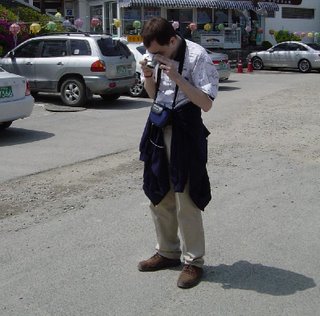
Nathan was a good guy but seemed to have a fascination with ants. This is a pose he took about ten times during our hike.
Sometime before Arbor Day, I expressed a wish to help with treeplanting on Nak Mountain's denuded slopes. I thought that the planting would resemble the work I did one spring back in Canada in my university days. I imagined carrying a bag with perhaps a hundred little trees and a shovel; pacing off two metres and planting another one.
I had seen the reality a few weeks ago but was only in a position to take a picture today. An ajummah army planted the trees and placed the stakes. No one can compete with them.
Nathan was a good guy but seemed to have a fascination with ants. This is a pose he took about ten times during our hike.

Friday, April 28, 2006
Dock-do
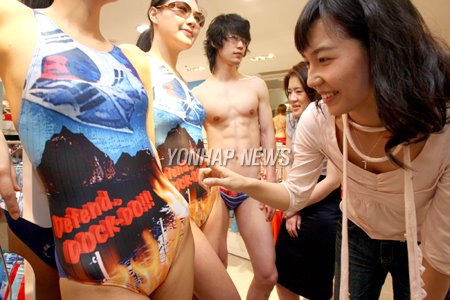
I'm torn over whether or not this is a good idea.
I like any excuse to spend a little extra time studying women's bathingsuit, but mis-spelling the name makes the suit seem a little silly.
Alright. The proper spelling in in Hangeul, so, in english maybe it's not mis-spelled. Still, I am comfortable, most media outlets are comfortable, with 'dok' rhyming with 'Coke'. 'Dock' doesn't.
Of animals endangered and ubiquitous
The Times has an article about 44 species that are either considered on the edge of extinction or on the wrong side of that edge have been spotted (They don't say when, -odd that) in rural areas.
First, what is a hobbie?
In a previous post, I wrote about train station workers clearing the tracks of dead animals, including wildcats. I hope that's not how they count them.
This is what confused me in the article:
The ministry has also been studying genetic profiles of 113 endangered species, including Siberian tigers and wolves, to better increase their numbers.
Increase? I guess it is a increase from zero to more than zero. I would have chosen the word re-introduce'. Am I wrong here? Are there wild tigers loose in South Korea?
And who wants more? I am excited about seeing wildlife and would love to more, in general. I think the farmers around Chilisan would be the first (after me, actually) to point out that reintroduced animals, bears, in their case, don't stay in the park or reserves they are placed in. Tigers would have trouble hiding in the mountains of major cities but wolves might do okay....
Certainly boar appear to love the cities. Another article in The Times describes a boar boom on Bukhansan and other mountains in and around Seoul.
One boar, about the size of two Korean burst into a bar in Amsa-dong, escaped and was eventually killed somewhere nearby. I don't even know what mountains are near Amsa-dong; in my visits, it seemed pretty flat and developed.
A hunting ban is blamed but the reason for the ban - nobody wants rifle fire downtown - seems sound. Perhaps wolves are the answer. To my knowledge, coyotes do well in urban environments.
Are there any other reasons for the increase in the boar population?
In a country whose people can be terrified of a loose lapdog, I think the boar, very smart animals, can quickly learn that cities are relatively safe places to live.
Four critically endangered species, such as flying squirrels, hobbies and wildcats, which were formerly thought to have disappeared, were found in Hoengsung and Hongchon, Kangwon Province.
First, what is a hobbie?
In a previous post, I wrote about train station workers clearing the tracks of dead animals, including wildcats. I hope that's not how they count them.
This is what confused me in the article:
The ministry has also been studying genetic profiles of 113 endangered species, including Siberian tigers and wolves, to better increase their numbers.
Increase? I guess it is a increase from zero to more than zero. I would have chosen the word re-introduce'. Am I wrong here? Are there wild tigers loose in South Korea?
And who wants more? I am excited about seeing wildlife and would love to more, in general. I think the farmers around Chilisan would be the first (after me, actually) to point out that reintroduced animals, bears, in their case, don't stay in the park or reserves they are placed in. Tigers would have trouble hiding in the mountains of major cities but wolves might do okay....
Certainly boar appear to love the cities. Another article in The Times describes a boar boom on Bukhansan and other mountains in and around Seoul.
One boar, about the size of two Korean burst into a bar in Amsa-dong, escaped and was eventually killed somewhere nearby. I don't even know what mountains are near Amsa-dong; in my visits, it seemed pretty flat and developed.
A hunting ban is blamed but the reason for the ban - nobody wants rifle fire downtown - seems sound. Perhaps wolves are the answer. To my knowledge, coyotes do well in urban environments.
Are there any other reasons for the increase in the boar population?
But experts are divided over why the boars increasingly come out into city streets. Some say that the invaders have been driven away from food and territory in the mountains after fights, but others questioned that reasoning.
"In normal conditions, a wild boar does not go into a noisy, polluted city to find food," said Kim Won-myong of the National Institute of Environmental Research.
He said the boars probably head for the city only when they get lost or are flushed out of their domain by mountain climbers or dogs.
In a country whose people can be terrified of a loose lapdog, I think the boar, very smart animals, can quickly learn that cities are relatively safe places to live.
Thursday, April 27, 2006
The economics of caring about cheating.
Midterm exams have just finished and I fairly zealously watched over my students to prevent cheating at the beginning of the week but somewhat less so at the end of the week.
My reasoning reminded me of some animal behavior classes I took at university and an explanation for Real Estate agent's behavior in setting housing prices (from Freakonomics). I will start by describing my two examples.
When a caregiving animal has young, there is a mismatched struggle for resources. The caregiver wants all the young to have the same amount of food, while each infant wants more for itself, even at the expense of the other infants. It requires some effort for the caregiver to try to spread the food around; effort that does not have a great value for the caregiver itself. It also requires effort for the infant to try to take more than its share of the food but there is great value when it succeeds.
In Real Estate, you should be able toget a better price if you sell the house yourself for similar reasons. To the agent, selling your house for $150,000 or $155,000 does not make a big difference in his/her commission, but it is a significant difference for the homeowner.
Now, back to me. In a cynical sense, how much value does cheating or catching cheaters have for me?
So long as the cheating does not go beyond a certain level (in this case, does not screw up my grading curve), it does not really affect class itself. Also, cheaters, and others, typically sit with their friends; It is uncommon for a cheater to deliberately place him/herself next to a stronger student of English. Most exam cheating does not significantly effect the cheater's score much nor my all-important grading curve.
To the cheater, there is potential for greater value. Most of the times I have seen known cheater's test papers, they have terrible answers. They may have misread the answer they tried to copy or looked at the wrong answer; I don't know. Still, if a student already knows they will fail the test, cheating can have great value and little downside. If the student is caught, there is little change in the end result and if they get away with cheating, they might pass the exam.
As the week progressed, I thought about this more and maybe began to care a little less. I certainly started marking previous class's exams while invigilating (my vocabulary is fading - I copied this word from Seoul Hero) another set of exams. On the other hand, when I did see someone cheating, it was with pleasure I marked his paper with a red marker to determine its fate later. Again, the score was already so poor that I chose to deduct only the marks on the question he has been cheating on (he lost 2 out of a possible 8 marks).
I have to conclude by saying that although catching cheaters does not have a strong tangible value, it does have a wonderful satisfaction value!
My reasoning reminded me of some animal behavior classes I took at university and an explanation for Real Estate agent's behavior in setting housing prices (from Freakonomics). I will start by describing my two examples.
When a caregiving animal has young, there is a mismatched struggle for resources. The caregiver wants all the young to have the same amount of food, while each infant wants more for itself, even at the expense of the other infants. It requires some effort for the caregiver to try to spread the food around; effort that does not have a great value for the caregiver itself. It also requires effort for the infant to try to take more than its share of the food but there is great value when it succeeds.
In Real Estate, you should be able toget a better price if you sell the house yourself for similar reasons. To the agent, selling your house for $150,000 or $155,000 does not make a big difference in his/her commission, but it is a significant difference for the homeowner.
Now, back to me. In a cynical sense, how much value does cheating or catching cheaters have for me?
So long as the cheating does not go beyond a certain level (in this case, does not screw up my grading curve), it does not really affect class itself. Also, cheaters, and others, typically sit with their friends; It is uncommon for a cheater to deliberately place him/herself next to a stronger student of English. Most exam cheating does not significantly effect the cheater's score much nor my all-important grading curve.
To the cheater, there is potential for greater value. Most of the times I have seen known cheater's test papers, they have terrible answers. They may have misread the answer they tried to copy or looked at the wrong answer; I don't know. Still, if a student already knows they will fail the test, cheating can have great value and little downside. If the student is caught, there is little change in the end result and if they get away with cheating, they might pass the exam.
As the week progressed, I thought about this more and maybe began to care a little less. I certainly started marking previous class's exams while invigilating (my vocabulary is fading - I copied this word from Seoul Hero) another set of exams. On the other hand, when I did see someone cheating, it was with pleasure I marked his paper with a red marker to determine its fate later. Again, the score was already so poor that I chose to deduct only the marks on the question he has been cheating on (he lost 2 out of a possible 8 marks).
I have to conclude by saying that although catching cheaters does not have a strong tangible value, it does have a wonderful satisfaction value!
Wednesday, April 26, 2006
Trapped

Yesterday was the last day of exams and this particular exam had a written and an oral component. This class might be my worst in study habits and english ability and I didn't think very highly of them. I was unsurprised when they had trouble opening the door to the classroom; that's how slow they are. I actually showed several of them, individually, how to open the door after they were reduced to knocking and asking to be let in.
Anyway, the students had finished the written component and were waiting in another classroom and coming to see me one at a time for their oral exam. Again, I had to open the door for a few of them and I was just about to wedge some paper in the doorway so it wouldn't close all the way, when I heard a student on the other side twisting left and right and not getting anywhere.
With a quiet curse, I went to open the door to find I couldn't. The knob just floated left and right, with no feeling of moving anything inside the mechanism.
I have to give the students credit. They stayed with me -on the other side - and tried to help me get out, or the next student in. Finally, I told the students we would finish the oral exam next week if the door wouldn't open in the next five minutes. The time went by and they stayed until, thirty minutes later, I got out.
Before I told them that, I phoned my department's office and a secretary came to try to help me. She couldn't but called maintenance.
I got tired of waiting and had started working on the screws holding the bars in place over the ventilation window leading into the hallway when a professor asked me to stop and wait for assistance.
The maintenance man came and worked on the door with no luck and eventually a student and I returned to removing the bars so I could climb out and not miss my bus home.
My opinion of the students improved a great deal during my imprisonment. If they had broken the lock (accidentally), would that make my feelings an example of the Stockholm Syndrome?
The office staff were apologetic as though it might be their fault and I might be angry. I played on that a little and told them I wouldn't come to work on Wednesday (today). So, here I am at home, relaxing.
Today is Founder's day at our university; there are no classes.
Monday, April 24, 2006
Gangwondo: the alpha and omega of Boilermakers
The Times has an article about boktanju (little bombs or boilermakers). Gangwondo is featured twice.
Recently, Choi Yoon-hee, a Gangwon lawmaker who became too touchy-feelie after drinking, has probably ended the popularity of the practice.
Still, if you want to sample this part of Gangwon culture, the article inlcudes tips:
1. “The Atomic”A whisky shot is plunked into a glass filled with beer. Foam then puffs up like a mushroom cloud, hence its name. This is the basic boilermaker.
2. “Taekwondo” Fill a glass to the brim with beer, place two chopsticks on top (slightly spread apart), then place whisky shot on top of the chopsticks. Punch the chopsticks to let the whisky drop into the glass.
3. “Golfshot” Place two chopsticks on top of the glass of beer and then the whisky shot glass on top. “Putt” the whisky shot into the beer using another chopstick or a spoon.
4. “The Tornado” Make a basic “Atomic” shot. Cover the glass with a napkin, hold on to the top and then flick it, while extending your arm. The beer will spin around like a tornado. This shot is said to have the smoothest mix. Before downing the contents of the glass, hurl the drenched napkin against a wall or ceiling to hear that satisfying “thwack!”
5. “Sperm” Pour beer into a glass and place a whisky shot inside. Cover the glass with a paper napkin. Shake it lightly ― the napkin should tear very slightly. Pour a little milk in through the hole. One look and you’ll see how it got its name.
Mr. Shim, who is currently writing a book about Korea’s drinking culture, said that people here have drunk poktanju as early as the Three Kingdoms period, which ended in 668 AD. But according to urban legend, the current style of poktanju ― beer with a shot of whisky ― made its Korean debut in the early 1980s, at a meeting between prosecutors, policemen and journalists in Chuncheon, Gangwon province. The concoction quickly spread across the country.
Recently, Choi Yoon-hee, a Gangwon lawmaker who became too touchy-feelie after drinking, has probably ended the popularity of the practice.
The “bombshot,” however, has recently come under heavy fire. Leading the charge is Park Jin, a lawmaker in the Grand National Party, who took a hammer to poktanju glasses at the National Assembly to demonstrate his determination to end Korea’s love for poktanju. The stunt was done in reaction to a scandal involving Choi Yeon-hee, a former GNP member, who sexually harassed a woman after downing a number of glasses. Mr. Choi leads a movement to eradicate Korea’s “bombshot culture.”
Still, if you want to sample this part of Gangwon culture, the article inlcudes tips:
A glimpse of how to make boilermakers
1. “The Atomic”A whisky shot is plunked into a glass filled with beer. Foam then puffs up like a mushroom cloud, hence its name. This is the basic boilermaker.
2. “Taekwondo” Fill a glass to the brim with beer, place two chopsticks on top (slightly spread apart), then place whisky shot on top of the chopsticks. Punch the chopsticks to let the whisky drop into the glass.
3. “Golfshot” Place two chopsticks on top of the glass of beer and then the whisky shot glass on top. “Putt” the whisky shot into the beer using another chopstick or a spoon.
4. “The Tornado” Make a basic “Atomic” shot. Cover the glass with a napkin, hold on to the top and then flick it, while extending your arm. The beer will spin around like a tornado. This shot is said to have the smoothest mix. Before downing the contents of the glass, hurl the drenched napkin against a wall or ceiling to hear that satisfying “thwack!”
5. “Sperm” Pour beer into a glass and place a whisky shot inside. Cover the glass with a paper napkin. Shake it lightly ― the napkin should tear very slightly. Pour a little milk in through the hole. One look and you’ll see how it got its name.
Diplomatic Tennis Championship
 Picture found here.
I wonder how you play diplomatic tennis. I imagine the games go like this:
"Oh, that was a great shot! I was just lucky to be in the right place."
I have never been very diplomatic or tactful myself, so I would probably do poorly at the game. This seems fitting as I also do poorly at regular tennis.
I made a similar connection between the wrong words when reading about Moslems being upset with Danish cartoonists. Everytime I read, "...cartoon battle" and the like, I pictured the Peanuts gang fighting Spiderman or something.
Sunday, April 23, 2006
Two Surprises
First, it rained today and when I looked out the window as the rain ended, the cars were sparkling clean. I'd forgotten that rain can do that. From now on, I hope that a cloudy sky only means clouds, and not yellow dust.
UPDATE: I was wrong. More dust due today, dam' it!
Second, on Arirang TV, I saw a documentary about Korean Water Deer. The show claimed that these deer are the only ones that are attracted to water; I thought moose were a kind of deer. I guess it's how you define deer.
Anyway, the surprise came in seeing these deer. I would have named them, "saber-toothed deer". I found these photos online.
From Deer-UK:
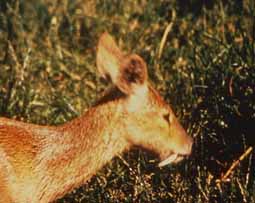
And this one from evolutionnyc:
UPDATE: I was wrong. More dust due today, dam' it!
Second, on Arirang TV, I saw a documentary about Korean Water Deer. The show claimed that these deer are the only ones that are attracted to water; I thought moose were a kind of deer. I guess it's how you define deer.
Anyway, the surprise came in seeing these deer. I would have named them, "saber-toothed deer". I found these photos online.
From Deer-UK:
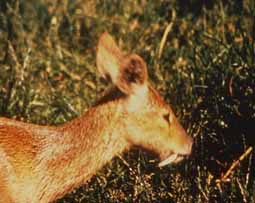
And this one from evolutionnyc:
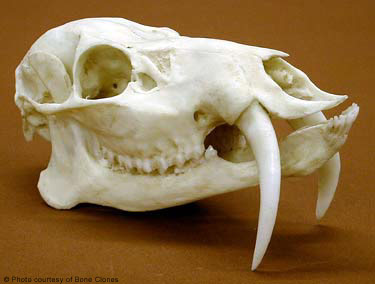
This isn't an April Fool's joke - or, if it is, it's a pretty pervasive one.
Saturday, April 22, 2006
Two recent articles in the Joongang Ilbo discuss travel and Gangwondo.
The first I treat with scepticism. Yet another airline (or possibly the same airline but with yet another date for starting) is planning to offer flights to and from Yangyang Airport. Jeju Air, a discount airline will offer flights starting in July to Gimpo and Gimhae.
The second just makes me sad. It is the story of three miserable train station attendents at the highest altitude station in Korea; Chojeon, near Taebaek. Chujeon was a thriving community until the local coal ran out. Now, no passenger trains stop here.
The article claims the temperature is so cold at that altitude that the staff run their brickette heater twenty-four hours a day eleven months of the year. Before coming to Korea, I was pretty skeptical of people who complained of the bitter cold on mountains. I have since become a believer but the highest peak of Seoraksan, Daechungbong, doesn't seem as cold as Chujeon and is twice the altitude.
I do sympathize that there is nothing to do but record which trains pass by and when, but on the other hand, I love the outdoors: I might be very happy to be posted in a location with deer and lynx.
This short quote shows how the staff don't even seem to be trying to enjoy themselves:
Look around, for crying out loud. Enjoy being away from light pollution. Your situation is almost unique in Korea, get satisfaction from that.
The article also lists other rail stations that don't see many people; the station above Samcheok sounds like an interesting trip.
The second just makes me sad. It is the story of three miserable train station attendents at the highest altitude station in Korea; Chojeon, near Taebaek. Chujeon was a thriving community until the local coal ran out. Now, no passenger trains stop here.
The article claims the temperature is so cold at that altitude that the staff run their brickette heater twenty-four hours a day eleven months of the year. Before coming to Korea, I was pretty skeptical of people who complained of the bitter cold on mountains. I have since become a believer but the highest peak of Seoraksan, Daechungbong, doesn't seem as cold as Chujeon and is twice the altitude.
I do sympathize that there is nothing to do but record which trains pass by and when, but on the other hand, I love the outdoors: I might be very happy to be posted in a location with deer and lynx.
This short quote shows how the staff don't even seem to be trying to enjoy themselves:
Mr. Kim said the place is so dark at night everything outside the door is inky black. In line with an energy conservation campaign, the Korea Railway recommended that the station leave only two lights lit during the nighttime.
“It’s only about 15 steps to the restroom outside, but walking in the dark, and hearing the strange howls from the woods, believe me, you get the creeps,” he said. His body actually visibly shuddered. “I try to run to the bathroom as fast as I can and turn on the lights in there as fast as possible, but it’ll scare you every time.”
Look around, for crying out loud. Enjoy being away from light pollution. Your situation is almost unique in Korea, get satisfaction from that.
The article also lists other rail stations that don't see many people; the station above Samcheok sounds like an interesting trip.
Friday, April 21, 2006
Muskoka in The Onion (America's Finest News-source)
If you don't know or care about smalltown Ontario, the district of Muskoka in particular, read one of my other, very interesting, entries.
This week, my home district, Muskoka was mentioned in the Onion. Who-hoo! Apparently, a beaver in Huntsville (Ontario, not Texas) is having trouble settling on a dam design plan. The village of Baysville is mentioned and a dam nearby but not the Lincoln Lodge, which is the best place to eat by a damsite!
Completely off subject, I have Octopussy on in the background. When Bond flies to India he takes a helicopter past the Taj Mahal and lands near the ghats in Varenasi - that's a long helicopter flight!
This week, my home district, Muskoka was mentioned in the Onion. Who-hoo! Apparently, a beaver in Huntsville (Ontario, not Texas) is having trouble settling on a dam design plan. The village of Baysville is mentioned and a dam nearby but not the Lincoln Lodge, which is the best place to eat by a damsite!
Completely off subject, I have Octopussy on in the background. When Bond flies to India he takes a helicopter past the Taj Mahal and lands near the ghats in Varenasi - that's a long helicopter flight!
Thursday, April 20, 2006

From wild drinking binges to reenactments of the Great Leap Forward
MT or Membership Training has come a long way, although it still seems no actual training takes place.
I have never been sure how to translate the konglish term, "Membership Training". Class Retreat? Orientation and welcome? I may be having problems due to my declining English skills (see April 19th post) or maybe it is a Korean activity that one should not translate, just as one normally doesn't translate food names. 'Samgyetang' is fine; one can add an English description but there is no need to change the name to 'Boiled whole stuffed chicken with ginseng'.
An article in the Times describes how MT is becoming less popular and also changing in focus. MT was a chance (and mostly still is) to drink without needing (or, with peer pressure, being able to) stop until every soju, makkoli, dongdongju, beer and cough medicine bottle was empty in a place far from home so someone else could clean up the resulting, reeking mess.
According to the article, some students are more eager to spend time in the library and prepare for an uncertain future. Only in Korea would that be considered noteworthy; university students studying rather than drinking. Well, that was true at my university, too; the main difference was of scale.
Other classes are going on MTs where the focus is volunteer work or training in other fields. One such group
Quoting another group:
Mao would be proud to see university students working in the fields. Alright, that's pretty sarcastic. I, too, would be happy to see students putting in a few days on farm work. I certainly wish I were available to help my father-in-law on his farm more often...well, a little more often; the right amount to make myself feel good without making myself too tired.
One final comment on students doing farm work: how does that affect FTAs? Is sending students to do free labor a kind of subsidy?
I have never been sure how to translate the konglish term, "Membership Training". Class Retreat? Orientation and welcome? I may be having problems due to my declining English skills (see April 19th post) or maybe it is a Korean activity that one should not translate, just as one normally doesn't translate food names. 'Samgyetang' is fine; one can add an English description but there is no need to change the name to 'Boiled whole stuffed chicken with ginseng'.
An article in the Times describes how MT is becoming less popular and also changing in focus. MT was a chance (and mostly still is) to drink without needing (or, with peer pressure, being able to) stop until every soju, makkoli, dongdongju, beer and cough medicine bottle was empty in a place far from home so someone else could clean up the resulting, reeking mess.
According to the article, some students are more eager to spend time in the library and prepare for an uncertain future. Only in Korea would that be considered noteworthy; university students studying rather than drinking. Well, that was true at my university, too; the main difference was of scale.
Other classes are going on MTs where the focus is volunteer work or training in other fields. One such group
... helped reconstruct farms badly ravaged by heavy snows last winter, ahead of the farming season. They stayed in abandoned elementary schools, which had been shut down, to reduce accommodation costs. They held a ``makkoli party,'' (makkoli is a Korean traditional unrefined rice wine), along with a pork barbeque which they shared with residents.
The students gave massages to the elderly and farmers, using what they learned from university, and held a basketball class for children living in the remote area. ``At first, students felt strange when they went on the volunteer trip in the region instead of their previous training which involved drinking binges,'' Kim Sang-chon, professor of the university, said.
Quoting another group:
``However, that kind of membership training is far from spiritual and academic training for freshmen. So we've decided to transform the membership training as a whole by inducing students to participate in the farmer's school,'' a school official said. Students are not allowed to consume alcohol nor enjoy ``karaoke,'' or dancing at the school. Their meal consisted mainly of vegetables harvested in the region without any meat. Under the theme of ``working, volunteerism and sacrifice'', students woke up at 5 a.m. and sang the Korean national anthem.
In the morning, they took a walk along a four-kilometer course and attended a lecture named ``successful careers.'' A 20-year-old student, identified as Kim, said that it was a great opportunity for him to understand the life and a spirit of farmers to harvest crops with their own sweat and labors.
Mao would be proud to see university students working in the fields. Alright, that's pretty sarcastic. I, too, would be happy to see students putting in a few days on farm work. I certainly wish I were available to help my father-in-law on his farm more often...well, a little more often; the right amount to make myself feel good without making myself too tired.
One final comment on students doing farm work: how does that affect FTAs? Is sending students to do free labor a kind of subsidy?
Wednesday, April 19, 2006
treatment of pets and how to help - in Korea - those poor American dogs are still suffering
A few weeks ago, I posted about Chindo Dogs in The US being killed and how terrible the Americans were. Alright, that was what the newspaper article I referenced said; I said the article was crap.
Today, the Herald had an article about mistreated dogs here.
Foreigners here in Korea, David and Catherine Peacock, started an organization to help protect these animals. It seems to be in it's beginning stages with many things planned. There is a fundraiser at Bar Nana in Itaewon on April 29. you can learn more here.
Today, the Herald had an article about mistreated dogs here.
You would be hard pressed to walk down a residential block in Seoul without noticing a chained up dog outside on a leash just a few feet long. They may be provided with the basics of food, water and a dog house, but many are not. Are these dogs given walks? Are these dogs given medical care? Are these dogs given any love or attention?
Take the example of a scruffy pup in my neighborhood whose water was a block of ice and the blanket in his dog house was frozen stiff in winter. He was fed table scraps. At only a few months old, he looked mangy and thin. How harmful is this for a dog?
Foreigners here in Korea, David and Catherine Peacock, started an organization to help protect these animals. It seems to be in it's beginning stages with many things planned. There is a fundraiser at Bar Nana in Itaewon on April 29. you can learn more here.
Losing my, ... word-bank in head thing
I have a coworker, Travis, who has been awing us with his large vocabulary.
I, on the other hand, felt it was too much trouble writing "Scribblings of the metropolitician" on my blogroll, shortened it to "the scribbler" and then misspelled that (fixed today - if you read this, Michael, sorry 'bout that).
I may have an excuse. Travis is a new guy - to my university anyway, while I have seniority - and that seniority may be doing me in.
From the Korea Herald:
One of my friends made a short trip home to the US and was teased mercilessly after he said, "I have to go to a store and buy a [big shaving motions, slow and with his face leaned forward and to one side] razor."
I know this is pretty obvious but I had hoped it would not be that bad. I actually find that I benefit from speaking more slowly; I used to stutter when I got excited and spoke too fast. Now, my pronunciation and speaking are much clearer.
I, on the other hand, felt it was too much trouble writing "Scribblings of the metropolitician" on my blogroll, shortened it to "the scribbler" and then misspelled that (fixed today - if you read this, Michael, sorry 'bout that).
I may have an excuse. Travis is a new guy - to my university anyway, while I have seniority - and that seniority may be doing me in.
From the Korea Herald:
English teachers who spend their days repeating slow, exaggerated and simplified speech risk losing their native language skills the longer they stay in Korea.
Eventually it might seem that CNN newscasters speak too fast, or when trying to find the perfect word to explain something... the word just doesn't come.
...
The loss of vocabulary and fluency is inevitable when there is a lack of educated native speakers around. Dickey lives in a small city where there are a handful of English native speakers, "so when I meet a native speaker of English, I sometimes trip over my own tongue in excitement and find myself without words. Both vocabulary and grammar seem to atrophy," he said.
Dickey suspects that a similar process happens to stay-at-home mothers, primary school teachers, and he said that he has also lost the specialized vocabulary of two professions - management and law - that he has passed through.
...
Outside of the classroom though, the simplicity can spill over into everyday conversation. Friends may find themselves subject to a lecture-style explanation with exaggerated facial expressions and hand gestures that replace complex sentence structure.
One of my friends made a short trip home to the US and was teased mercilessly after he said, "I have to go to a store and buy a [big shaving motions, slow and with his face leaned forward and to one side] razor."
I know this is pretty obvious but I had hoped it would not be that bad. I actually find that I benefit from speaking more slowly; I used to stutter when I got excited and spoke too fast. Now, my pronunciation and speaking are much clearer.
Monday, April 17, 2006
Great work, Laurie!
Gangwon Kotesol participant and acquaintance of mine, Laurie Malcolmson was featured in an editon of last week's Korea Times. Although he looks fit, he is a quiet guy and I had no idea he's the real deal when it comes to athletics. I hope I didn't brag about my own (now long-past) prowess in front of him.
Here is an exerpt:
Here is an exerpt:
Laurie Malcolmson has been running for as long as he can remember. When asked why he started running, he replies, ``I dunno. I grew
up on a farm, and I just started running. I guess it was the natural thing to do.’’He set the New Zealand record for the 100-meter dash, an amazing 10.4 seconds, more than 30 years ago. It has only barely been broken to this day, and at the ripe age of 56 he is still one of the fastest _ at least in his age category _ men alive, clocking the 100_meter dash in a hair under 12 seconds.
The blond, blue-eyed, soft-spoken Kiwi who lives and teaches English in Donghae, Kangwon Province, has raced against the best in track and field competitions all over the world. He recently returned from his native New Zealand, where he placed first in an international masters’ decathlon event entailing a 100-meter dash, long jump, shot put, high jump and 400-meter dash on the first day, followed by 110-meter hurdles, discus, pole vault, javelin and 1,500-meter run on the second day.
Saturday, April 15, 2006
Hans Island Rider(s?)
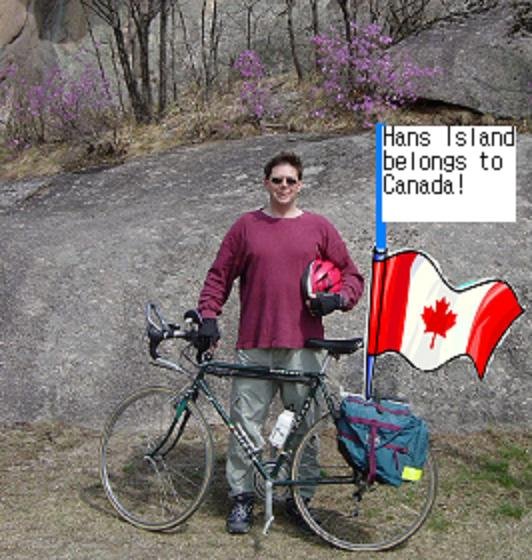
I have been inspired by the Dokdo Riders. I will be a Hans Island Rider and travel across Korea (or, at least, part of Gangwondo) telling people about how Denmark is trying to steal our island, Hans Island, away from us wonderful Canadians. I will ask Koreans whether Hans Island is marked on their maps as Canadian territory or erroneously as Danish Territory.
I need to make some flyers explaining the value of our claim. I hope the flag and the banner don't slow my cycling down too much.
To learn more about Hans Island, listen to their radio broadcasts.
Who will join me? No Bernard Carleton, please. Canadians welcome.
I will even lobby back in Canada for support for Danish Cartoonists if they give up on Canada's Island.
...
Well, Hell. It looks like some accommodation has already been made. There is a joint Canadian-Danish expedition mapping the Arctic Ocean floor in the vicinity.
Hmmm. Can I settle for a compromise? I will settle only when Korea and Japan agree to have one island each (East Island for Japan, West Island for Korea).
Sorry about the short but link-heavy post. I had planned to actually hang a flag and sign off the back of my bike and bother some Koreans with flyers but I turned out to be too lazy. Oh, and I already do support the Danes in their troubles over cartoons.
Saturday, April 08, 2006
I'm so envious!
This post has nothing to do with Korea - although I guess I could work in some comparison with the Dok-do riders and a pair of real adventurers.
Two men from my hometown rode through Mexico and Central America for the winter. They apparently covered about 9,000km on their bikes during the trip.
Barrie Faulkner was the one who really encouraged me to ride and taught me that distance riding is as simple as just getting on the bike and putting time in. You don't have to be a super-hero or Lance Armstrong to cover vast distances, you just have to be patient. I coached his son Nat in swimming nearly twenty years ago.
I have pasted large portions of the Bracebridge Examiner story as their archived articles disappear after three weeks.
Bracebridge resident Barrie Faulkner, 58, lost about 15 pounds, carried more than 100 pounds of supplies and rode across 9,400 km of Central America and Mexico on his bicycle this winter.
He returned home March 12 with a tan, a smile and hundreds of stories to tell.
Faulkner and his son Nat, 27, started their three-month trek in San Diego, California on December 19. They finished in Panama City March 10 after travelling at a pace of about 120 km a day through the Mayan ruins and third world countries.
...
"I don’t think I could take a single day and not write a chapter in a book people would want to read," Faulkner said. "You wake up in the morning and don’t know what kind of adventure you’re going to have."
To finish the trip, Faulkner rode from the Pacific Ocean, to the Atlantic Ocean and back in a day, a 170-km ride across Panama with 8,000 feet of uphill climbing.
The father and son were chased by thousands of wild dogs and surrounded by vehicles of armed men — who turned out to be escorts worried about their safety — but were never harmed.
"We had armed men in a vehicle in front of us and armed men behind us travelling six kilometres an hour up a mountain for about two hours. I said we’re either really safe right now or really up a creek," Faulkner said. "When we started we were told we’d get mugged 10 times and stabbed. I never felt in danger. Everyone’s just overcautious. If we dropped a coin, somebody would point at it and let us know. Go. Ignore all the people telling you all this stuff. Just don’t be stupid and wear jewellery and try to pick up the local girls who belong to somebody else."
Everywhere along the ride, Faulkner said he gathered stories about people who worked hard, had little, but kept smiling, including one stop where townspeople led him to the central well and suggested he camp there. He gave four pieces of candy to a group of children, who later showed up with fried tortillas, blankets and an offer to use their showers. The boys also tried to draw a copy of Faulkner’s Canadian flag.
Two men from my hometown rode through Mexico and Central America for the winter. They apparently covered about 9,000km on their bikes during the trip.
Barrie Faulkner was the one who really encouraged me to ride and taught me that distance riding is as simple as just getting on the bike and putting time in. You don't have to be a super-hero or Lance Armstrong to cover vast distances, you just have to be patient. I coached his son Nat in swimming nearly twenty years ago.
I have pasted large portions of the Bracebridge Examiner story as their archived articles disappear after three weeks.
Bracebridge resident Barrie Faulkner, 58, lost about 15 pounds, carried more than 100 pounds of supplies and rode across 9,400 km of Central America and Mexico on his bicycle this winter.
He returned home March 12 with a tan, a smile and hundreds of stories to tell.
Faulkner and his son Nat, 27, started their three-month trek in San Diego, California on December 19. They finished in Panama City March 10 after travelling at a pace of about 120 km a day through the Mayan ruins and third world countries.
...
"I don’t think I could take a single day and not write a chapter in a book people would want to read," Faulkner said. "You wake up in the morning and don’t know what kind of adventure you’re going to have."
To finish the trip, Faulkner rode from the Pacific Ocean, to the Atlantic Ocean and back in a day, a 170-km ride across Panama with 8,000 feet of uphill climbing.
The father and son were chased by thousands of wild dogs and surrounded by vehicles of armed men — who turned out to be escorts worried about their safety — but were never harmed.
"We had armed men in a vehicle in front of us and armed men behind us travelling six kilometres an hour up a mountain for about two hours. I said we’re either really safe right now or really up a creek," Faulkner said. "When we started we were told we’d get mugged 10 times and stabbed. I never felt in danger. Everyone’s just overcautious. If we dropped a coin, somebody would point at it and let us know. Go. Ignore all the people telling you all this stuff. Just don’t be stupid and wear jewellery and try to pick up the local girls who belong to somebody else."
Everywhere along the ride, Faulkner said he gathered stories about people who worked hard, had little, but kept smiling, including one stop where townspeople led him to the central well and suggested he camp there. He gave four pieces of candy to a group of children, who later showed up with fried tortillas, blankets and an offer to use their showers. The boys also tried to draw a copy of Faulkner’s Canadian flag.
Friday, April 07, 2006
Was Edison from Eastern Europe?
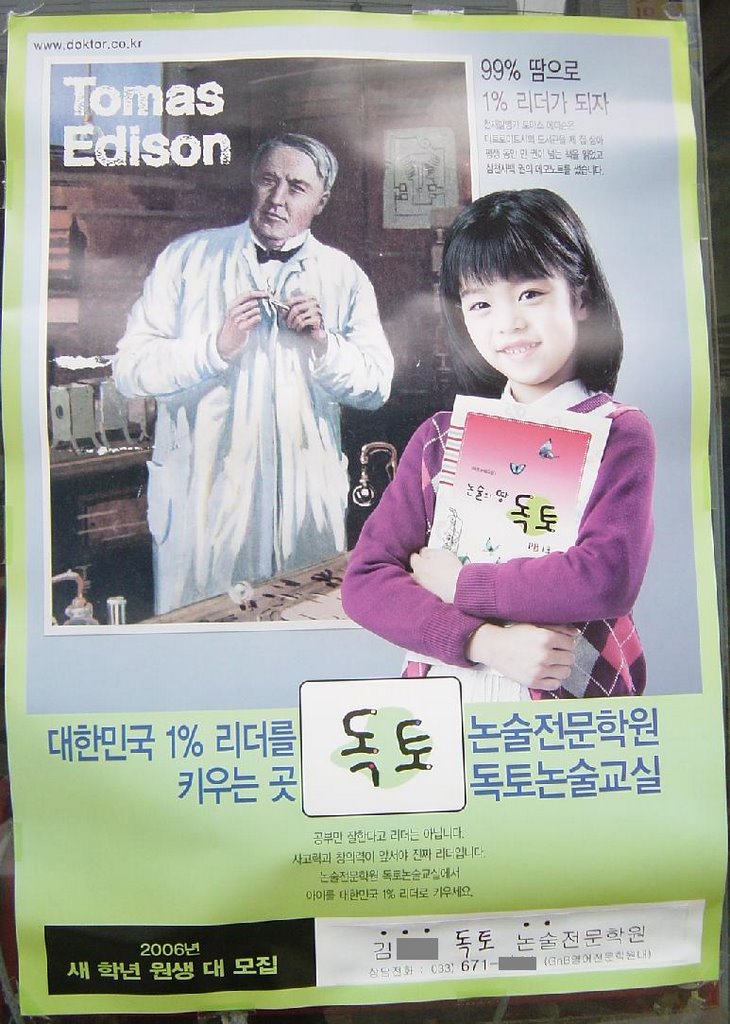
They spell the name, "Tomas" rather than "Thomas" in the old country, don't they?
Edison was a remarkable man and using his name to promote a hagwon seems like a good idea, but I would have done some basic research on the name (okay, now is the time to report all my spelling errors on this blog).
Loose nets
Last summer, Yankabroad complained about nets that have come loose and drifted into shore. I've never noticed any around the beaches but perhaps the nets aren't emplaced near beaches. This rocky shore has collected it's share.

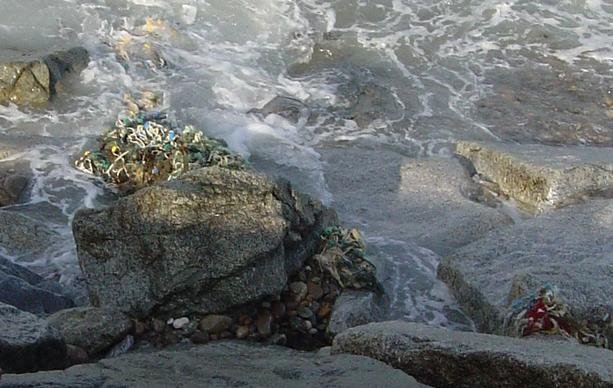
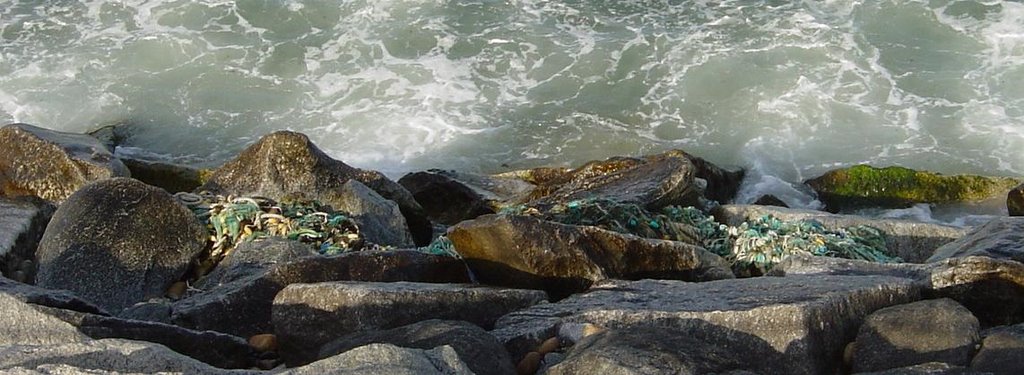

Wednesday, April 05, 2006
English spelling is inconsistent
I found a site that is dedicated to simplifying English spelling. Of note to edutainers like myself are the poems that highlight crazy English pronunciation and spelling.
Here are some of the spelling changes they suggest be adopted.
Poems showing the absurdities of English spelling.I take it you already know
Of tough and bough and cough and dough?
Others may stumble, but not you,
On hiccough, thorough, lough and through?
Well done! And now you wish, perhaps,
To learn of less familiar traps?
Beware of heard, a dreadful word
That looks like beard and sounds like bird,
And dead: it's said like bed, not bead - For goodness sake
don't call it deed!
Watch out for meat and great and threat
(They rhyme with suite and straight and debt).
Here are some of the spelling changes they suggest be adopted.
1. SR1/short E - use E always as in: eny, meny, frend, hed.
2. PH - replace
by F as in: foto, telefone.
3. augh - either delete the GH as in caut,
dauter, nauty or replace UGH with F as in laf, draft.
4. ough - either
(a) drop the GH as in bou, drout, plou, or
(b) change to AU as in baut,
thaut, saut, or
(c) change to OF or UF as in cof, trof; enuf, tuf; or
(d) cut to O as in tho, altho, or
(e) cut to U as in thru.
5. DUE -
as in hav, giv, negativ, opposit.
Sunday, April 02, 2006
From the hills overlooking Sokcho
Sokcho, this morning, was cool and we stayed in, only venturing out around two pm. As we shopped the skies cleared and the late afternoon became wonderful.
KwandongAlex and I went for a hike. Just above our apartment, is a set of low mountain that I had never explored. KwandongYoungnam was pregnant last spring so we didn't hike much.
Wow, look what we missed.
The Azaleas are just beginning to bloom.
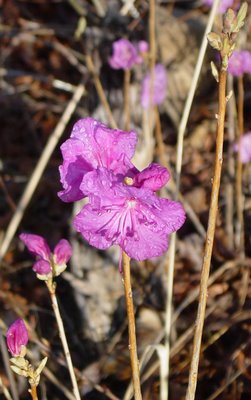
This pic is out of order. I took it as we left the mountain. I had hiked until Alex fell asleep, then turned back.
KwandongAlex and I went for a hike. Just above our apartment, is a set of low mountain that I had never explored. KwandongYoungnam was pregnant last spring so we didn't hike much.
Wow, look what we missed.
The Azaleas are just beginning to bloom.

This pic is out of order. I took it as we left the mountain. I had hiked until Alex fell asleep, then turned back.
.jpg)
At our highest point, this was our view. Below is our apartment and a million others and Lake Cheongcho..jpg)
Friday, March 31, 2006
Terrus strongylocentratus found in Korea
Terrestrial urchins have long been known in Russia but these are some of the first found in Korea.
The AAAS (American Association for Advancement of Science) Science Journal article can be found here (registration required for the full article).
I have been (un)lucky enough to sight some myself. Just as with coral reef infestations, first you find one:
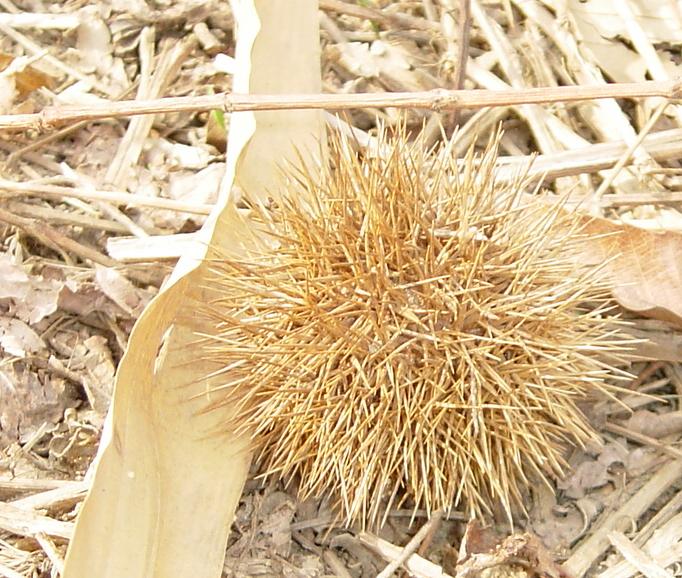
Then you find blooms of them.
I do not know if these are actually poisonous as many of their aquatic relatives are. In fact I could find little information about them. Local farmers and orchard owners obviously should use caution. Foxes are natural predators of urchins and possibly raccoon-dogs are as well. Perhaps this threat might be a boon for other native wildlife if they are re-introduced to combat the menace.
At Enchanted Learning, I found this diagram of sea urchins.
The pot calling the ...shiny, white thing, black.
Man, I have to learn how to fisk. I have just finished reading (and even re-reading a few times) a terrible article that seems to display poor research, ridiculously loaded terminology and especially stunning hypocrisy, and I don't think I can do justice to it.
The article is called, "Chindo Dogs on American Death Row". The background info, I can accept: A Korean breed of dog, called the Chindo after the island it originated from, is so well-loved that it is an official national treasure. Some Koreans in the US and US servicemen (service-people?) brought the dog to the US. Now there are more Chindo than homes for them and some are ending up in shelters. Why do they end up in shelters? Because, like many purebreeds (the Dalmatian is a good example), the Chindo does many things well but is not really a cuddly house pet for city-folk.
Part of the problem or outrage felt by Koreans may be because the dogs are legally protected in Korea.
Okay, that's the background.
Let's see the third paragraph:
I have just learned that at the Toronto Humane Society, "No animal is ever euthanized due to lack of space or because the animal has simply “been here too long.”, which surprised me because I thought three days was the typical garranteed stay for animals and as space was needed, longer-term guests might be euthanized. Still, that is the Humane Society. There are other shelters and they are trying to help the situation. I don't particularly blame the doctor for the cancer that killed my father. To blame the shelters is crazy.
There is one specific case described and it involved a US serviceman:
Firstly, all the best to the serviceman involved. Come home safe.
This is where my claim of hypocrisy comes in. Koreans may wonder why the parents couldn't care for the dog. They may think, "Was it too hard to carry food and water to the one meter by one meter by one meter cage the dog is just-naturally kept in?" QUALITY OF LIFE, PEOPLE! Sorry to shout but I get sick seeing almost every dog on a one meter line or in a small cage for their entire life.
The article comes with a picture that seems to prove me wrong but really shows the only two dogs in all of Korea that have some freedom.
Chindo on Chin Island ..................Chindo in it's natural habitat
(from the article)..............................(link)
While I type this, the neighbor's tiny dog yaps constantly because it's owners are away. The dog does this all day, everyday. Now, it isn't a wonderful Chindo but it is a living thing. I feel all dogs should be walked by their owners for exercise daily and I don't see many Koreans doing that.
The chindo is described as a hunting dog in the article:
Where to start? First most Koreans dogs seem to be raised alone - again, in their own private cages.
We read that Chindo sometimes attack their owners but later, "...the overall impression they give is one of gentleness..."
As I said at the beginning, I don't know if I did the article justice. I guess I am most displeased by the 'Those horrible Americans" theme when little blame for the admittedly bad situation of having the unwanted dogs put down is given to the Koreans who own most of the dogs.
The article is called, "Chindo Dogs on American Death Row". The background info, I can accept: A Korean breed of dog, called the Chindo after the island it originated from, is so well-loved that it is an official national treasure. Some Koreans in the US and US servicemen (service-people?) brought the dog to the US. Now there are more Chindo than homes for them and some are ending up in shelters. Why do they end up in shelters? Because, like many purebreeds (the Dalmatian is a good example), the Chindo does many things well but is not really a cuddly house pet for city-folk.
Part of the problem or outrage felt by Koreans may be because the dogs are legally protected in Korea.
Okay, that's the background.
Let's see the third paragraph:
But, each year in the U.S. hundreds are either turned out, literally dumped, or given up by their owners, inviting certain death in ``kill'' shelters where animals are quickly euthanized if new homes cannot be found.We will see the phrase "kill shelters" many more times. You may wonder about 'kill shelters' and the certain death they house. Later in the article, we get a definition of sorts:
...many of the Los Angeles County shelters are ``high-kill'' shelters in which Jorgensen said dogs ``generally have three days to be adopted before they are euthanized.'' Many do not leave alive.
I have just learned that at the Toronto Humane Society, "No animal is ever euthanized due to lack of space or because the animal has simply “been here too long.”, which surprised me because I thought three days was the typical garranteed stay for animals and as space was needed, longer-term guests might be euthanized. Still, that is the Humane Society. There are other shelters and they are trying to help the situation. I don't particularly blame the doctor for the cancer that killed my father. To blame the shelters is crazy.
There is one specific case described and it involved a US serviceman:
...the eight-year-old chindo was adopted in Korea by a U.S. serviceman who later raised it in the U.S. It grew up on military bases, including Fort Bragg, just west of Fayetteville, N.C., before being flown to Afghanistan when its owner was posted there. However, the dog ``was not welcome there so he was flown home to Pennsylvania and has been taken care of by the owner's parents.'' The dog has since been surrendered to the shelter because the soldier's parents are no longer able to care for it. The soldier is said to be on his second tour of duty in Afghanistan.
Firstly, all the best to the serviceman involved. Come home safe.
This is where my claim of hypocrisy comes in. Koreans may wonder why the parents couldn't care for the dog. They may think, "Was it too hard to carry food and water to the one meter by one meter by one meter cage the dog is just-naturally kept in?" QUALITY OF LIFE, PEOPLE! Sorry to shout but I get sick seeing almost every dog on a one meter line or in a small cage for their entire life.
The article comes with a picture that seems to prove me wrong but really shows the only two dogs in all of Korea that have some freedom.


(from the article)..............................(link)
While I type this, the neighbor's tiny dog yaps constantly because it's owners are away. The dog does this all day, everyday. Now, it isn't a wonderful Chindo but it is a living thing. I feel all dogs should be walked by their owners for exercise daily and I don't see many Koreans doing that.
The chindo is described as a hunting dog in the article:
``They don't understand the traits of the chindos, and because of it, they are sometimes attacked. So, as the reputation of these dogs grows around the world, it is necessary to properly inform people of the traits of the chindos. If owners keep in mind certain things the dogs would be their best pet.'' Park Byung-chul believes, ``Americans view chindo dogs as animals that bite easily and then because of it, they tend to not like [them]. Koreans, on the other hand, most value [their] loyalty. Obviously, the dogs have negative traits like hunting instincts. However, if chindo dogs are raised alone and not in a group as they should be, there would be no problems in raising [them].''
Where to start? First most Koreans dogs seem to be raised alone - again, in their own private cages.
We read that Chindo sometimes attack their owners but later, "...the overall impression they give is one of gentleness..."
As I said at the beginning, I don't know if I did the article justice. I guess I am most displeased by the 'Those horrible Americans" theme when little blame for the admittedly bad situation of having the unwanted dogs put down is given to the Koreans who own most of the dogs.
Wednesday, March 29, 2006
Driving from Seorak to Odae
GI Korea has started describing great drives in Korea. Naturally, one of his first posts is about my neighborhood.
He describes a back road from Southern Seoraksan National Park to Odaesan National Park. If I ever get into fantastic bike-shape, I may try it but the road has some serious changes in elevation.
I had to laugh at one phrase, "...the city of Yangyang..." I lived in Yangyang for two years and am nearby now. Where is the city?
Visit GI if you want to know more.
He describes a back road from Southern Seoraksan National Park to Odaesan National Park. If I ever get into fantastic bike-shape, I may try it but the road has some serious changes in elevation.
I had to laugh at one phrase, "...the city of Yangyang..." I lived in Yangyang for two years and am nearby now. Where is the city?
Visit GI if you want to know more.
He's just jealous of us!
...Although, if we change the word, 'CANADIANS' (in the third paragraph) to 'ESL teachers', he might have the majority opinion these days. The Seoul Hero is the only one defending ESL that I can find.
I can't improve on the Herald's article. Here it is in full (including the email address the Herald reporter included - I was uncertain of the etiquette, but the reporter must know what people are likely to do with the address and they have a larger circulation than Gangwon Notes).
UPDATE: After writing and publishing this post, I began to wonder about the timing and believability of this article. If this is an April Fools joke - ya got me - but only for an hour or so.
UPDATE 2: If was an April Fool's joke as I sort of guessed. Cathartidae broke the story.
I can't improve on the Herald's article. Here it is in full (including the email address the Herald reporter included - I was uncertain of the etiquette, but the reporter must know what people are likely to do with the address and they have a larger circulation than Gangwon Notes).
Canadians banned from group for cultural understanding
I found the ad itself at KScene.An organization that promotes cultural understanding and brings together people from different nations is open for anyone in Seoul to join. Anyone that is, except Canadians.
In a classified ad in KScene, a free biweekly magazine, World Class describes itself as a group that "brings together all nationalities to discuss world issues and break down cultural barriers and prejudices."
Breaking down the prejudices, however, doesn't extend to all countries. "No Canadians please," the ad continues.When contacted by a Korea Herald reporter by e-mail, the organizer of the group, Bernard Carleton, elaborated further, "The thing is, CANADIANS ARE SCUM! They are self-loving, welfare supporting, over taxing, work ethic hating scum!!! They are not welcome in our group."
Anyone who would like to join the meetings with Carleton in order to break down prejudices, dissolve stereotypes and have an enhanced understanding of people from other countries can contact him at cbicsmd@yahoo.co.
World Class is an organization in Seoul that brings together all nationalities to discuss world issues and break down cultural barriers and prejudices. We meet once a week. No Canadians please. Contact cbicsmd@yahoo.com
UPDATE: After writing and publishing this post, I began to wonder about the timing and believability of this article. If this is an April Fools joke - ya got me - but only for an hour or so.
UPDATE 2: If was an April Fool's joke as I sort of guessed. Cathartidae broke the story.
Monday, March 27, 2006
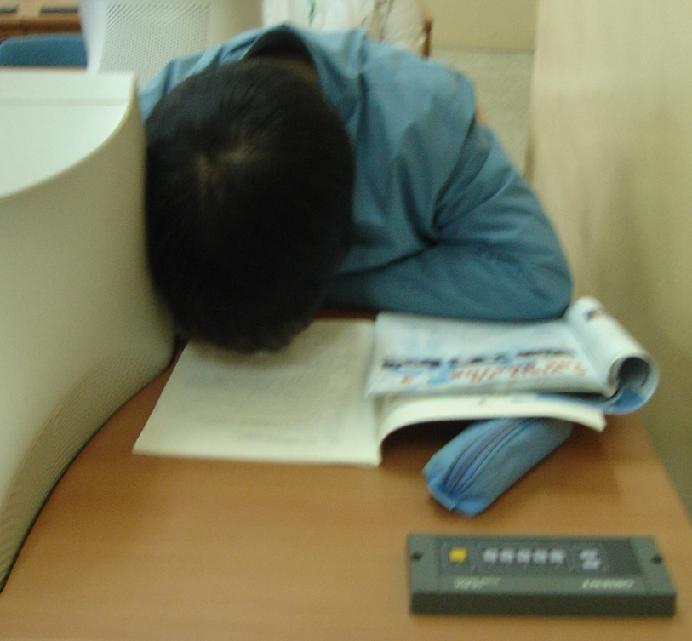
Thursday, March 23, 2006
Homework, the easy way
Recently, two students emailed me their homework - and very strange homework it was, too. Having taught university students for a few years now, I immeditaely recognized what I was looking at. The assignment was to list ten goals they had for the next ten years.
Here are the two emails (lightly editted to hide identity and with my favorite entries highlighted)
How are you the Brian Dean teacher....
my name's **** ****
my number : 200******
I must want doing after 10 years
1) With the pretty wife it will get married
2 )It wants doing the engineering works day which I am majoring now
3) It joins to the early rising football sliced raw fish and morning will exercise
4) Health to come and go and manage inside oneself
5) The hook will come and go with a hobby
6) One it wants learning the musical instrument. Piano??
7) Will acquire the engineering works technical company qualification certificate
8) Will change a travel in Italy. And Canada??
9) Will associate the Canada friend. Brian Dean
10) ) And now it is in that person and travel. From Italy
^^ have a! good time
____________________________________________________
Monday 5.6 periods class repot
Hagosips are 10 after 10 years
1)I want to get married
2)I want to have child
3)I want to have robust rectum
4)I want to earn much money
5)I want to go to travel
6)I want to have good wife
7)I should like to be easy life
8)Is dutiful to parent
9)There should like to be much good fatality
10)Day should like to be full
Major:With engineering works environmentology
Hakbeon:200****
Name:Lee ***-****
Let's see. The first assignment is in the third person-inanimate. "...it will get married." This is the first clue to what the student has done- use an internet translator like Babelfish.
This is because the subject is not always requried in Korean. The example I use in class is "사과를 좋아한다" - "like apples" or in proper English, 'I like apples." The internet translator usually chooses the simpliest pronoun -'It".
The second clue is found in the third entry "...football sliced raw fish". Masuro helped me here. The Korean would have been "죽구회" or Chuk-gu hoe. 'Chuk-gu' is football or soccer. the tricky word is 'hoe'. You don't use in the garden for describe inner-city women with this hoe. I usually find the word 'hoe' on restaurants - it means raw fish - usually sliced. With a sport, though, it means 'league' or 'club'. The student wants to join a soccer league to get some exercise.
The situation must be the same for 'hook come and go with a hobby' entry and the two highlighted entries in the second student's homework ('Robust rectum' and 'many good fatality') although I am unable to guess the root words and what the translation error is.
This being Korea, with it's citizen's fascination with asses, farts and more in the vein, maybe the student does want a robust rectum - that may be protection from 'ddong chim'- a two-finger stab between the cheeks.
Oh, 'hagosips' translates as 'wants'. I don't know why the translator simply changed the alphabet.
I feel sympathy for the students and they did hand their homework in way early. I like that enthusiasm so I gave them the opportunity to hand in the assignment again with no penalty.
Here are the two emails (lightly editted to hide identity and with my favorite entries highlighted)
How are you the Brian Dean teacher....
my name's **** ****
my number : 200******
I must want doing after 10 years
1) With the pretty wife it will get married
2 )It wants doing the engineering works day which I am majoring now
3) It joins to the early rising football sliced raw fish and morning will exercise
4) Health to come and go and manage inside oneself
5) The hook will come and go with a hobby
6) One it wants learning the musical instrument. Piano??
7) Will acquire the engineering works technical company qualification certificate
8) Will change a travel in Italy. And Canada??
9) Will associate the Canada friend. Brian Dean
10) ) And now it is in that person and travel. From Italy
^^ have a! good time
____________________________________________________
Monday 5.6 periods class repot
Hagosips are 10 after 10 years
1)I want to get married
2)I want to have child
3)I want to have robust rectum
4)I want to earn much money
5)I want to go to travel
6)I want to have good wife
7)I should like to be easy life
8)Is dutiful to parent
9)There should like to be much good fatality
10)Day should like to be full
Major:With engineering works environmentology
Hakbeon:200****
Name:Lee ***-****
Let's see. The first assignment is in the third person-inanimate. "...it will get married." This is the first clue to what the student has done- use an internet translator like Babelfish.
This is because the subject is not always requried in Korean. The example I use in class is "사과를 좋아한다" - "like apples" or in proper English, 'I like apples." The internet translator usually chooses the simpliest pronoun -'It".
The second clue is found in the third entry "...football sliced raw fish". Masuro helped me here. The Korean would have been "죽구회" or Chuk-gu hoe. 'Chuk-gu' is football or soccer. the tricky word is 'hoe'. You don't use in the garden for describe inner-city women with this hoe. I usually find the word 'hoe' on restaurants - it means raw fish - usually sliced. With a sport, though, it means 'league' or 'club'. The student wants to join a soccer league to get some exercise.
The situation must be the same for 'hook come and go with a hobby' entry and the two highlighted entries in the second student's homework ('Robust rectum' and 'many good fatality') although I am unable to guess the root words and what the translation error is.
This being Korea, with it's citizen's fascination with asses, farts and more in the vein, maybe the student does want a robust rectum - that may be protection from 'ddong chim'- a two-finger stab between the cheeks.
Oh, 'hagosips' translates as 'wants'. I don't know why the translator simply changed the alphabet.
I feel sympathy for the students and they did hand their homework in way early. I like that enthusiasm so I gave them the opportunity to hand in the assignment again with no penalty.
Saturday, March 18, 2006
I'm thinking of selling my bike...
...Because I had the best damn ride today and have trouble thinking there will be a better one. "Leave on a high note", as George Kostanza would say. Okay, the bike isn't for sale; I'm really expecting a fantastic spring of riding.
My course was from Sokcho, go south on the highway past Sunrise Park and then inland to Jinjeon Temple and nearby reservior. From there, I returned inland. having an easy tim eof it thanks to a new tunnel.
At Sunrise park, I saw a 'Namja Haenyo". Haenyo are Jeju women who dive to collect seafood all year long. I don't think the local term is haenyo but the man laughed and said yes when I asked.
Nearby were two small boats. I am not an expert but I am knowledgable about how to paddle most canoes, row most boats and racing shell and to kayak. I want to learn how to paddle with one arm and one leg as the Burmese do (I know the country is now Myanmar - what are people from Myanmar called?) and to scull as the Koreans do.
 I turned inland off the highway at the Jinjeonsa sign but the road is pretty difficult to follow. I passed many pigfarms and got a little lost. I asked some farmers where to go and they said to go straight - on a road that twisted like a snake - but I understood to stay on that road and it worked.
Jinjeonsa was an important temple years ago but was destroyed. It was very interesting then to see archeology grid and leftovers - broken carved stones and stone foundations for the buildings. The new Jinjeon is only a year old and I think it looks great now, before they eventually add the paint.
 I had trouble posting seven pictures in one post so you can learn about the end of trip below.
My course was from Sokcho, go south on the highway past Sunrise Park and then inland to Jinjeon Temple and nearby reservior. From there, I returned inland. having an easy tim eof it thanks to a new tunnel.
At Sunrise park, I saw a 'Namja Haenyo". Haenyo are Jeju women who dive to collect seafood all year long. I don't think the local term is haenyo but the man laughed and said yes when I asked.
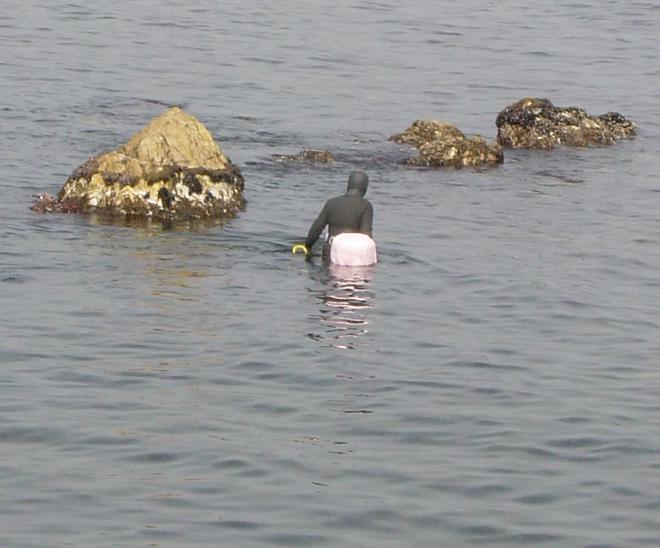
Nearby were two small boats. I am not an expert but I am knowledgable about how to paddle most canoes, row most boats and racing shell and to kayak. I want to learn how to paddle with one arm and one leg as the Burmese do (I know the country is now Myanmar - what are people from Myanmar called?) and to scull as the Koreans do.
 I turned inland off the highway at the Jinjeonsa sign but the road is pretty difficult to follow. I passed many pigfarms and got a little lost. I asked some farmers where to go and they said to go straight - on a road that twisted like a snake - but I understood to stay on that road and it worked.
Jinjeonsa was an important temple years ago but was destroyed. It was very interesting then to see archeology grid and leftovers - broken carved stones and stone foundations for the buildings. The new Jinjeon is only a year old and I think it looks great now, before they eventually add the paint.
 I had trouble posting seven pictures in one post so you can learn about the end of trip below.
Jinjeon Temple trip
The temple overlooks a reservior. Its a beautiful setting when the reservior is full. Skindleshanks told me Sokcho is suffering from a water shortage; seeing this, I believe him. There's not much water in the mountains now.
I got a little lost on the way home. I was determined to take an inland route but had to ask around to find how to get over one of the ranges. I went a great distance out of my way but it was worth it. I found a shaman's tree. There is a bottle of makoli to the right of the tree that might be an offering.
 These bottles and the rest are nothing but garbage, however.
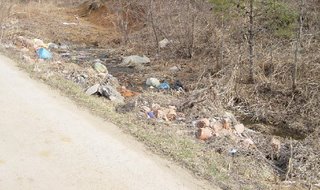 I finally found my way to the Mu-u-jae Tunnel. Last year I struggled up and over the hill and nearly threwup. Although I rode 40km today, I consider myself a lazy cyclist. I am very happy there is now an alternative. The tunnel is well-lit and not long; I did not feel nervous at all rolling through it.
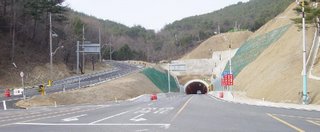

I got a little lost on the way home. I was determined to take an inland route but had to ask around to find how to get over one of the ranges. I went a great distance out of my way but it was worth it. I found a shaman's tree. There is a bottle of makoli to the right of the tree that might be an offering.
 These bottles and the rest are nothing but garbage, however.
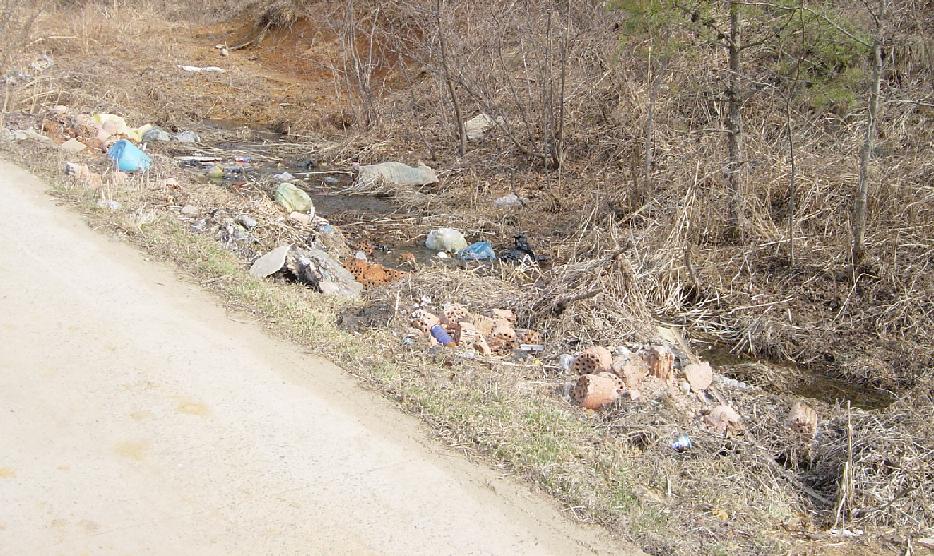 I finally found my way to the Mu-u-jae Tunnel. Last year I struggled up and over the hill and nearly threwup. Although I rode 40km today, I consider myself a lazy cyclist. I am very happy there is now an alternative. The tunnel is well-lit and not long; I did not feel nervous at all rolling through it.
Friday, March 17, 2006
New Lego
Being a dad has brought to mind my old toys. Of course I don't remember any toys specifically from my first year, but I do remember many toys. I am excited waiting for KwandongAlex to be old enough to play with the toys I remember.
Let's see. There were Tonka Trucks, a variety of stuffed animals, a Ready Ranger Pack (worth a post of it's own) and Lego, wonderful Lego.
 Modern Lego, though, looks like a better toy for me now, than for a child. Check out Mindstorm.
Lego has made a robot brain, sensor array and motors that can be built around with a variety of blocks, wheels and all the rest that Lego makes.
 Do I need to say that I really want one? Of course, modern Lego is much more than I had thirty years ago. Apparently there is more variety than square and rectangular blocks. Well, I can't wait.
Let's see. There were Tonka Trucks, a variety of stuffed animals, a Ready Ranger Pack (worth a post of it's own) and Lego, wonderful Lego.
 Modern Lego, though, looks like a better toy for me now, than for a child. Check out Mindstorm.
Lego has made a robot brain, sensor array and motors that can be built around with a variety of blocks, wheels and all the rest that Lego makes.
 Do I need to say that I really want one? Of course, modern Lego is much more than I had thirty years ago. Apparently there is more variety than square and rectangular blocks. Well, I can't wait.
Saturday, March 11, 2006
Visibility is crappy - is the 'hwang-seo' back?
UPdate 2: I mis-spelled yellow dust in Korean - it should be hwang-sa. Sounds like a temple. Thanks Kevin.
UPdate: Yes, the yellow dust (in Korean, Hwang-seo) is back. Arirang noon news described the situation and forecast the air being clearer tomorrow (Sunday). Sunday will also be much cooler as the wind that brings the dust is from the north. People at risk (the young, the elderly and those with breathing problems) should stay inside or wear a mask today.
Yellow dust is dust from China's deserts that is carried great distances. Some of the dust is composed of pollutants and some is radioactive, but inhaling even relatively benign dust makes breathing difficult. A few years ago in Seoul, I could barely see 100 metres. Visibility today is better but we don't have the open sky Coastal Gangwondo is known for.
I found in the Chosun information about the yellow dust in Seoul on Friday and checked some weather sites but found no information on yellow dust here. Is there a good dust forecasting site? Should I keep my little guy in and place a towel over his mouth just to be sure?
Skindleshanks, take care of your little guy as I know he is having breathing difficulties these days. All the best.
UPdate: Yes, the yellow dust (in Korean, Hwang-seo) is back. Arirang noon news described the situation and forecast the air being clearer tomorrow (Sunday). Sunday will also be much cooler as the wind that brings the dust is from the north. People at risk (the young, the elderly and those with breathing problems) should stay inside or wear a mask today.
Yellow dust is dust from China's deserts that is carried great distances. Some of the dust is composed of pollutants and some is radioactive, but inhaling even relatively benign dust makes breathing difficult. A few years ago in Seoul, I could barely see 100 metres. Visibility today is better but we don't have the open sky Coastal Gangwondo is known for.
I found in the Chosun information about the yellow dust in Seoul on Friday and checked some weather sites but found no information on yellow dust here. Is there a good dust forecasting site? Should I keep my little guy in and place a towel over his mouth just to be sure?
Skindleshanks, take care of your little guy as I know he is having breathing difficulties these days. All the best.
Friday, March 10, 2006
Does the Nomad fish like this?
I doubt it. The Nomad, I think, fishes legally and in a sustainable fashion.
This really pisses me off. People snagging fish with giant treble hooks. I am not pissed off to see the guy (although women do fish in Korea) got snagged himself on the light-standard.
To make things worse, anyone fishing here is as likely to catch a duck as a fish. Any fish caught in this polluted lake would be pretty frightening to eat.
 I saw a lot of people snagging salmon in spawning season in Yangyang's Namdae River. The water there was just as shallow as CheungCho Lake but much clearer so I could see that the snaggers would bring one in for every three or more they would rip open but lose.
This really pisses me off. People snagging fish with giant treble hooks. I am not pissed off to see the guy (although women do fish in Korea) got snagged himself on the light-standard.
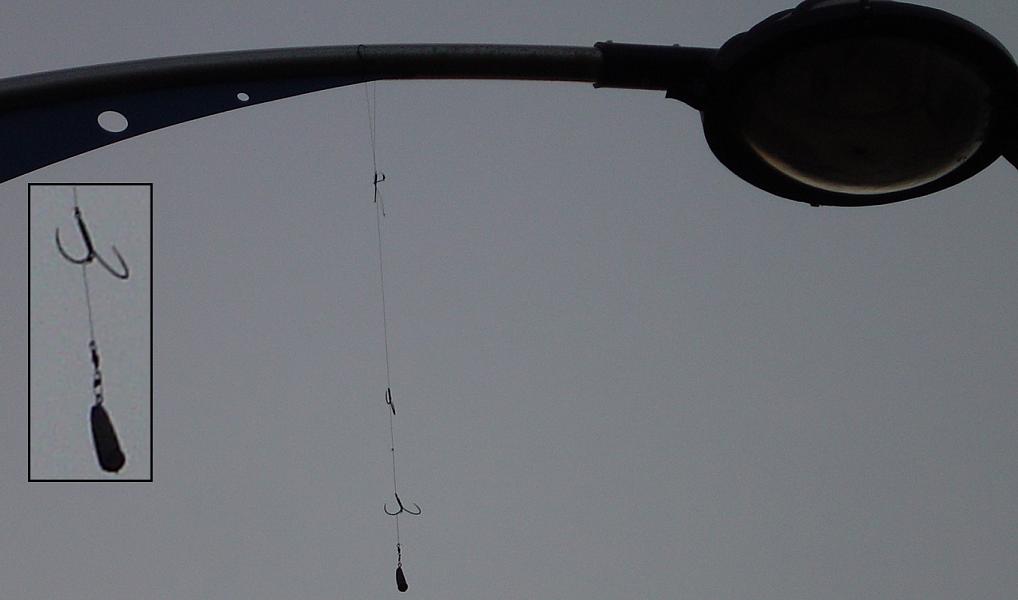
To make things worse, anyone fishing here is as likely to catch a duck as a fish. Any fish caught in this polluted lake would be pretty frightening to eat.
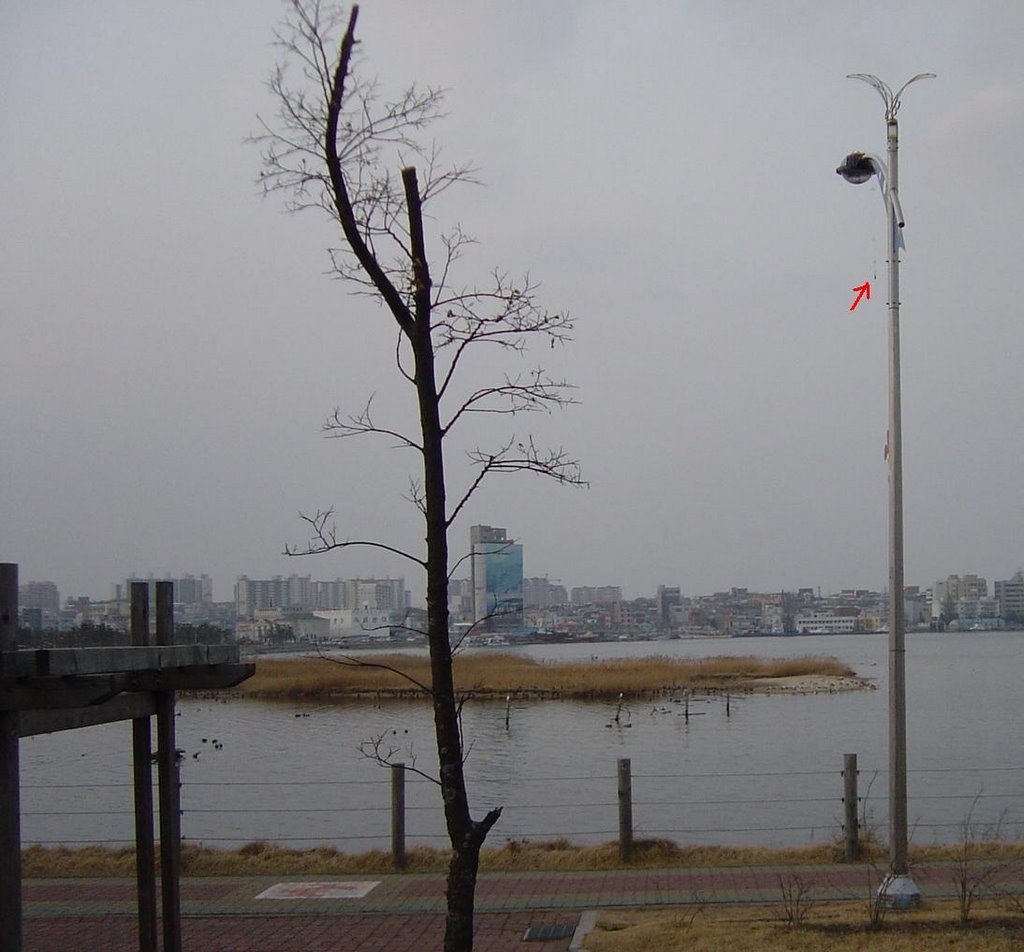 I saw a lot of people snagging salmon in spawning season in Yangyang's Namdae River. The water there was just as shallow as CheungCho Lake but much clearer so I could see that the snaggers would bring one in for every three or more they would rip open but lose.
Subscribe to:
Posts (Atom)


 Posts
Posts


