Showing posts with label Naksan Temple. Show all posts

Tuesday, April 08, 2008

Early April, the season of temple fires

Luckily, it is not in Gangwondo this time. Ah, luckily is probably not the right word. Fortunately for Gangwondo, it is not a local fire. Yeah, that's better.

A fire in Jeollanamdo threatens the Buddhist temple, Unju-sa.


Photo from Naver News -story found through Koreabeat.

To read about a local temple fire, see here for my coverage of the Naksan temple fire, the day after and a year after.

Saturday, April 29, 2006

Naksansa, a year later

NOTE: I had written a different opening that I decided was pretty stupid so if you visited on Saturday night, this post now has a new title.

I had the opportunity to meet two Seoul bloggers today (Saturday). We met at Naksan Beach Hotel and I tried to show them around the temple.

Nathan, the Seoul Hero, seems like a great guy and I had a good morning chatting and looking at how Naksan Temple has begun to rebuild after last year's fire. His friend, Joe, the Seoul man, was also a friendly sort and I enjoyed a good but too-short talk with the two of them.

Nathan has also blogged about his experience with many compliments to me - so thank you very much! Joe blooged about it as well, and, as well, had blogger problems putting many photos into one post. As it is the end of the month, I will link to his archive for April '06 and his three (!) posts should be at the top. (If anyone cares, I have a solution that dates back to the Picasa -Hello days: Post as many pics as you can in one post, set blogger to 'Edit html', copy the html into Wordpad or something, do that as often as you want, then paste the whole bundle into one post (again, set to 'Edit html') and delete all the previous posts used solely to upload pictures. Simple stuff, hey? Near the end of the month, as now, it's easier to link to the archive for that month.)

We spent Saturday morning wandering around Naksan Temple looking at what damage remains from last year's fire (Check the archives for April '05 for my several posts and eye witness accounts of the fire).

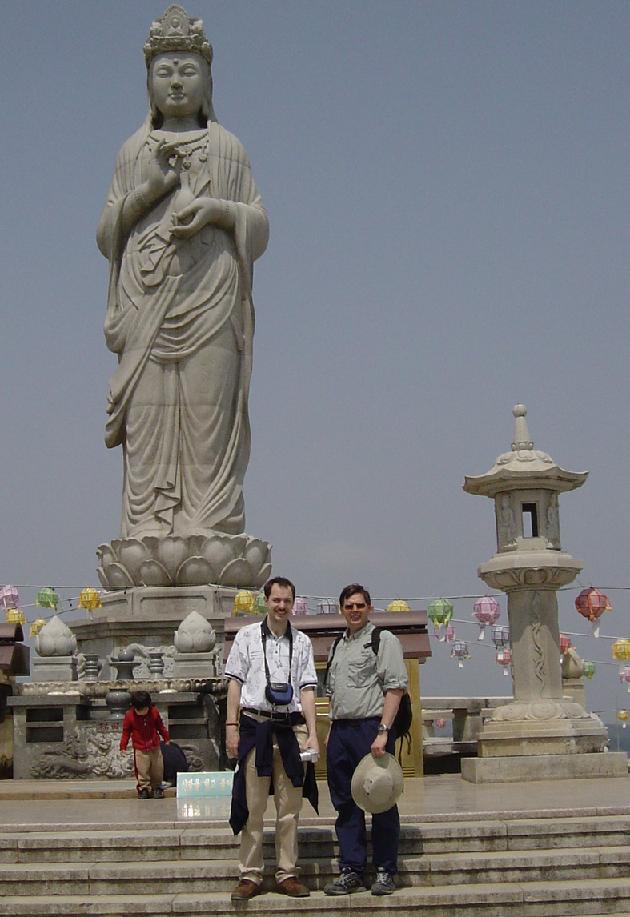
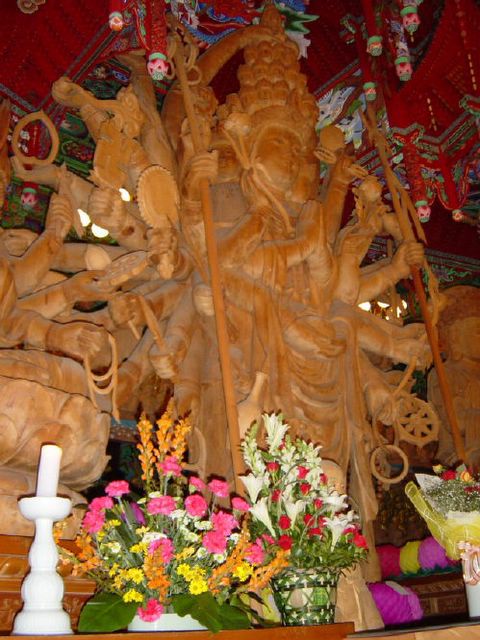
Here are Nathan and I at the giant Bodisatva of Mercy. Although the statue is fine, some of the stone around the base has heat fractures.


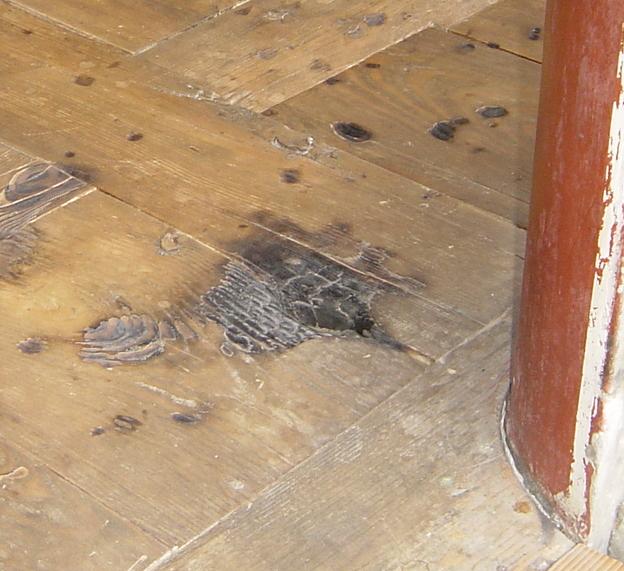
The temple just below the statue sustained some burns on it's floor.
The ancient bell that had been at the temple for, well, a long time, melted in the fire. It had crystallized with age and use so it was not in use in recent times. Here is the bell used in early '05. I hadn't realized they had just left the bell in the wreckage of its platform.


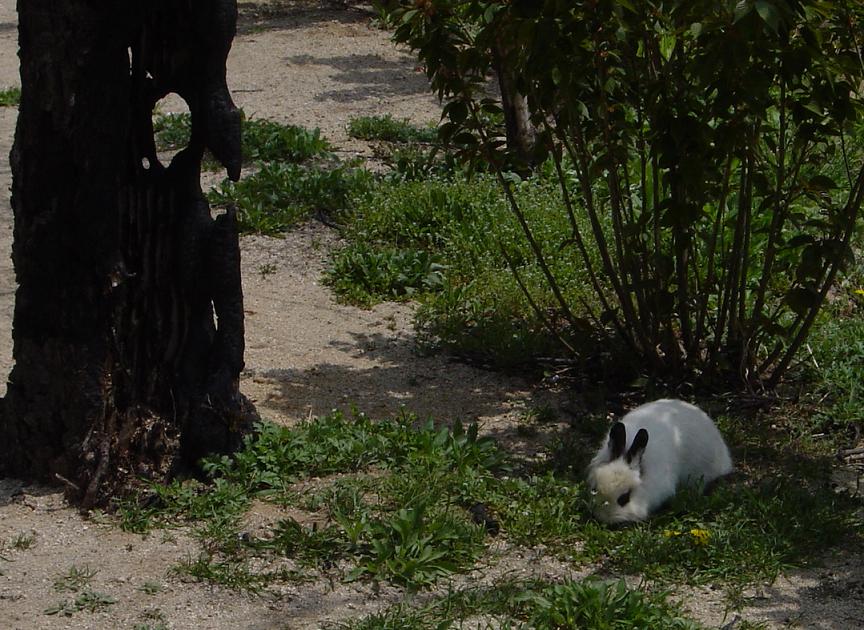
As perhaps a sign of the old and new, here is a burnt-out cherry tree and new temple resident rabbit.
Blogger has trouble allowing me to place more than four or five photos in one post so this photos are continued in the next post.

Naksansa, a year later

Again, Blogger has trouble allowing me more than four pictures in a single post.

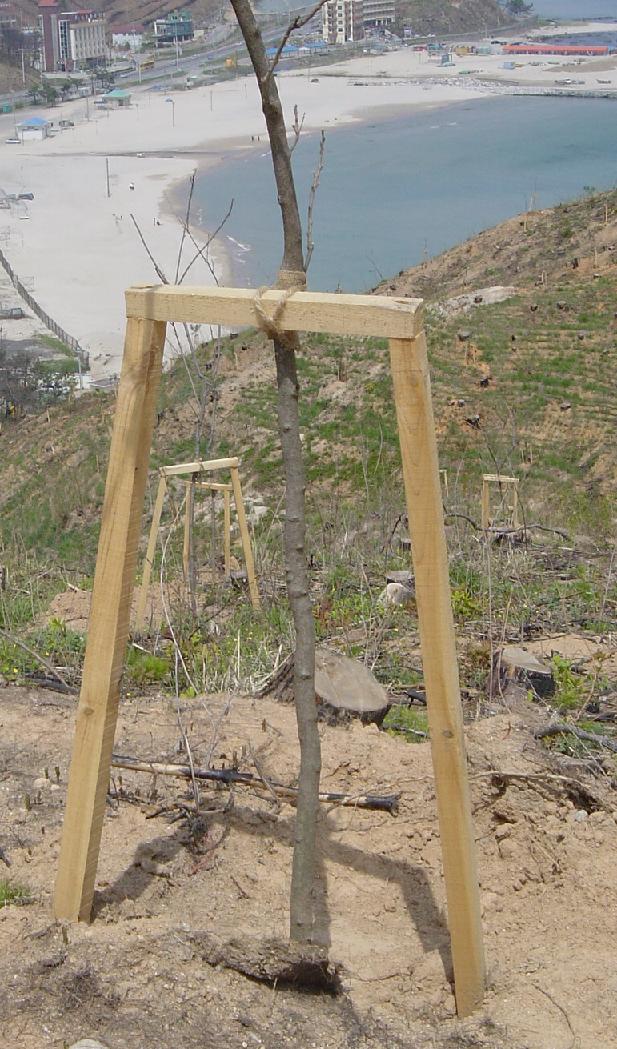
Sometime before Arbor Day, I expressed a wish to help with treeplanting on Nak Mountain's denuded slopes. I thought that the planting would resemble the work I did one spring back in Canada in my university days. I imagined carrying a bag with perhaps a hundred little trees and a shovel; pacing off two metres and planting another one.

I had seen the reality a few weeks ago but was only in a position to take a picture today. An ajummah army planted the trees and placed the stakes. No one can compete with them.

Nathan was a good guy but seemed to have a fascination with ants. This is a pose he took about ten times during our hike.

Tuesday, January 31, 2006

Lunar New Year's Day at Naksansa

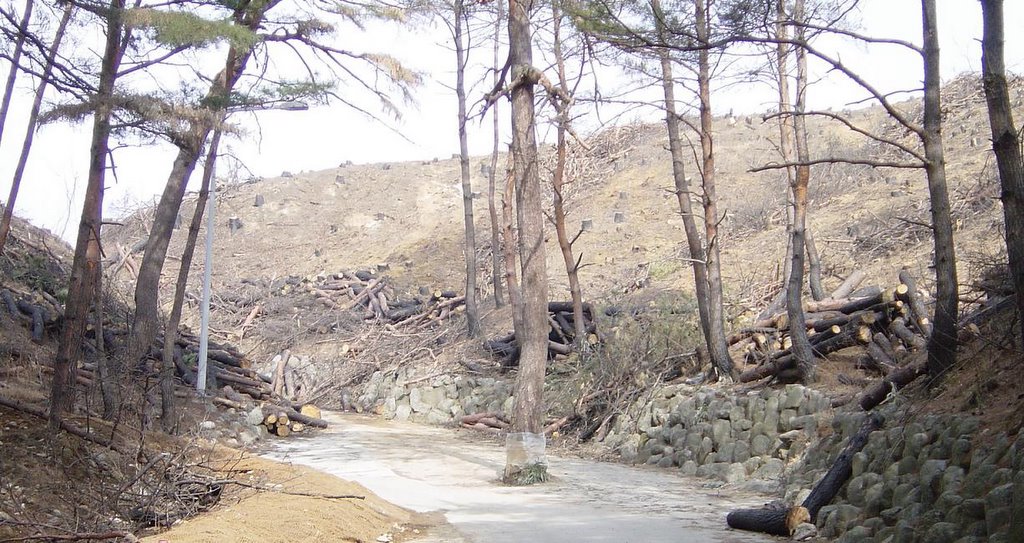
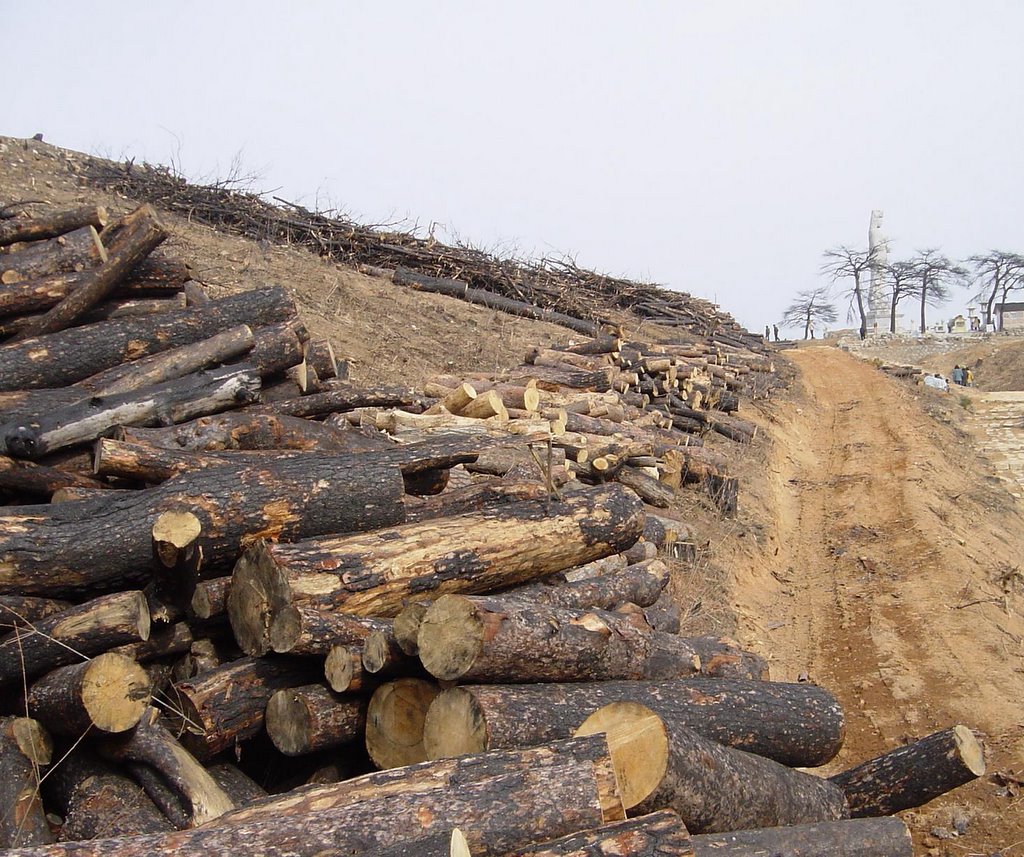
As these pictures show, Naksan did indeed get a shave. If you could ignore the long lines of piled, blackened pine logs, you might admire the improved views from the base of the 23 metre Kwaneum Buddha at the peak of Naksan. Unfortunately, you can't ignore the long lines of piled, blackened pine logs; the view actually is both depressing and very orderly.


I don't know what will be done with the Naksan lumber but some big tree trunks, probably from Russia, maybe Canada, are stacked and ready to begin the rebuilding. They don't look like they were soaked for a year or a few years in salt and then fresh water. I know that was how the 80,000 wood blocks for the Koreana Tripitaka were prepared; wasn't a similar process used to prepare the temple lumber? I seem to remember hearing about the base of many temple logs being white from the salt settling and leaching out.
Notice the rabbit sitting at the base of the wood pile. I also saw many woodpeckers; they are attracted to dead wood and Naksan is a motherload right now.

I'm sorry about the order of the pictures right now. I am sick with a cold and don't care enough to fix the order. Proper blogging will resume shortly.

Anyway, I don't know when new trees will be planted. Ironically, I was looking for a place to plant trees on Arbor Day 2005 when Naksan burned. If plans are made for volunteers to plant on the hills and slope around Naksan for this year's Arbor Day, you'll read about it here.

Monday, January 09, 2006

Naksan Got a Shave

I am now working in Hoengseong, about two hours from Sokcho. I went home for the weekend and had an incredible sense of disorientation. I was reading a book on the bus and when I looked up, I saw unfamiliar treeless slopes but I knew I was near Sokcho; what had happened? When I finally saw a stretch of shoreline I recognized, I realized all the dead trees (basically all trees) from Naksan had been cut down.

Visually, it's possible that the Kwaneum Buddha at Naksansa may be visible from Sokcho. Certainly it is from a few km down the road now.

I understand why the trees were removed. After being damaged in the fire, many sprouted green needles from upper branches but they didn't last through the summer. I suspect the cambium, the living layer just under the bark) had been cooked so no water or nutrients from the roots could reach the needles.

Pine trees are normally pretty flammable. Why, I remember when no less a scientist than McGyver used pine sap to make a bomb; that's how flammable pine trees are. Trees that have dried for eight months, combined with Korea's dry winters means that the mountain might have been more at risk than even before the fire.

Still, it looks odd. Arbour day is a long way away but I hope that Yangyang will be looking for volunteers to plant. I will sign up and I will post information here should anyone else be interested.

I guess the roots are still in the ground and I think they can continue to slow erosion until new trees take hold. Otherwise, Naksansa visitors had better look exclusively to the East to have views that won't make them cry.

(Again, I saw the mountain from a bus. I will try to visit next weekend to take some photos.)

Sunday, May 01, 2005

Forest fires are a wake-up call: Defend Dokdo or King Munmu will be angry!

My university is funded, or founded, or otherwise connected to Myoungji. Seoul has a Myoungji elementary, middle and high school and a university. There is also Myoungji construction. Today, I found an artcle by someone from the Myoungji Education Foundation. So much for disclosure.

The article is titled "Lessons from the Forest Fires" and anyone who has seen my blog knows this is a subject of interest for me. The article discusses the Naksan fire and was in the Joongang Ilbo a day before Yangyang experienced it's second major fire of the year.

I was expecting suggestions on fire fighting, maybe some critism of the fire fighters or of smokers or farmer burning refuse.

Instead, it is a strange and mystical account of how the burning of Naksan is related to Korea's ownership of Dokdo.

King Munmu was the greatest ruler throughout
the thousand-year history of the Silla Dynasty,
and he asked that his ashes be thrown in the East
Sea to defend his country forever, even after his
death, and Venerable Euisang established Naksansa
temple to defend the East Sea with the help
of religious power.

A political leader and a religious leader of the Silla
Dynasty devoted their body and heart to the
defense of the East Sea, wishing a lasting peace
in their fatherland at a time when Korea's first
unification was achieved with greatness.

There are strong winds and high waves in the
East Sea near Dokdo islands, between South
Korea and Japan. Now Naksansa temple, the
watchman of the East Sea, has been burned
to the ground. Can we not see the historical
providence and lessons in these events?

Although I cannot read much Korean beyond street signs and books for very young children, I have read a fair bit in English about Naksansa. Buddhapia has a good description of Naksansa as says only that Euisang went to the East coast to find the Bodhisatva of Mercy.

I am fully aware that the legends that attach to historic events are larger-than-life and written according to the sensibilities of the contemporous times. Still, finding the Bodhisatva of Mercy seems more reasonable than using the Bodhisatva of Mercy to defend the country.

"Defending with Mercy" sounds sufficiently mysterious and abstract to to be a line in a Kung-fu movie. Maybe some people really talk this way, I sure don't.

Anyway, if you want to read about how forest fires are part of the design of nationalistic demi-gods, give it a read.

Wednesday, April 06, 2005

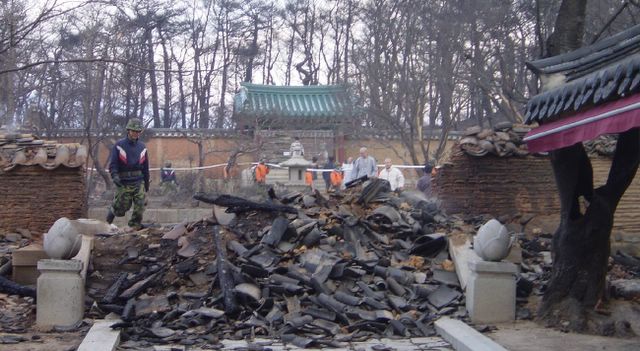
Naksansa, the day after

I went through pictures I'd taken at Naksan in the past two years and when I found a match to a photo I took this morning, I put them together below.

I arrived at Naksan at 8:00 this morning and was able to walk right in. I felt like a real reporter because they arrived the same time I did. It was sad to see the burnt areas but the first thing I noticed was the absence of all the vendors at the main gate.


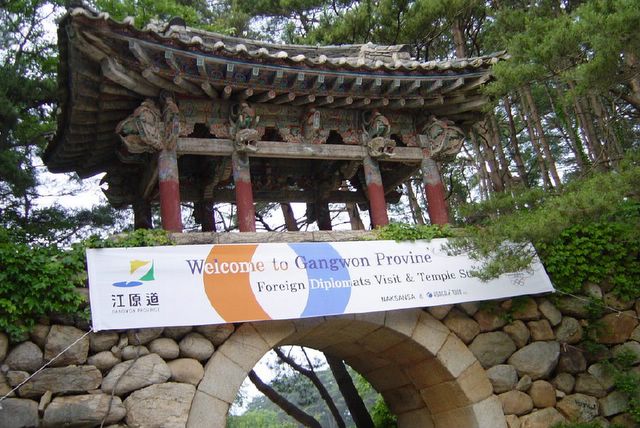
before the fire Posted by Hello


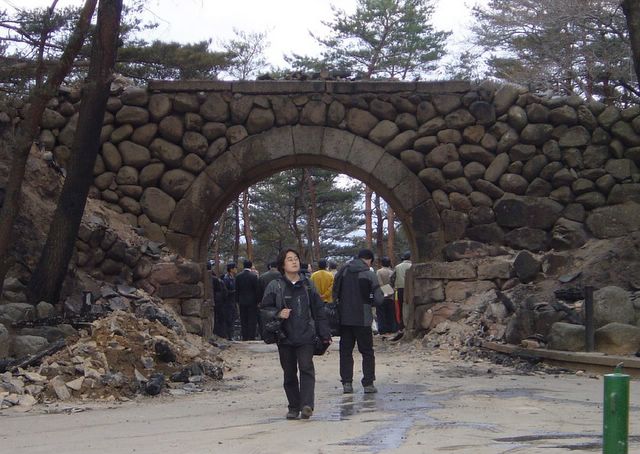
after the fire Posted by Hello
In 2003, I helped guide an international group of ambassadors around this temple. The upper photo has the banner from that occassion.


after the fire Posted by Hello
I didn't have a good duplicate for these two (above and below). There should be another gate and a building behind the one visible. This is the oldest part of the temple and the missing building is the "Hall of the Great Veneration" or main hall. I did 108 prostrations twice here during an overnight stay.

still working at 8:00am Wed. Posted by Hello


still working on the fire Posted by Hello
I guess the wind had carried burning material high into trees because they were still working on this one at 8:00am.


before the fire Posted by Hello


after the fire Posted by Hello
Sorry about this photo being a little out of focus. If you've been here, this is the temple with the hole in the floor so you can see where the dragon arose and gave Ui-sung a jewel as a sign of his enlightenment.


after the fire Posted by Hello
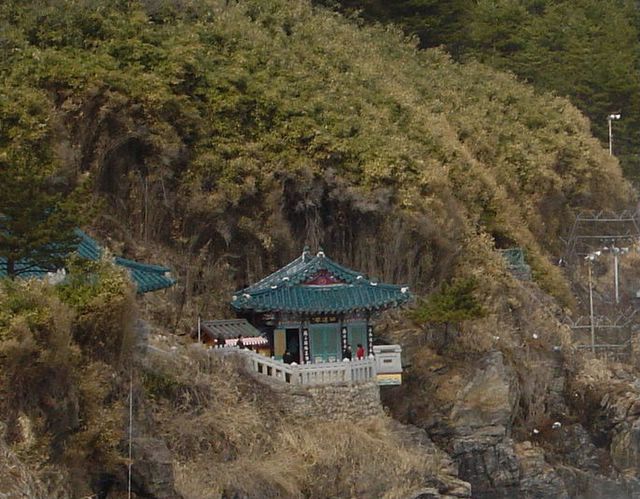
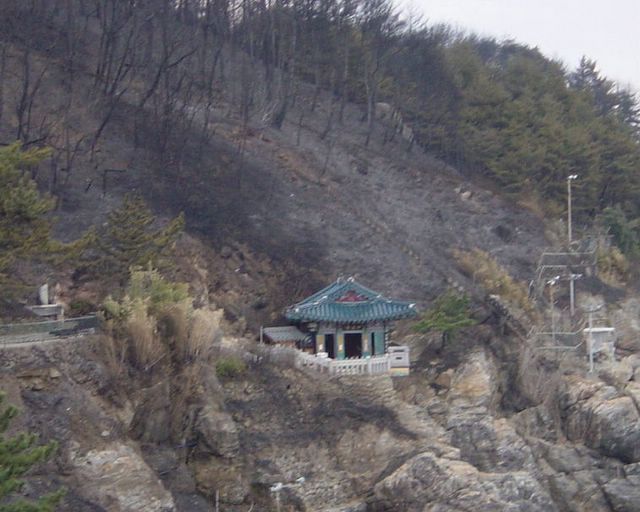
This picture was taken from Ui-sung Dae, a well known place for seeing the sunrise. Normally the giant Kwaneum is hidden by the trees. I didn't actually get close to the boddhisatva of mercy but it seemed to retain it's white colour.


before the fire. Posted by Hello


after the fire Posted by Hello
Gone are the meeting/teaching hall, cafeteria and sleeping quarters.


undamaged Posted by Hello
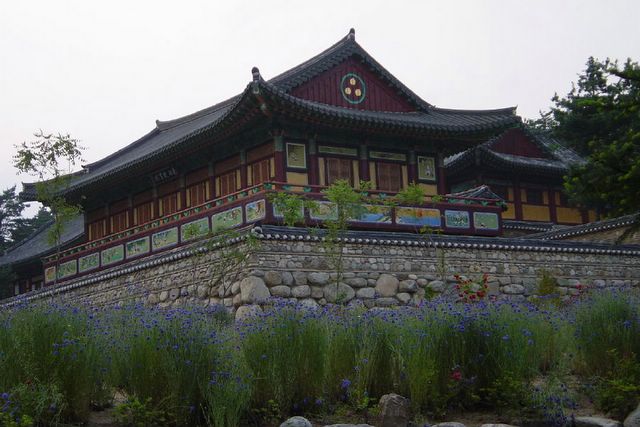
I think this wooden Boddhisatva was undamaged. The hall that houses it was fine. The building is about 20-30 years old; it's the big one by the turtle pond.

after the fire Posted by Hello
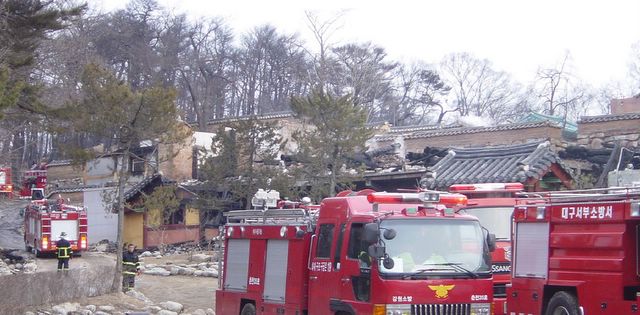
More fire truck, fewer army trucks.


fire truck plates: Chungnam Province, Seoul, Kimpo and Daegu Posted by Hello

I spoke to some soldiers that spent the night fighting fires and gave them some can-coffee. At around 8:00 they were just leaving. They looked pretty tired.

A key point of Buddhism is accepting the impermenance of things. The temple site is ancient but monks aren't supposed to be excited about old building or possession on the site. As much as I admire the philosophy, I still had a few tears in my eyes (maybe because of the smoke, maybe).

I don't know about Korea, but I noticed in China that they were very good at building old looking buildings. I wonder how they will construct the new buildings.


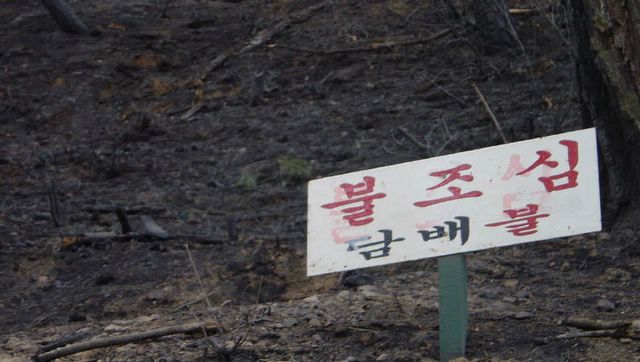
Beware of fires, don't smoke. Posted by Hello

I suspect that the fire was caused by an inattentive or unlucky farmer, but only because I saw many farmers burning refuse in their fields. I don't know what the cause was for sure.

Tuesday, April 05, 2005

Fire on Nak Mountain

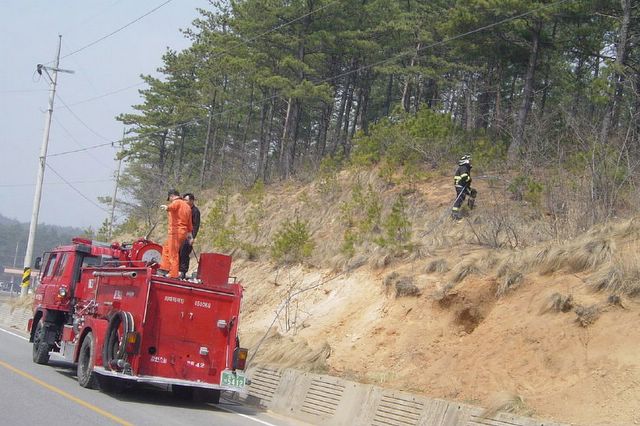
As of 11:00am this morning, Naksan Temple was safe but several small (or maybe not so small) forest fires were buring on Naksan and on several hills and forested areas inland. I would not be surprised if there were more than a thousand people fighting the fire, fire fighters, police, soldiers, rescue workers and volunteers. Highway 7, running from the DMZ, past Naksan and on to points south was fully open, although police were at all the relevant major intersections. The paved roads leading inland from Naksan were also all open.

I don't know how big the fire is (or hopefully 'was') but the high winds and dust devils were spreading it in a difficult way to control. There was a lot of ash floating in the air and as early as 8:00am, the smoke could be smelled in Sokcho, 12 km away.

Students staying in residence at Kwandong University were evacuated to a point two km further from the fire and are now at a wedding hall.

Below are some pictures with minimal text as they explain themselves pretty well. Below the pictures are my story.
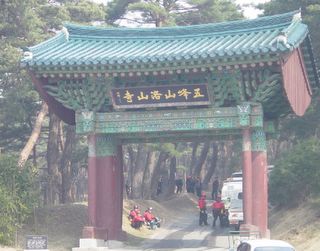

waiting for instructions Posted by Hello
Above is the main gate to NakSan Temple and groups of forest fire fighters were milling about.

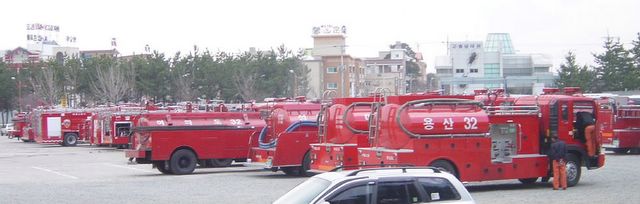
Naksan Bus Parking lot Posted by Hello
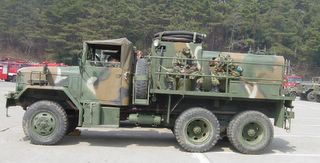

Hurry up and wait or a long night? Posted by Hello
The bus parking lot held at least 40 of these tanker trucks plus 15 or more fire trucks. Ocassionally, one would race out, siren wailing. The soldiers in this line of truck (10 or more behind this one) were all sleeping.

North side of the road: the wind carried hot ash, fire was crossing the field and road. Posted by Hello
These two pictures might be in the wrong order or story telling but they are in chronological order of my arriving on the scene. I think the main fire was on the South side of the road but that it had jumped to this side.
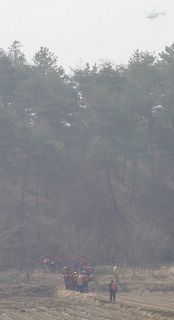

South side of the road. Fire fighters approaching from the field while a helicopter maneuvers above. Posted by Hello


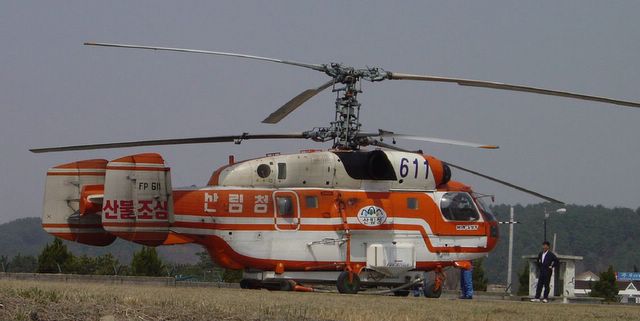
Sokcho Airport, where the helicopters were being refueled. Posted by Hello
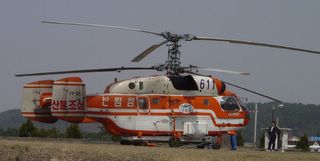

Water tanker helicopter. Posted by Hello

I awoke this morning and went into the kitchen where I smelled smoke. I merely wondered what the neighbours were cooking. Later, I went to meet a group to plant trees near Sokcho Beach. No-one was there and when I called, I was told the planting was cancelled due to the fire. When I heard Naksan was on fire, I was very concerned for the temple. Somewhat stupidly, I rode my bike there.

On the way I kicked myself for leaving my apartment windows open (I'm home now, typing this- the apartment may smell like smoke; after having been to Naksan, I probably can't smell smoke very well right now). I also wondered about the wisdom of riding into thicker smoke at a time when I was breathing so deeply.

The people at the local Yangyang Tourism office were at work so the area surrounding Naksan wasn't being evacuated. We watched trucks and helicopters come and go. I questioned some soldiers and bought drinks which I later gave to some fire fighters.

From Naksan, I went inland and saw many groups of fire fighters heading into and out of the woods. Helicopters were constantly in evidence but I didn't actually see any water being dumped. The wind was strong enough that I had to lean into it while riding.

Reaching a crossroads, I headed North, passing the old Sokcho airport, now being used to refuel the helicopters and headed home.

IMMEDIATE UPDATE:
YTN showed footage of the fire and it was by no means small. Reports are that Kwandong students have returned to campus and that the fire either under control or soon will be.


3:00pm
The highway between Yangyang and Sokcho has apparently been closed.

4:00pm
The fire has reached Naksan Temple and Naksan Beach hotel. The situation is clearly bad but I don't know how bad as yet.

5:00pm
I see something about Ui-seung Dae and Ryeon Hong Am on YTN news but I can't read enough Korean to know if they are damaged or if they have escaped damage. Ui-seung Dae is a pavilion for watching the sunrise and is on a cliff right above the ocean. Ryeon Hong Am is also next to the ocean (it's a small, uh, attached temple, related to, but not administratively connected with Naksansa.) These two places are as far to the east as you can go without getting wet feet; I can't see how they could be damaged without the other buildings being affected first. However, as I said before, there are some crazy winds today. They are whistling through my apartment as I type and I can smell smoke on them again.

6:00pm
Highway 7, running past Naksansa, has been reopened.
Flying Yangban notes that 1,600 people have evacuated their homes.

9:00pm From the papers
Chosun
Yangyang County issued a disaster warning as traffic
came to a standstill after authorities, in an effort to
block the path of the fire, closed nearby roads. Some
40 helicopters and 6,000 firefighters were mobilized
to put out the blaze.

Hankooki
Some 5,600 firefighters, police, military personnel
and government officials had difficulties bringing
the fire under control due to strong wind reaching
a maximum velocity of 26 meters per second.

The Korea Forest Service (KFS) dispatched 15
helicopters to battle the fire, pouring water to
contain the flames, beginning at 6 a.m. yesterday.
The dispatch of helicopters was delayed due to
the strong wind.

That's it for me. I may try to visit the temple tomorrow before work, but I'll put that in a separate post.