Showing posts sorted by relevance for query close the door. Sort by date Show all posts

Monday, August 04, 2008

Fire safety

I am back at camp, starting week three of four.

During the week, we have regular classes (I am teaching ecology) but every Saturday is different. Two days ago, we had survival English. Two of the classes were first aid (Which I taught) and fire safety. I am amused to see fire safety offered as there could be a bit of hypocrisy in it. Those who teach the subject are sincere, but the school management are more interested in climate control and preventing theft and possible misdeeds by students who cannot be tracked.

My classroom is in a corner so there is a door leading to an emergency exit.

Try to open that door. Do you carry an emergency door knob for such occasions?
If you could get through the door, or if you walked to the centre of the building and back through another hallway, you end up at this door, leading out. You can see the effort on my face as I desperately try to turn the knob. Locked.
I went outside and around the building and up the stairs to the other side of the door. No knob and a large sign saying "don't use. Use other door." the smaller sign, above, says, "be aware of heating, keep door closed".

There is another door on my floor that does open. Its on the other side of the building. I guess I am not really upset that the door is locked, more I wonder why did they think they needed it? Is it a legal requirement and after the building passed the local version of the building code, they felt they could lock it?
On the first floor of the building are the main entrance and two smaller entrances. One is padlocked closed and the other, above, is closed with caulking. I suppose a strong or motivated person could push hard enough to rip out the caulking, but still, it is strange. I also suspect that they could manage better climate control by teaching the students to close the main entrance doors after walking through them. Koreans, away from their homes, don't feel a need to close a door after opening it.

A few years ago, I posted a similar story about the school and how the students are locked up at night. Since that time, this big-ass mallet now sits near the main doors - the smaller fire exits are still chained and locked. I guess students could now smash the glass doors out if they need to leave in a hurry.

Wednesday, April 26, 2006

Trapped


Yesterday was the last day of exams and this particular exam had a written and an oral component. This class might be my worst in study habits and english ability and I didn't think very highly of them. I was unsurprised when they had trouble opening the door to the classroom; that's how slow they are. I actually showed several of them, individually, how to open the door after they were reduced to knocking and asking to be let in.

Anyway, the students had finished the written component and were waiting in another classroom and coming to see me one at a time for their oral exam. Again, I had to open the door for a few of them and I was just about to wedge some paper in the doorway so it wouldn't close all the way, when I heard a student on the other side twisting left and right and not getting anywhere.

With a quiet curse, I went to open the door to find I couldn't. The knob just floated left and right, with no feeling of moving anything inside the mechanism.

I have to give the students credit. They stayed with me -on the other side - and tried to help me get out, or the next student in. Finally, I told the students we would finish the oral exam next week if the door wouldn't open in the next five minutes. The time went by and they stayed until, thirty minutes later, I got out.

Before I told them that, I phoned my department's office and a secretary came to try to help me. She couldn't but called maintenance.

I got tired of waiting and had started working on the screws holding the bars in place over the ventilation window leading into the hallway when a professor asked me to stop and wait for assistance.

The maintenance man came and worked on the door with no luck and eventually a student and I returned to removing the bars so I could climb out and not miss my bus home.

My opinion of the students improved a great deal during my imprisonment. If they had broken the lock (accidentally), would that make my feelings an example of the Stockholm Syndrome?

The office staff were apologetic as though it might be their fault and I might be angry. I played on that a little and told them I wouldn't come to work on Wednesday (today). So, here I am at home, relaxing.

Today is Founder's day at our university; there are no classes.

Tuesday, June 20, 2006

Falcon Chicks

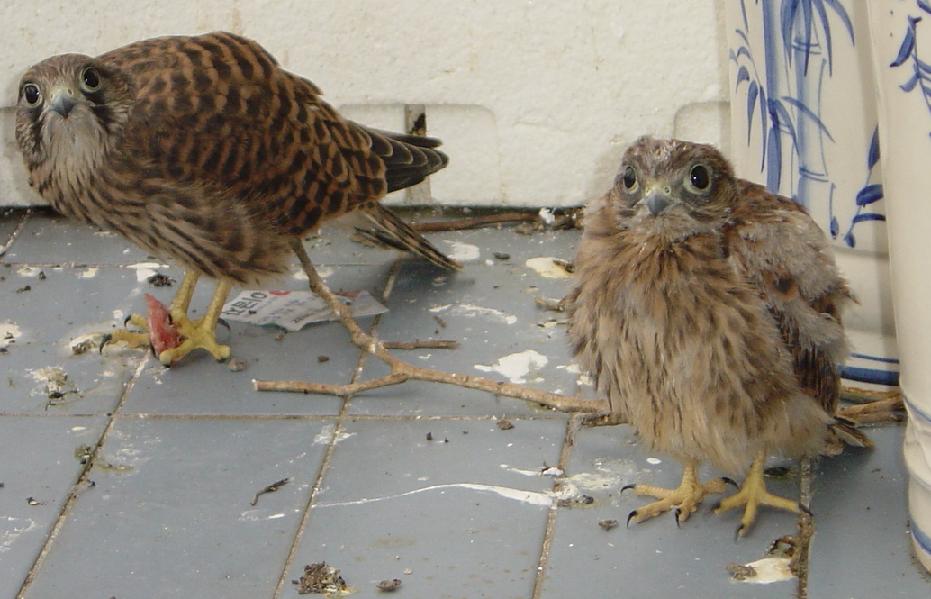
In the previous post, I wrote about a falcon's nest in a neighboring apartment verandah. Today, I nervously went to the apartment and knocked on the door. The resident, a cheerful ajummah, welcomed me as soon as the word, "Seh" (bird) left my mouth. She guided me to the verandah and told me about the birds as I watched them and took pictures.

Don't worry the pictures below are much clearer and less obscured - I just put this one in as a teaser.
She said the birds were "hwang JoRongHe" and I am uncertain how to write that in Korean and find the english name. I may have the name wrong - I am sure of the first three syllables but I may be off with the 'he'. Babelfish tells me I just typed "hwang bird cage" and I hope that is not what the lady told me. There were six chicks and three flew off. I thought there were only two on the verandah...

...but then I looked around the planters and found a third (the left hand bird in both pictures is the same bird). The one on the verandah deck looks to be the youngest.

I was surprised to hear about six (or possible five- the smallest chick may not be in a good way) healthy offspring. Falcons, and most birds, typically have clutches perhaps as large as six but with the expectation that many will die, leaving one or two to reach adulthood.

From CBC's Quirks and Quarks (click the link to hear an interview on the subject):
Parents often produce too many young to raise and, as a result, the natural world is rife with infanticide. Mothers will ignore some offspring and prefer others.


On the other hand, if the stress of close human activity is not too much, a verandah is a great place to be. The birds are safe from predators and from falling off the 'cliff'. Also, the ajummah supplies some food to the chicks.

Human activity nearby is a serious problem for many birds so I probably will not return to the apartment to take more photos. I may upload a short video but my computer is reaching the end of it's useful lifespan and I am concerned about downloading the Videoegg software here. Perhaps I will do that on my office computer.

I don't know why the falcons chose that apartment to make a nest. Well, I do know that it is one of the few without an outer layer of glass doors so it is easily accessable but I don't know if the woman somehow encouraged the birds or what. As I wrote earlier, the chicks can be darn loud and not everyone would be pleased to have them so close.

Saturday, November 27, 2004

Close the door (again)!

Just before it got cold, I asked (maybe demanded) that Koreans close doors to keep the heat inside. Yesterday was the first snowfall here and here are the open doors.

open door policy Posted by Hello


open door policy Posted by Hello

Every room has a gas heater. I think there's not much logic to the idea of 'fan-death' but 'heater-death'- caused by bad ventilation, fires, etc, seems much more likely. It's hard to insulate and heat a concrete box but keeping the air that has been heated inside just makes good sense.

Below is a different but related problem with open doors. This picture was taken from the middle of a hall at my university. Even when I was a volunteer at the Seoul World Cup Stadium, I noticed that people urinating were free to wave to the crowds outside. Am I the only one to feel a little shy in the bathroom?

open door policy Posted by Hello

Friday, October 29, 2004

Hey!...Close the door!

It is now mid-fall and the temperature is falling. I have one basic, heartfelt plea for Koreans at this time: Please, please, after you leave your house, start closing any outer door you use.

I don't care about your homes... That sounds kind of mean-spirited; I do care about your homes, but you have the right to leave your own door open if you want. Other doors; at work, at school, public buildings, shops...., please close them after you go through.

My country is a cold one. In my part of Canada, we will have more than two months of -10 degrees Celsius or colder weather. Inside virtually every building, it will be 16 to 20 degrees. I love winter sports, making snowmen, cross-country skiing, downhill skiing, skating and more.

All that said, I still feel uncomfortably cold in Korea. I think Korea is colder than Canada. Why? Because there is no escape from the temperature. Outside, it is -1 to +8 degrees Celsius and inside it is 4 to12 degrees. In late November and through to March, I will teach wearing a sweater and vest...sometimes even a scarf and long-underwear. Some students bring cushions to class because the seats are so cold.

Some Koreans might say that keeping the interior temperature down is for health reasons; to prevent a thermal shock going from hot to cold to hot to cold... I'll believe that when the gas and electrical heaters are turned off, instead of being close enough to some that they almost cook their legs.

Other Koreans may exclaim that Korea is a developing country, they don't have the money to heat their workspaces. Here is where we agree. However, you could afford to heat your offices if you CLOSED THE FRICKIN' OUTER DOORS!

Perhaps I'm biased by my nationality. Canada's R2000 building technology is famous for it's energy efficiency. The early R2000 homes had one flaw: they were so well sealed and airtight that there was some danger of suffocation. That's a little extreme, but keeping warm air in and cold air old seems like a good idea to me.

Saturday, December 29, 2007

Bak Tae-hwan goes coach shopping

In this post, I engage in a bit of name-dropping. I name several Olympians whom I have met but only one would recognize my name. To the others, I was only one of a multitude. I offer their names only to describe what was public knowledge and claim no special insight into their choices or behavior.

.

In my youth, I was a competitive swimmer of barely national caliber. I managed to scrape past the standards and qualify for a few national championship swim-meets.


To be quite honest, Bak Tae-hwan is as far beyond me in swimming ability as I am to the average Korean.


Which suggests that I cannot comment on the most recent Bak Tae-hwan news from personal experience. Ah, that news being he has fired his coach and is in the market for a new one. The new coach would be his third.

It is the second time for Park to change his coach this year. In January, when Park decided to train with coach Park outside the Korea Sports Center in Taeneung, he split with former coach Roh Min-sang, who had taught him for 10 years.

Still, even without experience at his level of swimming, I have seen world champions up close and I can certainly compare their coach/swimmer relationships with his.


I met and spoke briefly with Alex Baumann, at one time the world's best swimmer, a few times at swim meets and worshipped his ability. I also spoke to his coach, Dr. Tihanyi, as I was considering going to that university.


I raced him in the 200 Individual Medley at a meet in Laurentian University. I presume he raced the clock for no one came near him at that little meet. In fact, I paced him for the first fifty metres, mostly as a protest to my own coach for entering me in a race I disliked so much.*


And that is the key to my confusion over Mr. Bak’s revolving door regarding coaches. A coach is someone you need to have faith in. You can argue at times, but the coach is the expert. The Olympian I knew best (not all that well, but best), Dave Schemilt, once ranked fourth in the world for 1500 metres freestyle, followed his coach when the coach changed jobs and locations. Baumann’s loyalty to his coach, Dr Tihanyi was well known. I think Victor Davis followed his coach, Cliff Barry, when he changed jobs as well.


Perhaps there is a cultural element. I am not exactly comparing this situation to Korea’s dumping of Cha Bum-gun after a bad showing by the national soccer team but Koreans do seem comfortable changing course frequently.


I am thinking more of the famous stereotype of focus and concentration and fanaticism in Koreans. I think Mr. Bak thinks he can provide the motivation and focus internally and only needs an assistant for some technique tweaking.


Finally, there seems to be a strange dynamic regarding the sponsor, Speedo.

``Speedo and Park's parents have meddled in training Park along with the low salary,'' said the coach.

The meddling parents part is nothing new. All swim coaches (and I was one) need to be prepared for second-guessing parents. Again, I don't have international experience, but I have never heard of a sponsor being all that 'hands-on' in the actual training.


While I hope he does well, I fear that changing coaches so often will hurt him at the Olympics.


Oh, one Canadian example of a swimmer choosing coaches would be Mark Tewksberry. From Wikipedia: For some years he ranked as one of the top backstrokers in the world; never a strong below-the-water swimmer, he was unmatched on the surface, but, as the importance of below-the-water swimming increased, Tewksbury's ranking began to fall.


He eventually hired a synchronized swimming coach to train him in breath-holding techniques. That seems like a minor adjustment compared to Mr. Bak's though.

---___---

*My coach had a coherent plan and looking back I can see that if I had followed it more closely, I would have done better over all in my swimming career. I still have my problems with his choice of events for me but I respect and admire him for his efforts all the same.

Saturday, January 16, 2010

Or, you could close the door, I guess

The Herald has an article about saving energy by reducing the room temperature for businesses and government offices.

Banks, major retailers and hotels plan to keep their temperatures down at 20 degrees Celsius on recommendations, or some say indirect pressure, from government officials, who themselves have pushed their office temperatures down to 18 degrees Celsius to reduce power consumption.
In a meeting the Ministry of Knowledge Economy had with representatives from the services industry yesterday, a 5 percent decrease in power consumption was made as an industry-wide goal this winter.

Participants also agreed to encourage employees to wear long johns and turn off decorative lights.
"Most banks maintain their office temperatures at 20-22 degrees Celsius, but I expect more companies to join the nationwide campaign and lower it soon," said Shin Dong-gyu, chairman of The Korea Federation of Banks.


I've gotten used to teaching while wearing a winter coat.  somewhere I have a pic of me teaching while wearing a wool hat, scarf and gloves in addition to the coat.  18 degrees isn't anything like that bad and one could easily be comfortable without extreme measures.

I approve of trying to saving energy, but I think they are going about it wrong.  If citizens could be taught to close doors when they enter or leave a building, energy costs could be cut tremendously and rooms would be much warmer.

Another option would be to properly seal doors and windows to keep the heat in.  This option might be dangerous if gas powered heaters rather than electrical heaters are used.  There's a geek in Korea trying this out now.

Previously at Gangwon Notes:  controlling air conditioner use and open door policy(1, 2).

-------
Sorry about the lack of posts recently.  I just haven't felt like writing much lately.  I'm sure there will be more to come.

Friday, December 07, 2007

Baby news

The following story or event in my life is going to be boring for those without children, moderately interesting to those with young children, and thrilling to my mother. I could have emailed her and wrote about what happened last night or even told her on MSM chat. I think, though, that I want to remember and record this for my benefit. Perhaps when I am angry with my son, I could read it and relive it to calm myself down.

My little guy hates having his hair washed. I am not sure if it is the water in his eyes or ears that bothers him most, or perhaps he got a mouth or nose-full once or twice. It’s definitely clear that he hates it, though.

Yesterday, he was having a bath, more for play than any other reason. I was watching him, sitting on the closed toilet lid. We had the door shut to keep the warm moist air in and both were naked.

He started to splash water around and after he got me with a ladle-full, I sat closer to the tub. He poured water over my head and seemed to get the idea of washing my hair.

He poured water over my hair. It took him a long time because, well, he’s a baby and most ladles arrived over my head with very little water remaining. Still, he managed.

Then, he got some shampoo. Actually, he used the closest bottle, which was rinse. One hand kept my head in position so he simply pushed the spigot on the bottle and then scooped up the rinse from the side of the tub.

He was very careful about using washing my hair completely. Firstly, he used about a litre of rinse. After that, he massaged my hair and head for a surprisingly long time. I had to encourage him to go back to ladling water to remove the shampoo and he continued to massage my head as he poured the water.

It was a wonderful ten minutes or so-perhaps not that long, but I felt close to him right up until I had to wrestle him back into clothes. Then the wailing and confrontation with a totally alien consciousness returned.

Perhaps another time I will try to record a minute or so of his washing my hair. I warn you that at least one of us will be dressed, though.
___---___---___

In other baby news, a certain Gangneung blogger may have to turn in his el-camino for a more family-friendly vehicle as he is now a father. Congrats to Paktheelcamino!

Saturday, July 19, 2008

climate conditioning

The Donga has an article describing how Korea and Japan have policies for temperature regulation in government offices including a set-point for air conditioners, a not-that-cool 28 degrees. This is another article relating energy saving measures to the high price of fuel.

The point is a good one, but Korea could make maintain cool rooms (and warm ones in the winter) while making great energy savings with a ridiculously simple procedure: close the freakin' doors and windows! My head spins when I see an active air conditioner next to an open window or cold classrooms in the winter with every exterior door wide open.

I do think using air conditioners to moderately cool and dry the air is a good idea, too.

Previously at Gangwon Notes.

Tuesday, September 28, 2004

Chuseok

Here's wishing you a Happy Chuseok, unless Chuseok shouldn't be considered 'happy'. Then, a Solemn Chuseok to you. Whatever, maybe the proper descriptive should be 'frustrating' or 'exhausting'.
From the Korea Herald:

For many others, and especially housewives, the Chuseok
holiday is an unwelcome return of stress - time-consuming
journeys to visit parents and relatives as well as preparing
food for ancestral rites.

"I'm still undecided whether I should go to see my

parents-in-law living in Mokpo, South Jeolla Province,"
said Seoul housewife Yoo Sun-ock. "It's usually a five-hour
trip from Seoul to Mokpo, but during the holiday season it
will take as many as 14 hours because of traffic jams. Even
thinking of fighting the mass traffic irritates me so much."

I had a similar distance to travel but flew as the two airports involved are close enough to my home and my in-laws' home to make it feel like door-to-door.