
Showing posts with label culture. Show all posts
Showing posts with label culture. Show all posts
Monday, June 27, 2011
Surfers from Gangwon - and elsewhere - try to compete in Busan
The original post is here at my new blog. Note the final few paragraphs where I discuss the typhoon's effect on Gangwondo and nationally.


Wednesday, January 05, 2011
The fan-death story won't go away
Years ago, I found on wikipedia an article on Fan-death that quoted a professor at my university. I interviewed him and found he didn't really say all those things he said but I think the audio-recording website has since disappeared. Anyway, here are some articles I wrote about fan-death.
Today, XKCD put up a comic about common misconceptions and provided a link to wikipedia's list of common misconceptions. It includes:
"In South Korea, it is commonly believed that sleeping in a closed room with an electric fan running can be fatal in the summer. According to the Korean government, "In some cases, a fan turned on too long can cause death from suffocation, hypothermia, or fire from overheating." The Korea Consumer Protection Board issued a consumer safety alert recommending that electric fans be set on timers, direction changed and doors left open. Belief in fan death is common even among knowledgeable medical professionals in Korea. According to Dr. Yeon Dong-su, dean of Kwandong University's medical school, "If it is completely sealed, then in the current of an electric fan, the temperature can drop low enough to cause a person to die of hypothermia."[80][81][82][83] Although an airconditioner transfers heat from the air and cools it, a fan moves air to increase the evaporation of sweat. Due to energy losses, a fan will slowly heat a room."
Wednesday, July 01, 2009
Happy Canada Day!

It's six am and the little guy and I have just come in from a walk to the dock, where we saw two or three beavers and some Canada geese - a good way to start Canada Day.
The picture is from a recent trip to Tim Horton's donuts. I had planned to write about some new symbols of Canada that I don't care for - Tim Horton's is one, although I like the food - but I'll leave it to be grumpy on another day.
We have a lot of events to take the little guy to, so expect photos about when my Korean readership wakes up.
Thursday, April 23, 2009
sorry for the late notification
The Joongang has an article about traditional Korean homes and lodging in them.
If you had registered by the deadline, a week ago, you might have been able to stay at a traditional home in Gangneung for free. Still, you are still able to stay at one if you pay.
I am late in announcing the event and also lazy in describing it. Here is a long excerpt from the Joongang:
If you had registered by the deadline, a week ago, you might have been able to stay at a traditional home in Gangneung for free. Still, you are still able to stay at one if you pay.
I am late in announcing the event and also lazy in describing it. Here is a long excerpt from the Joongang:
To promote hanok culture and help tourists find one they can stay in, the government set up a Web site (http://korean.visitkorea.or.kr/hanok) this month that contains information on 145 hanok available for lodging across the nation.
In addition, the Ministry of Culture, Sports and Tourism and the Korea Tourism Organization have been subsidizing renovations at over 100 hanok to make the aging homes more suitable for commercial lodging.
Visitors can search hanok by location, price and program. The site also has explanations on tourist destinations nearby, and an English language service will be available soon, the ministry says.
“The Web site was created to help visitors experience the Korean traditional residential style and learn about the advantages of living in hanok,” said Jung Jae-hwon, an employee at the tourism organization.
To mark the launch of the Web site, the ministry will provide free lodging and cultural programs for 80 people at a hanok in Gangneung, Gangwon, on April 25 and 26.
The Gangneung Seongyojang, built during the Joseon Dynasty (1392-1910), was the first privately-owned hanok to be registered as a cultural asset. There will be traditional masked performances, folk plays and sessions on Korean etiquette and woodcraft.
Interested parties can apply via KTO’s Web site (www.visitkorea.or.kr) through April 19. A similar event is scheduled for a hanok in Andong, North Gyeongsang, on May 23 and 24. More information on the second event will be available later from the tourist organization.
Monday, March 23, 2009
Slow, or Failed, Cities?
From the Joongang: "In Italian, citta slow means a slow life." Other places have it translated as "slow city", which makes a little more sense to me.
What is a slow city? From the slowmovement website:
Here is a bit of nationalism:
Hooray! Korean farming villages aren't well organized.
Alright, that's enough of the easy insults.
The idea of a slow city needs a little explaining but once the basics are covered, it does sound like a nice place to live. Small town friendliness, cleanliness and, um, local cultureliness all sound great. I have been away from my hometown (Bracebridge, Ontario) for ten or so years and, in brief visits, I feel disappointed by the Walmart and other big boxes (A&P, by contrast, felt like a local store- only because it had been there in my childhood). I would like my hometown, especially if I return to stay, to be the way I remember it; a small town in which I knew most of the people I passed on the street.

The examples in the Joongang, however, include the island village of Cheongsan in South Jeolla (a little poaching, Bizarro Brian):
Elsewhere: Officials from Cittaslow said the island came close to the very spirit of slow life when they went there to evaluate its environment in 2007.
I think the movie Mapado publicized the way Island communities are fading; basically becoming "silver towns" (for the silver haired). I can accept a "city" of 2,613, but it seems moribound tradition is being celebrated here more than low-key comfort.
another region is Sinan County:
I know how to work hard and respect people who do so. I don't think that is an end in itself. If salt production, for example, is best and more environmentaly friendly using human labour, fine. If the village is small because it is poor, that is not a great reason to celebrate it.
On a contrary note, at the end of the article, they describe slow food, which does seem productive, at least as marketing:
What is a slow city? From the slowmovement website:
Fired by the success and support for Slow Food the Italians set about initiating the Slow Cities movement. Slow cities are characterised by a way of life that supports people to live slow. Traditions and traditional ways of doing things are valued. These cities stand up against the fast-lane, homogenised world so often seen in other cities throughout the world. Slow cities have less traffic, less noise, fewer crowds.The slowmovement site is not entirely thrilled by this:
Towns in Italy have banded together to form an organization and call themselves the Slow Cities movement. In their zeal to help the world they have formed what amounts to a global organization that sets out to control which cities in the world can call themselves Slow Cities and which cannot. This is not a movement. Social movements are movements from the bottom from the community. The seachange movement, the organic movement, the vegetarian movement, the homeschooling movement, are examples of movements. No-one controls them. No-one assesses you to see if you are allowed to call yourself a seachanger or if you can say you are a vegetarian.From the Joongang:
The Cittaslow Association selects a slow city after visiting candidate cities, which has to pass a total of 24 assessments.
For example, the population of a would-be slow city should be less than 50,000, and the natural environment should be well preserved.
The city should also have its own locally grown organic products, and the city should not have big-box chains or fast-food chains.
Any city that is selected must undergo reassessment once every four years to ensure standards are maintained.
Here is a bit of nationalism:
Korea has five slow cities, but China and Japan, two of Asia’s most-visited tourist attractions, don’t have any.
Twenty cities from these countries have applied for recognition from Cittaslow, but they all failed to make the grade, apparently.
The association said Japanese farming villages don’t have their own character because they are far too developed and organized.
Hooray! Korean farming villages aren't well organized.
Alright, that's enough of the easy insults.
The idea of a slow city needs a little explaining but once the basics are covered, it does sound like a nice place to live. Small town friendliness, cleanliness and, um, local cultureliness all sound great. I have been away from my hometown (Bracebridge, Ontario) for ten or so years and, in brief visits, I feel disappointed by the Walmart and other big boxes (A&P, by contrast, felt like a local store- only because it had been there in my childhood). I would like my hometown, especially if I return to stay, to be the way I remember it; a small town in which I knew most of the people I passed on the street.

The examples in the Joongang, however, include the island village of Cheongsan in South Jeolla (a little poaching, Bizarro Brian):
This is nothing but a poor fishing village. A total of 2,613 people reside on this island. Most of them are senior citizens,” said Park Eun-kyung, the head of the local council.
Elsewhere: Officials from Cittaslow said the island came close to the very spirit of slow life when they went there to evaluate its environment in 2007.
I think the movie Mapado publicized the way Island communities are fading; basically becoming "silver towns" (for the silver haired). I can accept a "city" of 2,613, but it seems moribound tradition is being celebrated here more than low-key comfort.
another region is Sinan County:
Sinan County, South Jeolla, became a slow city because of Jeung Island, where high quality sun-dried salt is produced. Workers labor all day under the blazing sun drying saltwater and raking the salt.I do accept that these places, and other in the article, are preserving important part of Korean culture and tradition and are worth bringing attention to. On the other hand, there is no point being poor for the sake of being poor. As the saying goes, "There is no nobility in poverty".
After witnessing the slow process of making salt, officials from the Cittaslow Association kept saying “wonderful.”
I know how to work hard and respect people who do so. I don't think that is an end in itself. If salt production, for example, is best and more environmentaly friendly using human labour, fine. If the village is small because it is poor, that is not a great reason to celebrate it.
On a contrary note, at the end of the article, they describe slow food, which does seem productive, at least as marketing:
Along with slow fashion, the importance of slow food is surfacing. Among typical Korean slow foods, fermented soy sauce, red pepper paste, soybean paste and kimchi are gaining attention.
“You have to wait at least two or three years to get authentic soy sauce and soybean paste,” said Kim Jong-ok, a 55-year-old housewife.
Kim is a daughter-in-law in the Sun family in Boeun, North Chungcheong.
The family has been making traditional soy sauce, red pepper paste and soybean paste for the past 350 years.
At one food fair which was held in 2006 by Hyundai Department Store, a 1 liter bottle of Kim’s soy sauce was sold for 5 million won ($3,541).
Sunday, March 15, 2009
Students work to save the economy, the Chosun reports and bloggers mock.
The Chosun Ilbo has an article about high school girls rolling up their uniform skirts to show more leg. The Ilbo has both complained in the past about Foreigners being oversexed and many photos of these girls in their short skirts. Bizarro Brian (I just like the name- if you don't, Brian in Jeollanam, I will stop) and Korea Beat quite rightly comment on the article.
However, what if there is a good and important reason, both for the shortened skirts and the reporting of same?
Possibly related: XKCD has a comic about correlation and causation and confusion between the two.
----
This post is slightly longer version of the comment I left at Korea Beat in the above linked post.
However, what if there is a good and important reason, both for the shortened skirts and the reporting of same?
Skirt Lengths and the Economy
Believe it or not, there is a long-standing theory that skirt length is linked to booms in a country's wealth: the better the economy, the shorter the skirt (and vice versa).Rising skirt lengths are a symbol of youth, playfulness and women's liberation – but are they also related to a nation's prosperity?
Possibly related: XKCD has a comic about correlation and causation and confusion between the two.
----
This post is slightly longer version of the comment I left at Korea Beat in the above linked post.
Wednesday, February 18, 2009
Rebuilding Namdaemun will take a while.
In a strange article (mixed Hangeul and English; appearing to be a translators draft more than anything) The Joongang reports that pine trees from Samcheok area have been felled and flown by helicopter to be used to rebuild Namdaemun.
I am no expert but I am pretty sure that lumber needs to "cure" for a while and that curing entails drying for several years. Korean Buddhist temples and the famed 80,000 wood blocks of Buddhist scriptures were soaked in salt water for years before being dried (look for an apparent white stain at the bottom of posts at a temple; that is the salt leaching out).
Maybe the pine collected recently will be for scaffolding or something non structural.
An excerpt from the article:
I am no expert but I am pretty sure that lumber needs to "cure" for a while and that curing entails drying for several years. Korean Buddhist temples and the famed 80,000 wood blocks of Buddhist scriptures were soaked in salt water for years before being dried (look for an apparent white stain at the bottom of posts at a temple; that is the salt leaching out).
Maybe the pine collected recently will be for scaffolding or something non structural.
An excerpt from the article:
A Korea Forest Service helicopter transports pine trees (felled) (for use) (in the restoration) (of Namdaemun), (yesterday) (in Samcheok, Gangwon).
“문장의 뼈대가 되는 주성분들로 주어 자리에 A Korea Forest Service helicopter, 서술어 자리에 transports, 목적어 자리에 ‘pine trees’가 각각 왔습니다. 주요 성분부터 흐름을 느끼며 말해 보도록 하겠습니다. A Korea Forest Service helicopter(산림청 헬기 한대가)….transports(운반하고 있다)….pine trees(소나무를)….
수식어 부분을 붙여 보도록 하겠습니다. 소나무들은 (felled) ‘벌채된’ 것인데 (for use) (in the restoration) (of Namdaemun)
Friday, January 30, 2009
A New Brunswick school decision has me facing my own prejudices
I've been following news stories about the removal of official prayer times from schools and the like for quite a while. Atheists do not work in a group with an established hierarchy but I followed the semblance of the party line in feeling that students are entirely welcome to pray at school, but that leaders -teachers, coaches and administration - should not lead such prayer.
My reason for this, again following the party line, is either the individual him/herself or that individual's parents should make decisions about religion. Even in a hypothetical town where everyone is Christian, it is unlikely that all will follow the same type of Christianity.
So, I'm for the removal of prayer from school.
A school in New Brunswick has removed the national anthem from opening announcements.
The principal's explanation doesn't really explain that much:
At first, I thought the disapproving parents might be from foreign countries and not want their children to sing our anthem. To these, entirely hypothetical, parents, I quickly thought up a counter argument: that religious choice should exist everywhere but nations are not abstract, intangible creations. Well, they are partly, but even more, they are huge block of entirely tangible land. In most places in the world, you can choose your religion, you can even choose your nationality to some extent, but you are standing where you are standing. If you don't want our anthem, you should move.
Man, I've heard the latter bit of that argument stated against me many times (well, against atheists, not me directly that much).
I am confused. If I don't want prayer in school and I have reasons that seem quite solid to me, can I really complain about others not wanting the anthem?
No matter how patriotic you are, you have to admit that the anthem is not exactly part of the core reasons schools exist. O Canada isn't really "readin', ritin', 'rithmatic" (and I hate the way we dumb down the fundamentals of teaching to the three "R"s), is it? If the dissenting parents agreed to allow O Canada to be taught in music class, would that be so bad? Maybe I should have had it in a formal class setting because I now would likely sing it as poorly as Roseanne Barr sang her anthem in 1990 (I really recommend against listening to that clip, but she seemed to remember all the words, which I don't).
I gave a rebuttal to a reason that might not exist but I am having trouble thinking of any other reason and the principal was (admirably?) discrete on the subject. I recall some Jehovah's Witnesses in my elementary school class leaving the room during morning announcements - were they avoiding the national anthem? Are there possible religious reasons? Can I, personally, accept having the anthem taught only in music class and not required of all students (or require students to opt-out)?
I've got some thinking to do.
My reason for this, again following the party line, is either the individual him/herself or that individual's parents should make decisions about religion. Even in a hypothetical town where everyone is Christian, it is unlikely that all will follow the same type of Christianity.
So, I'm for the removal of prayer from school.
A school in New Brunswick has removed the national anthem from opening announcements.
The principal's explanation doesn't really explain that much:
Whether to sing the national anthem appears to be a delicate matter in the small southern New Brunswick community.
Erik Millett, the school's principal, said he made the decision partly to accommodate parents who didn't want their children taking part in the daily anthem.
"We try to balance the needs of every student, and we want every student to feel welcome in our school," Millett said.
"And part of our school and included in that and if we need to make some accommodations or exceptions then we'll try to put those in place regardless of what the issue is."
At first, I thought the disapproving parents might be from foreign countries and not want their children to sing our anthem. To these, entirely hypothetical, parents, I quickly thought up a counter argument: that religious choice should exist everywhere but nations are not abstract, intangible creations. Well, they are partly, but even more, they are huge block of entirely tangible land. In most places in the world, you can choose your religion, you can even choose your nationality to some extent, but you are standing where you are standing. If you don't want our anthem, you should move.
Man, I've heard the latter bit of that argument stated against me many times (well, against atheists, not me directly that much).
I am confused. If I don't want prayer in school and I have reasons that seem quite solid to me, can I really complain about others not wanting the anthem?
No matter how patriotic you are, you have to admit that the anthem is not exactly part of the core reasons schools exist. O Canada isn't really "readin', ritin', 'rithmatic" (and I hate the way we dumb down the fundamentals of teaching to the three "R"s), is it? If the dissenting parents agreed to allow O Canada to be taught in music class, would that be so bad? Maybe I should have had it in a formal class setting because I now would likely sing it as poorly as Roseanne Barr sang her anthem in 1990 (I really recommend against listening to that clip, but she seemed to remember all the words, which I don't).
I gave a rebuttal to a reason that might not exist but I am having trouble thinking of any other reason and the principal was (admirably?) discrete on the subject. I recall some Jehovah's Witnesses in my elementary school class leaving the room during morning announcements - were they avoiding the national anthem? Are there possible religious reasons? Can I, personally, accept having the anthem taught only in music class and not required of all students (or require students to opt-out)?
I've got some thinking to do.
Tuesday, June 17, 2008
An apology to Canada's native people
I remember a conversation I had with my mother and sister more than twenty years ago. Conversation doesn't describe the heat; argument is a better term. My sister, AlaskaMarci was attacking historic government actions removing native American children from their families, while my mother and I took, not an opposing view exactly, but a counter view.
I felt that the government had done the wrong thing but simply wanted my sister to accept that they were not deliberately being evil.
In hearing the recent apology, I have to change my view. Some (I hope it was only some) authorities wanted to completely end the Native American way of life, culture and religion, creating, I guess, a nation with some variation in color but none in language or supposedly common history (alright, there would be two languages).
Our mother, who grew up in a small northern Ontario town with a reservation (or several) nearby and had many native American classmates, felt the government was wrong to remove children but there might have been a few defendable reasons for doing so. She noted that few Native Americans in her town completed high school (in town) and that even at public school (on the reservations) students had frequent absences for various hunting and fishing seasons. They did not put as much time into class as the other students in the community.
She told me that even a few Parry Sound (Ontario) Native children were sent to residential schools. We were both surprised; she hadn’t heard about it when it was occurring.
When we had this argument, I was naive and less political than I am now. Now, I wonder how the 1950's government could imagine removing children from their parents could possibly have good long-term results.
I am late on commenting on this story but I am glad that the government has apologized:
…aboriginal people packed Parliament to hear the prime minister say it for all Canadians: "We are sorry."
Stephen Harper made the historic apology Wednesday in the House of Commons for generations of racist policy meant to "kill the Indian in the child."
…
The apology is part of a massive compensation and healing package expected to top $4 billion.
Thursday, January 24, 2008
Water-Fire Festival
I think the Water-fire festival is newly invented and mainly an excuse to party in Sokcho in the off-season. That's not a bad reason, by any means. I'm just pointing out that it isn't the creation of Sokcho's rampant Roman Catholic citizen's to have a pre-Lent party; the main excuse Canadian cities use for winter carnivals.
Actually, I've been away most Januaries, working at one camp or another, so this festival could have been occurring for years.
 The mascot scared the heck out of KwandongAlex.
 A friendly guy took this picture for us. It would be mean-spirited to complain about his cutting the bear in half; the camera screen was uniformly black until the flash fired so he was just pointing it in the right direction.

 The festival continues through the weekend. There were many craft tents for children and the fires, candles, assortment of lights and cold, fresh air are romantic, I guess, but activities for adults seemed scarce. I'm sorry, as I wrote that, I recalled that two Human-powered ferry boats were set up- possibly for racing. I would like to compete in that.
I notice, too late, that Haeundae had it's Polar Bear Swim recently. I entered one year and had a great time but hadn't read anything in later years and thought the whole thing had been cancelled. I want the Sokcho Fire and Ice Festival to include one.
How about this: for New Year's Day or Lunar New Year's Day in 2009, we have a Polar Bear Swim at YangYang Beach, next to Naksansa and Naksan Beach Hotel with it's Hae-su Sauna for recovery afterwards. Depending on responses, I will begin to make plans and try to organize the event.
Actually, I've been away most Januaries, working at one camp or another, so this festival could have been occurring for years.
 The mascot scared the heck out of KwandongAlex.
 A friendly guy took this picture for us. It would be mean-spirited to complain about his cutting the bear in half; the camera screen was uniformly black until the flash fired so he was just pointing it in the right direction.
 The festival continues through the weekend. There were many craft tents for children and the fires, candles, assortment of lights and cold, fresh air are romantic, I guess, but activities for adults seemed scarce. I'm sorry, as I wrote that, I recalled that two Human-powered ferry boats were set up- possibly for racing. I would like to compete in that.
I notice, too late, that Haeundae had it's Polar Bear Swim recently. I entered one year and had a great time but hadn't read anything in later years and thought the whole thing had been cancelled. I want the Sokcho Fire and Ice Festival to include one.
How about this: for New Year's Day or Lunar New Year's Day in 2009, we have a Polar Bear Swim at YangYang Beach, next to Naksansa and Naksan Beach Hotel with it's Hae-su Sauna for recovery afterwards. Depending on responses, I will begin to make plans and try to organize the event.
Saturday, October 07, 2006
Ferryboat racing next week at Cheongcho Lake
A tourist attraction in Sokcho is the hand-powered ferry that connects Abai Village to northern Sokcho. The ferry crosses the narrow channel that permits boats entry to Cheongcho Lake. The ferry was featured in a movie or TV series; I think it was called, "Autumn story". Anyway, riding the ferry is mild fun and is part of a pleasant shoreline walk.
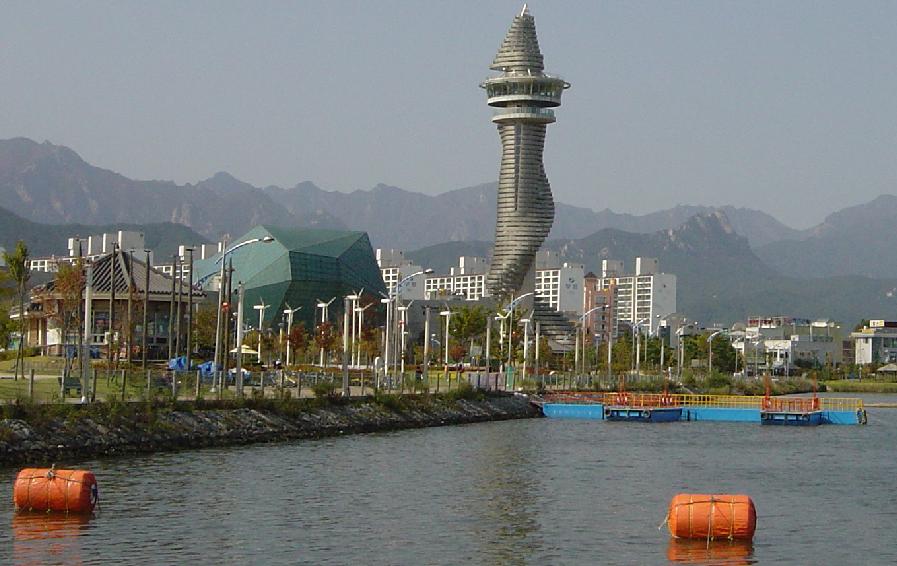
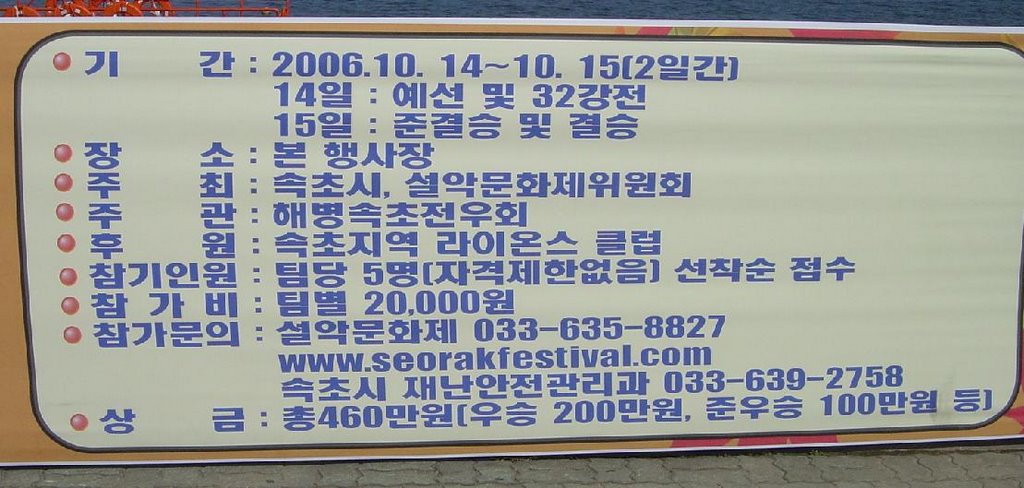
Next week, two replica ferries will be raced on a short course at Expo Park at Cheongcho Lake. The banner seems to say (my Korean language skills are not what they should be) that 32 teams can enter. A team consists of five members. Oct 14 and 15 are both on the banner so I don't know if the racing will take two days with heats on Saturday and finals on Sunday or what. The course is about 50 metres long and probably contestants have to travel to the bouy and back.
The race looks like a lot of fun. I have commitments next week so I cannot compete but I suggest the Gangwon KOTESOL enter a team (BTW, the next Gangwon KOTESOL meeting is that Saturday- perfect timing).
Oh, I said a team is 5 members, but I only saw four, uh, pull-tools. Maybe the fifth person cheers. I reccommend the fifth person bring a squirt gun to shoot the other team - that would be fun.
A cable is attached to the dock and to the bouy ( and anchored at both ends). The cable goes over the ferry. Simple metal tools with a handle and bent into a rectangle at one end are used to pinch the cable so one can tug and walk the cable to the stern, pulling the boat forward. A suggestion to contestants would be to ride the original ferry before the contest to be sure of how to hold the tool. I thought I was the sort to understand mechanical things but embarrrassingly close to half the time, I hold the tool backwards.
Here is the course:

And here is the banner if you want more information. The website (only in Korean) is here.

Next week, two replica ferries will be raced on a short course at Expo Park at Cheongcho Lake. The banner seems to say (my Korean language skills are not what they should be) that 32 teams can enter. A team consists of five members. Oct 14 and 15 are both on the banner so I don't know if the racing will take two days with heats on Saturday and finals on Sunday or what. The course is about 50 metres long and probably contestants have to travel to the bouy and back.
The race looks like a lot of fun. I have commitments next week so I cannot compete but I suggest the Gangwon KOTESOL enter a team (BTW, the next Gangwon KOTESOL meeting is that Saturday- perfect timing).
Oh, I said a team is 5 members, but I only saw four, uh, pull-tools. Maybe the fifth person cheers. I reccommend the fifth person bring a squirt gun to shoot the other team - that would be fun.
A cable is attached to the dock and to the bouy ( and anchored at both ends). The cable goes over the ferry. Simple metal tools with a handle and bent into a rectangle at one end are used to pinch the cable so one can tug and walk the cable to the stern, pulling the boat forward. A suggestion to contestants would be to ride the original ferry before the contest to be sure of how to hold the tool. I thought I was the sort to understand mechanical things but embarrrassingly close to half the time, I hold the tool backwards.
Here is the course:
And here is the banner if you want more information. The website (only in Korean) is here.
Sunday, December 19, 2004

Tuesday, September 21, 2004
Where will the dead go?
From the Joongang Ilbo:
By the end of this year, we will run out of space
for graves in both Seoul and Daejeon. By the year
2012, most of the nation's other cities and
provinces will experience a similar problem. Not
a single city or province has any plans to allot more
space for burial grounds. As it becomes increasingly
difficult to hold on to our traditional burial culture,
it is time to explore fundamental alternatives. ...
...nowadays a considerable number of people are
choosing cremation as an alternative.
Firstly, I'm not sure what 'space' they are talking about. I guess they are describing cemeteries but enterprising Koreans have known for years that cemeteries are only one option with the slopes of Gwanak and other mountains being other legitimate choices.
In fact, I am extrapolating. When teaching an adult student in Masan, Gyeongsangnam Province, I learned that while burying a body on the slopes of Muhak (the local mountain) is illegal, once it is done, the police don't have the right to dig it back up. If you do it without being caught, the body can stay. Having seen Muhak and other mountains randomly dotted with graves, I think this is true at least in practice, even if the laws themselves are not exactly as I've described.
My in-laws ancestors were laid to rest amongst their persimmon orchards and I don't actually know of any proper cemeteries in the area. We'll be paying them a visit next week so perhaps I will ask around if I can do so without sounding too ghoulish.
Grave Days on the Horizon
By the end of this year, we will run out of space
for graves in both Seoul and Daejeon. By the year
2012, most of the nation's other cities and
provinces will experience a similar problem. Not
a single city or province has any plans to allot more
space for burial grounds. As it becomes increasingly
difficult to hold on to our traditional burial culture,
it is time to explore fundamental alternatives. ...
...nowadays a considerable number of people are
choosing cremation as an alternative.
Firstly, I'm not sure what 'space' they are talking about. I guess they are describing cemeteries but enterprising Koreans have known for years that cemeteries are only one option with the slopes of Gwanak and other mountains being other legitimate choices.
In fact, I am extrapolating. When teaching an adult student in Masan, Gyeongsangnam Province, I learned that while burying a body on the slopes of Muhak (the local mountain) is illegal, once it is done, the police don't have the right to dig it back up. If you do it without being caught, the body can stay. Having seen Muhak and other mountains randomly dotted with graves, I think this is true at least in practice, even if the laws themselves are not exactly as I've described.
My in-laws ancestors were laid to rest amongst their persimmon orchards and I don't actually know of any proper cemeteries in the area. We'll be paying them a visit next week so perhaps I will ask around if I can do so without sounding too ghoulish.
Subscribe to:
Posts (Atom)


 Posts
Posts


